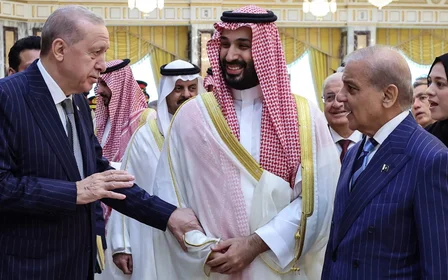
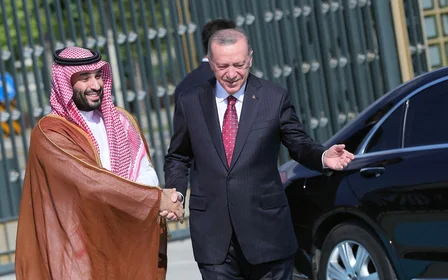
Pakistan says no plans for military action in Yemen after attacks on Saudi Arabia

Pakistan said on Thursday that no military response by Islamabad was currently being discussed under its joint defence agreement with Saudi Arabia and Turkey following attacks by Yemen's Houthis on Saudi Arabia.
Foreign ministry spokesperson Sajjad Haider Khan said Pakistan would act under the agreement if and when the circumstances required it.
“There is no such thing under discussion right now," Khan told reporters at a weekly media briefing. The question followed Houthi attacks on Saudi cities and energy infrastructure this week.
He added that Pakistan may act when the "time comes".
The defence agreement, signed last month, states that an armed attack on any one of the three countries would be treated as an attack on all of them, Reuters reported.
New MEE newsletter: Jerusalem Dispatch
Sign up to get the latest insights and analysis on Israel-Palestine, alongside Turkey Unpacked and other MEE newsletters
Pakistan has condemned the Houthi attacks and warned Iran to rein in its Yemeni allies, while Islamabad has also been mediating between the United States and Iran.
Khan said there were no plans to expand the Mecca alliance as regional tensions continued to disrupt energy supplies, Reuters reported.
Houthi advances
Yemen's Houthi fighters have advanced rapidly along the Red Sea coast as the country's previously dormant war against Saudi-backed government forces resumed in the summer.
The advances have put the Houthis in a prime position to control shipping in the Bab el-Mandeb choke point, while bolstering Iran’s leverage against the US, experts told Middle East Eye.
“The Houthis have pulled off a military victory that puts them one step closer to be in full control of the Bab el-Mandeb,” Corey Ranslem, CEO of maritime security group Dryad Global, told MEE.
As fighting intensifies across Yemen, images released by the Houthis show what they say is the wreckage of a Saudi military reconnaissance drone shot down over Hajjah province in northwestern Yemen. pic.twitter.com/4l70benmAF
— Middle East Eye (@MiddleEastEye) September 11, 2026
“I think it will actually be easier for the Houthis to exert control in Bab el-Mandeb than it is for Iran in the Strait of Hormuz because the US doesn’t have tangible military assets in the area,” he added.
After days of heavy fighting along a narrow plain known as the Tihama, on Thursday the Houthis routed Yemeni forces loyal to Saudi Arabia and seized the historic and strategic Red Sea port city of Mocha.
Arab media reported that the Houthis made further gains throughout the day.
Additional reporting by Sean Matthews
Middle East Eye delivers independent and unrivalled coverage and analysis of the Middle East, North Africa and beyond. To learn more about republishing this content and the associated fees, please fill out this form. More about MEE can be found here.