Rights groups press lawmakers to scrap provision to merge US and Israeli militaries

On Thursday, 56 civil rights and advocacy groups urged Congress to scrap a defence bill provision that would strengthen US-Israeli military technology ties, according to a letter seen by Reuters.
Section 219 of the 2027 National Defense Authorization Act (NDAA) intends to institute frameworks for joint ventures, licensing agreements and US-based co-production partnerships. It passed in the House of Representatives in July and is pending Senate approval.
Thursday’s letter addressed leaders of the House and Senate Armed Services Committees.
Reuters reported that some of the letter's signatories include Amnesty International and the National Lawyers Guild, as well as Arab and Jewish groups.
“At a time in which American interests are increasingly diverging from those of Israel, and American public opinion is turning increasingly against unconditional support to Israel, creating new points of influence for Israel in the US defense-technology ecosystem is exceptionally dangerous,” read the letter.
New MEE newsletter: Jerusalem Dispatch
Sign up to get the latest insights and analysis on Israel-Palestine, alongside Turkey Unpacked and other MEE newsletters
The letter criticises Israel for its genocide in Gaza and settler violence in the occupied West Bank, condemning it for its violations of international humanitarian law. It stresses that these developments should prevent any discussion of military ties.
A memorandum of understanding that secures $3.8 billion in annual US military aid to Israel is nearing its expiry in 2028, prompting conversations on how Washington’s assistance to Israel will evolve.
Several members of Congress have tried to scrap the provision from the fiscal 2027 NDAA. Republican Representative Thomas Massie of Kentucky and Democratic Representative Ro Khanna of California introduced an amendment to intervene, though it did not make it into the House.

After the House of Representatives and the Senate draft their respective versions of the NDAA, members of the two chambers will negotiate a compromise version, which must be ratified by both chambers at the end of the calendar year, before it heads to the White House for President Donald Trump’s signature or veto.
It's important to note that in the Senate version of the NDAA, Section 219 is labelled as Section 1217, with some notable differences.
It was introduced in a bipartisan manner by New York Democratic Senator Kirsten Gillibrand and North Carolina Republican Senator Ted Budd.
While the House version would require the Secretary of War to designate an "executive agent" responsible for synchronising efforts between the US and Israel, the Senate version goes further by spelling out that the Israeli minister of defence would be consulted on an ongoing basis.
Should the Senate's NDAA language in the provision pass later this year, lawmakers will have to come together and agree on one set of rules to guide the “United States–Israel Defense Technology Cooperation Initiative”.
What does Section 219 say?
The controversial provision would permanently integrate US and Israeli military tech advancements in a way that would - as Israeli Prime Minister Benjamin Netanyahu put it - turn Israel from a foreign aid recipient to a full-scale partner.
Future presidents would not be able to simply withdraw from such a project.
The NDAA is must-pass legislation, as it is needed to fund all of the Pentagon’s operations in the year to come.
Much of what is being codified through Section 219 is already how the Pentagon functions vis-a-vis Israel, which is the largest recipient of US foreign military assistance to the tune of billions of dollars a year, thanks to agreements signed under the Democratic administrations of Barack Obama and Joe Biden.
But now there is profound collaboration being proposed that allows Israel to have a say in US defence and national security mechanisms.

The move was first introduced by Texas Republican Representative Ronny Jackson, who was Trump’s White House physician during his first term as president. Jackson’s senior navy rank was demoted during Biden’s presidency after a series of accusations involving sexual comments and alcohol, but last year it was restored.
Section 219 establishes the United States–Israel Defense Technology Cooperation Initiative.
The project would identify jointly developed or Israeli-origin technologies with the utility for potential integration into US systems; ensure collaborative research initiatives involving government, private sector and academic institutions in both countries protect “sensitive technology”; and ultimately align military efforts with the Department of War that include the Irregular Warfare Technical Support Directorate, the Defense Innovation Unit, the Missile Defense Agency and the United States Space Command, among others.
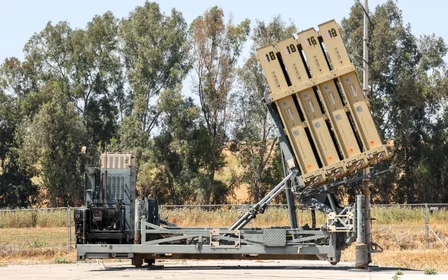
Secretary of War Pete Hegseth is effectively being ordered to formalise US-Israeli integration relating to counter-drone systems, missile and air defence, quantum computing, Artificial Intelligence systems, and cyber and electronic warfare, in a bid to reduce Israel’s dependence on US foreign aid.
Within a year of the adoption of Section 219, the secretary of war would be obligated to present Congress with a report on what activities were carried out, and how they are being assessed.
A New Policy, a lobbying group co-founded by whistleblower Josh Paul, strongly advocated for voting against the US-Israel Defense Technology Cooperation Initiative on the grounds that it would harm US national security.
"This approach exposes sensitive US capabilities to counterintelligence risk, normalizes technologies developed in contexts of occupation and civilian harm, disadvantages US defense companies ability to compete with Israeli competitors, deepens US legal and reputational exposure without clear strategic necessity, and aims to hide continuing US military support to Israel from Congressional and public transparency," it wrote in a policy brief.
Middle East Eye delivers independent and unrivalled coverage and analysis of the Middle East, North Africa and beyond. To learn more about republishing this content and the associated fees, please fill out this form. More about MEE can be found here.