Saudi Aramco reports bumper profits as it bypasses Strait of Hormuz

Saudi Aramco said on Tuesday its profits surged 33 percent in the second quarter of this year, as the kingdom benefited from the US-Israeli war on Iran, which drove up energy prices, while its oil pipeline allowed it to bypass the Strait of Hormuz.
The state-owned Saudi Arabian oil giant’s adjusted net income rose to $33.4bn from $25.2bn a year ago. The second quarter runs from early April to the end of June. The US and Iran reached a ceasefire in April that was extended in June, but fighting has continued to rage, keeping energy prices inflated.
Iran is attempting to assert its control over the Strait of Hormuz and has attacked dozens of vessels trying to transit the strait via Oman’s territorial waters. The US has bombarded Iran, and in response, Tehran has targeted Gulf states, particularly Kuwait and Bahrain.
The war drove Brent, the international benchmark, up above $100 per barrel in May and then again in July. Prices for refined products, like diesel, jet fuel, and gasoline, are up substantially.
Iraq, Kuwait, Bahrain, and Qatar have all had to cancel or massively curb energy shipments.
New MEE newsletter: Jerusalem Dispatch
Sign up to get the latest insights and analysis on Israel-Palestine, alongside Turkey Unpacked and other MEE newsletters
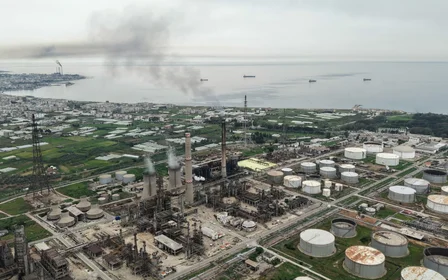
However, Saudi Arabia has been able to export around two-thirds of its pre-war oil capacity because of the East-West Pipeline, which connects the kingdom’s eastern oil fields to the Red Sea port of Yanbu.
Aramco CEO Amin Nasser noted the pipeline’s importance to the company while commenting on the results, according to a press statement.
“Despite the unprecedented supply disruption through the Strait of Hormuz, we continued to demonstrate our ability to maintain business continuity by capitalising on our diverse asset base and multi-decade planning, including strategic infrastructure such as the East-West Pipeline, storage capacity, and export terminals,” he said.
A model
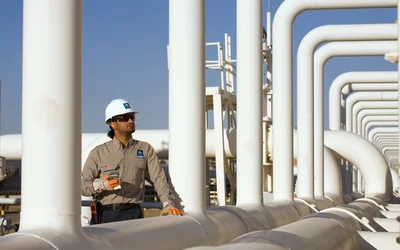
The East-West Pipeline has become a model for other Middle Eastern states looking to bypass the Strait of Hormuz in the coming years. Experts told Middle East Eye that tens of billions of dollars will be spent on new infrastructure in the coming years to get around Hormuz.
“When we speak to our customers in the region, they say they never want to deal with this again,” Artem Abramov, the deputy head of analysis at Rystad Energy, previously told MEE. “These bypass projects will move forward.”
The UAE is building a second pipeline to the port of Fujairah to bypass the Strait of Hormuz, doubling its export capacity by 2027.
Meanwhile, Iraq - the second-largest producer in the oil cartel Opec - signed a deal with Syria in July to rehabilitate a pipeline from its northern oil fields to Syria’s Mediterranean coast. MEE was the first to reveal the project and its US backing.
Aramco is not the only energy company that has benefited from the war. ExxonMobil and Chevron, the US’s energy behemoths, reported sky-high earnings in the second quarter also.
ExxonMobil’s profits doubled from a year earlier while Chevron had its highest quarterly earnings on record.
Trump, who is grappling with an unpopular war and frustration over high gasoline prices, has singled out the companies.
“Chevron: too much money. ExxonMobil: too much money,” Trump said. “They’re going to give some of that back to the public and they better cut the retail price, the consumer price,” he told reporters on Monday.
Brent has dropped about eight percent to $79 per barrel since Sunday, after Trump retreated from his threat to unleash the "biggest" bombing campaign since WWII on Iran.
US Treasury Secretary Scott Bessent said on Tuesday that the US and Iran were close to a deal to stop fighting and reopen the Strait of Hormuz.
Middle East Eye delivers independent and unrivalled coverage and analysis of the Middle East, North Africa and beyond. To learn more about republishing this content and the associated fees, please fill out this form. More about MEE can be found here.