Saudi Crown Prince Mohammed bin Salman arrives at White House after seven-year hiatus

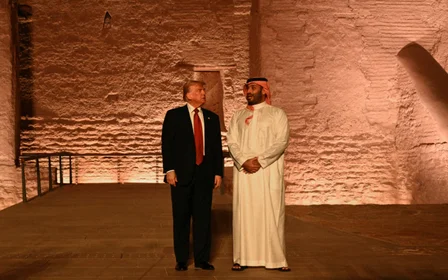
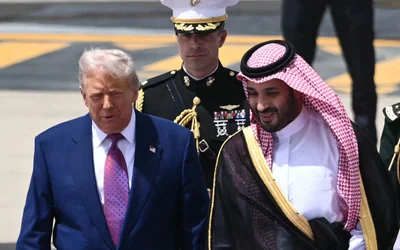
Saudi Arabian Crown Prince Mohammed bin Salman arrived at the White House on Tuesday, marking his first visit to the US in seven years.
The 40-year-old Saudi leader’s welcome included a full-colour guard, a band, a fighter jet flyover, and a drum roll, giving an early hint of the pomp and glitz expected for the trip.
Trump also took the crown prince on a televised stroll through the new "Presidential Walk of Fame", chatting with the Saudi leader as they toured portraits of past US presidents.
Notably, Israeli Prime Minister Benjamin Netanyahu did not receive an honour guard when he last visited the White House. Trump has also opted at times not to greet the leaders of European Union countries.
The visit caps a remarkable turnaround in the Saudi crown prince’s ties to Washington since US intelligence ruled he ordered the 2018 killing of Washington Post columnist Jamal Khashoggi.
New MEE newsletter: Jerusalem Dispatch
Sign up to get the latest insights and analysis on Israel-Palestine, alongside Turkey Unpacked and other MEE newsletters
Former President Joe Biden brushed off the crown prince in his administration’s early days, but then pivoted hard to courting him as he sought to tame high energy prices and navigate Israel’s war on Gaza.
Saudi analysts and western and Arab diplomats told Middle East Eye that the kingdom’s overarching aim is to reconfigure the 70-year-old US-Saudi Arabia partnership into one of equals. That, in part, reflects the shifting balance of global power.
MEE was the first to reveal that the crown prince will lobby for Trump to intervene against the UAE’s support for the Rapid Support Forces in Sudan’s civil war. Reuters later confirmed the story. Mohammed bin Salman also arrived after the UN Security Council approved a mandate for a US plan to send Arab and Muslim peacekeepers to Gaza.
But the main focus of the visit is business deals that Saudi officials want to advance their country’s domestic economic transformation and transition into a full-fledged regional power.
The wishlist
Trump hinted at what watchers can expect on Monday, when he said he planned to sell F-35s, the US’s most advanced fifth-generation fighters, to Saudi Arabia. Talks for Saudi Arabia to buy F-35s have been ongoing for years, but were linked to Riyadh normalising ties with Israel.
The kingdom appears to have effectively disentangled its bilateral wishlist from Israeli normalisation.
On the defence side of deals, Saudi experts say that what the kingdom wants most is cooperation with the US to develop its own industry, a step that other regional powers like Turkey are further along in. For example, Saudi Arabia is also eyeing a deal for AI-supported drones, people familiar with the talks tell MEE.
Hesham Alghannam, a Saudi defence analyst in Riyadh, previously said that in the defence sector, Riyadh wants “the localisation of content” adding that without US assistance, Saudi Arabia’s state-owned weapons manufacturer, Saudi Arabian Military Industries, could not become a “serious” player in the industry.
Saudi Arabia and the US unveiled $600bn in investment pledges when Trump visited Riyadh in May. The sale of F-35s is one of many that experts say will be finalised in the next two days. Trump and the crown prince will host an investment forum on Wednesday.
Saudi Arabia is pitching itself as a hub for the AI industry. With its vast reserves of fossil fuels and solar energy, the kingdom is promising cut-rate electricity prices to data centre operators.
AI stocks like Nvidia have driven the stock market to all-time highs, but there have been wobbles in the market. Saudi Arabia is one of the only G20 economies that can place massive orders for advanced AI chips with the stroke of a pen, given the kingdom’s $1 trillion sovereign wealth fund.
Still, experts say the days of Saudi Arabia simply splashing money around are long gone. The kingdom’s coffers have been hit by tepid energy prices, and grandiose mega-projects like Neom have stretched its budget.
Saudi Arabia is cutting back on more grandiose projects like The Line and is falling behind on the construction of a futuristic mountain ski resort for the 2029 winter games.
Diplomats, defence industry insiders and analysts say that Saudi Arabia is still willing to spend, but it wants the best US technology available. Those demands have upset pro-Israel voices, who wanted to use US technology as leverage to get Riyadh to normalise ties with Israel.
Trump’s willingness to sell the US’s most advanced technology to Saudi Arabia has also grated China hawks, wary of Riyadh’s ties to Beijing. China is the top buyer of Saudi oil.
In addition to AI chips, Saudi Arabia wants access to US civilian nuclear technology.
All in the family
The crown prince and his advisers have pushed for a deal that will allow them to enrich uranium, which they say the kingdom holds vast reserves of, a demand that has unnerved members of the US government.
“We will enrich it and we will sell it and we will do a ‘yellowcake'," Saudi Energy Minister Prince Abdulaziz bin Salman said at the start of the year, referring to a step in the process that comes after mining, but before enrichment.
Bernard Haykel, a professor at Princeton, said at an Arab Gulf States Institute event before the crown prince’s visit that Riyadh might defer discussions about enrichment, but would be looking for a trade-off that includes the stationing of US nuclear weapons in the country as part of a defence agreement.
“I suspect for now that they will give up on enrichment and processing, but they will want a nuclear umbrella protection from the US,” Haykel said, "which may involve the deployment of US nuclear weapons systems on Saudi soil.”
Trump signed an executive order that guaranteed Qatar’s security after Israel attacked Hamas negotiators in Doha in September. The US’s green light for that strike unnerved the Gulf.
Saudi Arabia was already suspicious of the US’s sincerity in its defence after its Aramco oil facilities were attacked by Iran in 2019. The first Trump administration refused to retaliate against Tehran or its allies, the Houthis, whom Saudi Arabia was fighting at the time.
Like other Gulf states, Saudi Arabia courted Trump's family after he left office. The kingdom, along with the UAE and Qatar, invested in Affinity Partners, an investment fund owned by Trump's son-in-law, Jared Kushner.
The Trump Organisation, which is run by Trump's sons, Eric and Donald Jr, has gone on a real estate deal blitz throughout the Gulf. Saudi firm Dar Global has emerged as the Trump Organisation's most important overseas partner.
Dar Global opened its first US office earlier this year at Trump Tower in New York City. Dar Global is a subsidiary of the sprawling Saudi development firm Dar al-Arkan, which has close ties to the Saudi government.
On Monday, Dar Global announced a new project with Trump's family in the Maldives. Meanwhile, one of Saudi Arabia's largest government-owned real estate developments, Diriyah, said it could unveil a deal soon.
Middle East Eye delivers independent and unrivalled coverage and analysis of the Middle East, North Africa and beyond. To learn more about republishing this content and the associated fees, please fill out this form. More about MEE can be found here.