Sliman Mansour, a pioneer of contemporary Palestinian art, dies aged 79

Sliman Mansour, one of the leading figures in contemporary Palestinian art, died over the weekend aged 79.
In a post to Mansour's Instagram account, his family announced his death, writing: “The final chapter has been written. With hearts heavy beyond words, we share that our beloved father has passed away.
“To the world, he leaves behind a life filled with beauty, memory, and a legacy that will continue to live through all those he touched. But to us, we lost a father, our source of love, strength and home.”
Mansour was born in Birzeit, a Palestinian town north of Ramallah, in 1947, a year before the Nakba, which saw more than 700,000 Palestinians forcibly expelled from their homes to make way for the creation of Israel.
The artist took to drawing at a very young age, and later a German tutor at a boarding school in Bethlehem noticed his talent, encouraging the young Mansour to delve deeper into painting and entering his work into art contests.
New MEE newsletter: Jerusalem Dispatch
Sign up to get the latest insights and analysis on Israel-Palestine, alongside Turkey Unpacked and other MEE newsletters
"He applied for my work to be a part of a drawing club and then told me that I had won a competition for the United Nations Children of the World. That was in 1962," Mansour told Middle East Eye in an interview in 2023.
According to Mansour, Palestinians long faced the risk of having their historical narrative disappear completely at the expense of tropes peddled by Israelis, such as the idea that modern Jewish settlers in the region had encountered a barren and sparsely populated land.
"That was the very strategy of the Zionist movement, to deny your existence, because when you are not there, it's much easier to take your land, to kill you, to imprison you," he told MEE.
Artists like Mansour sought to restate the Palestinian story by incorporating traditional symbols, as well as new ones, into their art.
"As artists, we started to search for images to reflect identity," he explained, adding that this was a process that involved referring to ancient culture and the landscape of historic Palestine.
"The landscape is artwork by our ancestors. When the Israelis occupied our land they started planting [non-native] cypress and pine trees instead of olive trees to change the landscape," he said.
Israel confiscated paintings
Besides the olive tree, Mansour's work features a number of other symbols that are associated with the Palestinian struggle, such as the Jaffa orange, thobes embroidered in the traditional tatreez style, the dove and the keffiyeh scarf.
"When I paint orange trees I am painting land that was occupied in 1948, and when I paint olive trees, I am painting about land that was occupied in 1967," he says, referring to the Nakba, as well as the later Israeli conquest of the West Bank, East Jerusalem and Gaza.
Mansour's work was targeted for decades.
"In 1979 when we had started doing exhibitions, the Israelis would come and confiscate paintings that they didn't like," he said, adding: "I would watch what they would take, and it was silly things, like a peasant woman wearing nice embroidery and working in the field."
One of his most famous paintings is his 1994 work, Last Summer in Palestine, which is his interpretation of Leonardo Da Vinci's The Last Supper, except the image of Jesus is replaced by a Palestinian man, and 12 Palestinian women take the place of the disciples.
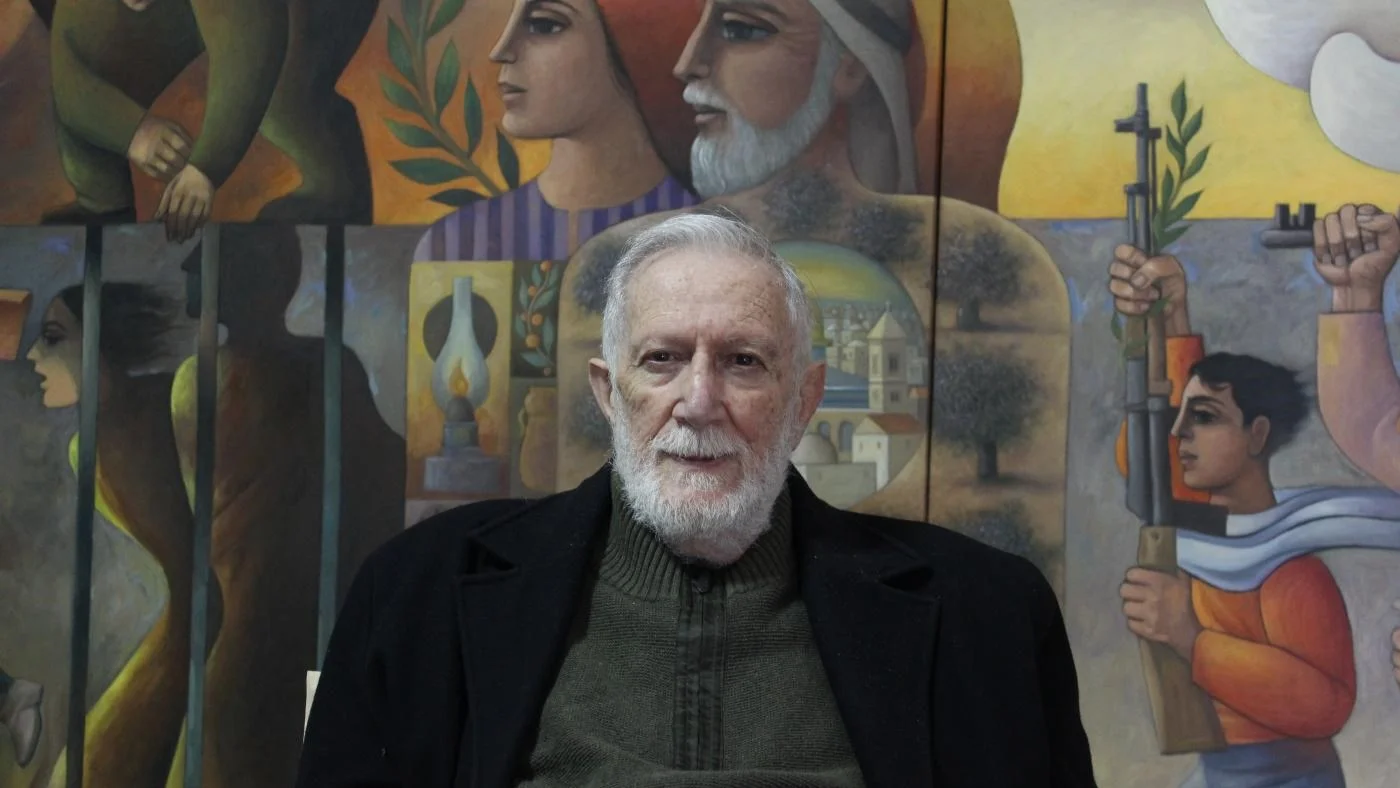

Another famous work is 2005's Camel of Burdens, which shows a frail Palestinian elder carrying an eye-shaped sphere on his back and within it is the city of Jerusalem.
Over the decades, Mansour amassed a dedicated following and gained international recognition for his work.
He was awarded the 2019 Unesco-Sharjah Prize for Arab Culture; he also received the grand prize at the Cairo Biennale in 1998 and the Palestine Prize for Visual Arts in 1998.
Later in life, Mansour dedicated his time to mentoring young artists and students.
"I firmly believe in the significance of embracing your craft and embracing your connection to your people, their culture, and their pursuit of freedom," Mansour said.
"It is crucial for my students to grasp the sense of belonging and never lose hope.”
Middle East Eye delivers independent and unrivalled coverage and analysis of the Middle East, North Africa and beyond. To learn more about republishing this content and the associated fees, please fill out this form. More about MEE can be found here.