‘We are starving’: Palestinians besieged by settlers in West Bank homes run out of food

Palestinians trapped in their homes by Israeli settlers in the occupied West Bank town of Qusra are running out of food as the siege enters its 12th day.
Aisha Hassan, who is sheltering in one of three surrounded homes south of Nablus with her mother and brother, said they were “starving”.
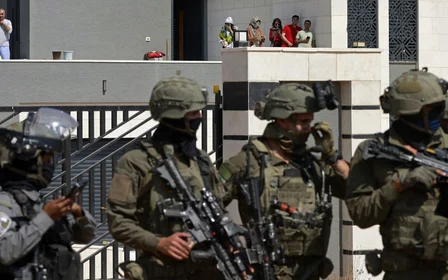
Israeli soldiers arrived last week, ostensibly to remove the settlers, but have since effectively contributed to the siege by blocking food deliveries to the families.
“The municipal council tried to bring us food, but the soldiers prevented them, and the food was left outside,” Hassan told Middle East Eye.
“Unicef staff were able to deliver some food to us a few days ago, and now it’s starting to spoil.”
New MEE newsletter: Jerusalem Dispatch
Sign up to get the latest insights and analysis on Israel-Palestine, alongside Turkey Unpacked and other MEE newsletters
Abdul-Azim Wadi, Qusra’s mayor, said he was in constant contact with the UN Office for the Coordination of Humanitarian Affairs (Ocha) to arrange food deliveries. Still, the Israeli army had not approved access.
He accused the army of deliberately obstructing deliveries and using various pretexts to delay them.
Even food delivered by Unicef was initially refused entry. The boxes were left outside for 24 hours before soldiers allowed the families to collect them, by which time some had spoiled, Wadi said.
“We, as a municipality, are still trying to coordinate with various parties to deliver food to the families, but we are facing significant restrictions and are prohibited from reaching those homes,” he told MEE.
Wadi said he had also arranged to enter one of the other houses, owned by Palestinian-American Luay Abu Rida, but the Israeli army commander refused him entry and turned him back, allowing only journalists to enter.
Hassan, 35, said her family began building their house six years ago and had been gradually furnishing it before moving in.
But after it became a frequent target of settler attacks in recent months, she moved in with her 56-year-old mother and brother to protect the property.
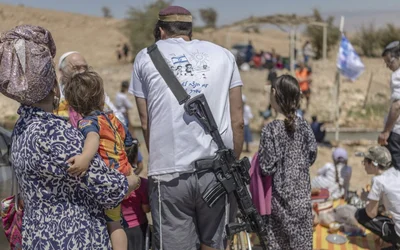
Last week, settlers set up camp around their house, Abu Rida’s and another nearby property, apparently seeking to take them over.
Settlers seized a house after besieging it last month in the nearby village of Jalud.
Around 15 people, including children, are trapped inside the three besieged houses in Qusra.
The siege has also prevented Hassan’s mother from attending the birth of one of her grandchildren.
“My mother is very sad because of the siege imposed on us,” Hassan said.
“She was very attached to her grandchildren, but now she can’t see them, and we are also worried about her health.”
Soldiers and settlers
The third house belongs to Youssef Hassan, his wife Ruqaya and their two daughters, Kinda, four, and Hoor, two.
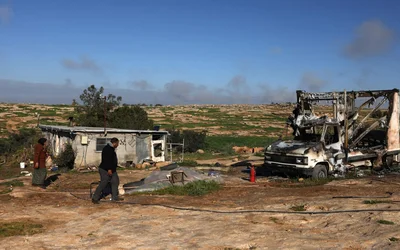
The family is now staying at Abu Rida’s house, after Israeli forces raided Qusra last week and turned their home into a military position.
“We’ve been under a complete siege for about a week. No one is allowed to enter or leave except through coordination,” Ruqaya, 28, told MEE.
“Food and water are provided through coordination with the army. No one is even allowed to leave the house.”
At the start of the siege, settlers cut off the family’s electricity and water supply.
'I suspect that the army and the settlers are working together'
– Ruqaya Hassan, besieged Palestinian mother
When people tried to restore them, settlers attacked them while Israeli soldiers were present, Ruqaya said.
“Of course, I suspect that the army and the settlers are working together,” she added.
After the army arrived, it declared Qusra a closed military zone, restricting residents’ movement.
Despite the order, which allows only Palestinian residents to remain in the town, soldiers have yet to remove the settlers or make any arrests. Instead, they have been seen drinking and praying with them.
The siege has drawn international attention, particularly because one of the homeowners is a US citizen.
The Israeli-Palestinian group Combatants for Peace has urged the European Union, Britain, Canada and Australia to sanction Major General Avi Bluth, commander of the Israeli military’s command in the occupied West Bank.
The group said the siege was not an isolated incident but reflected a “broader reality in which Palestinian communities face daily settler terrorism while those responsible continue to enjoy impunity”.
Amnesty International said last week that the attack was part of a “strategic settler terror” against Palestinians, which it said was “enabled, backed and funded by the State of Israel” to displace Palestinians across the occupied West Bank.
‘They don’t feel safe’
The three families had faced mounting pressure to leave for about eight months, after a settler outpost was established nearby. Settlers repeatedly harassed them, threw stones at their homes and used incendiary materials, according to Ruqaya.
“They were always trying to get us to leave the house, but thank God, we’re still standing strong,” she said.
But the siege has been particularly difficult for her two young daughters.
“The fear is constant for them,” she said.
“No matter how much I try to convince them that the situation is normal, it’s very clear to them that it’s not. They don’t feel safe, locked up at home.”
The children have developed bedwetting, she said, while obtaining medicine has become difficult when either falls ill.
The family has also been cut off from relatives living just metres away.
Ruqaya appealed to the international community to intervene against settlement outposts and attacks by settlers and Israeli forces.
“I hope that the international community will stand with the Palestinians in removing the settlement outposts throughout Palestine. They must help completely eliminate the presence of the settlers and return the homes of those who were displaced,” she said.
“The settlers’ aggression and the Israeli army’s aggression against the Palestinians must stop.”
Middle East Eye delivers independent and unrivalled coverage and analysis of the Middle East, North Africa and beyond. To learn more about republishing this content and the associated fees, please fill out this form. More about MEE can be found here.