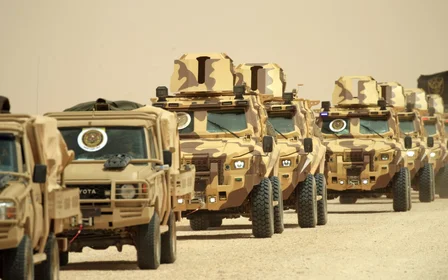
Sudan court sentences RSF commander to death over West Darfur killings

On Sunday, the anti-terrorism and crimes against the state court in Port Sudan sentenced Rapid Support Forces (RSF) commander Mohamed Hamdan Dagalo, known as Hemedti, and 15 other defendants to death in absentia.
According to the Sudan Tribune, they were convicted for their roles in the killing of West Darfur Governor Khamis Abdullah Abakar, crimes against humanity, war crimes, prohibited warfare, and genocide in el-Geneina.
Presided over by special judge Mohamed al-Amin, the ruling constitutes the first judicial conviction of the paramilitary group’s leadership since the outbreak of Sudan’s war on 15 April 2023.
The trial centred heavily on the 2023 assassination of Governor Khamis Abakar, a day after he denounced an RSF shelling on the el-Jamarik neighbourhood.
Human Rights Watch concluded in 2024 that actions in the capital of West Darfur, el-Geneina, constituted ethnic cleansing and possibly genocide against the Masalit people and other non-Arab communities.
New MEE newsletter: Jerusalem Dispatch
Sign up to get the latest insights and analysis on Israel-Palestine, alongside Turkey Unpacked and other MEE newsletters
Although video footage circulated online of Abakar’s body being mutilated by known RSF soldiers, the paramilitary group repeatedly blamed the Sudanese Armed Forces and denied responsibility.
Middle East Eye reported in June 2023 that around 1,500 people were killed in el-Geneina in the first two months of the war, forcing tens of thousands of Masalit residents to flee el-Geneina and West Darfur on foot to seek refuge across the border in eastern Chad.
The case
Among the trial’s defendants were two brothers of Hemedti: RSF deputy leader Abdel Rahim Hamdan Dagalo and Algoney Hamdan Daglo Musa, also known as al-Qoni.
The court also handed down convictions to Abdel Rahman Juma Barkallah, the RSF commander in West Darfur, and al-Tijani al-Tahir Karshoum, the state’s former deputy governor.
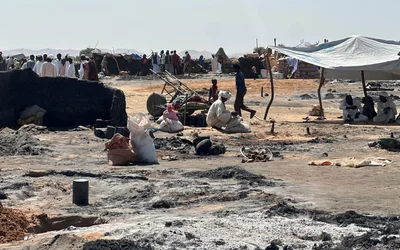
The court held Hemedti legally responsible for directing the genocide of the Masalit and siege of el-Geneina, citing the systematic destruction and looting of property, as well as deliberate attacks on civilians, residential areas, schools, and places of worship.
Dagalo was convicted of co-organising the siege of el-Geneina, the civilian displacement, and the genocide of the Masalit.
Qoni was found liable for facilitating the siege, while Barkallah was liable for leading frontline RSF soldiers during systematic assaults on Masalit neighbourhoods.
The court ordered the confiscation of all RSF assets and instructed the state to request Interpol red notices to secure the arrest and extradition of those convicted.
In his concluding remarks on the sentence, judge Amin delivered a scathing condemnation of the RSF’s tactics, stating that the paramilitary group used heavy weaponry in residential neighbourhoods, engaged in looting, arson, and rape, and acted out of an explicit ethnic hatred aimed at the extermination of the Masalit community.
“The convicted individuals were state leaders who abused their authority and used state weapons, which were meant to protect citizens, to commit crimes instead," continued the judge.
"Their actions resulted in the killing and displacement of thousands, the destruction of an entire city, and the devastation of its civilisation and history.”
Stagnation at the Hague, movement in Kenya
The judgment arrived days after the deputy prosecutor of the International Criminal Court, Nazhat Khan, announced a “breakthrough” in its investigations into crimes against humanity and war crimes committed in West Darfur, following a visit to eastern Chad.
However, a recent MEE investigation revealed that the Office of the Prosecutor had quietly decided not to proceed with an arrest warrant application for a member of the RSF, despite three years of investigations and public assurances that the applications would be filed imminently, raising questions about the timeline for ICC action.
But the first attempt to prosecute members of the RSF outside Sudan has materialised in Kenya.
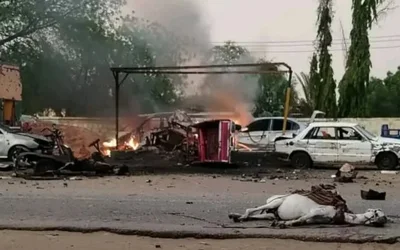
On 9 June, 12 Sudanese victims represented by Legal Action Worldwide and The African Centre for Justice and Peace Studies filed a complaint for war crimes and crimes against humanity with Kenya’s director of public prosecutions under the principle of universal jurisdiction.
The complaint demanded an investigation into allegations of torture and sexual violence against 10 members of the RSF, several of whom are believed to reside in Kenya.
The filing itself directly challenges the Kenyan government’s partnership with the RSF, as President William Samoei Ruto has hosted Hemedti at State House, permitted the RSF to convene a parallel administration meeting in Nairobi, and granted RSF leaders Kenyan passports to facilitate their movement.
The administration is additionally accused of supplying crates of ammunition to the paramilitary group and aiding the smuggling and processing of Sudanese gold and gum arabic through its ports.
Dr Owiso Owiso, Kenyan counsel for the 12 complainants, said: “This is not only an opportunity to test Kenya’s commitment to international justice. It is also a demonstration that, although domestic accountability systems and the international community have failed the people of Sudan, avenues for accountability are not entirely closed.”
Middle East Eye delivers independent and unrivalled coverage and analysis of the Middle East, North Africa and beyond. To learn more about republishing this content and the associated fees, please fill out this form. More about MEE can be found here.