
‘Suspicious deal’: US efforts to reunify Libya’s institutions face growing resistance

One month after what may have been the most significant diplomatic mission to Libya since taking up his post in the region, US envoy Massad Boulos continues to raise questions about Washington’s objectives.
Earlier this month, the senior adviser to Donald Trump on Arab and Middle Eastern Affairs met dozens of Libyan officials across the country's rival factions during a diplomatic tour that was widely expected to pave the way for major announcements.
After meeting with their inner circles in Malta on 6 July, Boulos held face-to-face talks with Libya's rival leaders: Prime Minister Abdul Hamid Dbeibah in Tripoli on 7 July, and Field Marshal Khalifa Haftar in Benghazi the following day.
Notably, the US president’s envoy also met numerous powerful actors not aligned with either camp, such as Central Bank of Libya governor Naji Issa and members of the Council of Elders in the influential western city of Misrata.
Yet, no clear roadmap has emerged for what the US diplomat repeatedly described as "unification efforts" during his visit, a plan now referred to as the "Boulos initiative".
New MEE newsletter: Jerusalem Dispatch
Sign up to get the latest insights and analysis on Israel-Palestine, alongside Turkey Unpacked and other MEE newsletters
Last September, Boulos publicly stated that Washington would actively seek to promote the unification of Libya’s institutions, which have been divided since the outbreak of the country’s second civil war in 2014 following the Nato-backed overthrow of long-time ruler Muammar Gaddafi in 2011.
Eastern Libya is controlled by Haftar and his allies, while a UN-backed government led by Dbeibah in Tripoli governs the west of the country. Since the end of the civil war in 2020, the peace process has been led by the UN Support Mission. Although large-scale battles have not resumed, the country remains divided.
After almost a year of negotiations and regular meetings with Libyan officials, Boulos’s only tangible achievement was the adoption of a unified budget for the two rival governments in April.
Since then, no further progress has been made. On 19 July, Speaker of the House of Representatives Aguilah Saleh confirmed that the legislative body, based in the eastern city of Tobruk and aligned with Haftar’s positions, had "so far not received anything official regarding [Boulos’s] initiative".
One of the reasons why the US envoy has been slow to advance is growing criticism from several Libyan factions.
Haftar’s appointment to key position
Tensions escalated in June after the Financial Times, citing “people familiar with the matter”, reported that Washington was pushing for an agreement under which Saddam Haftar would lead the Presidential Council, Libya's highest executive body, currently chaired by relatively neutral figure Mohamed Menfi.
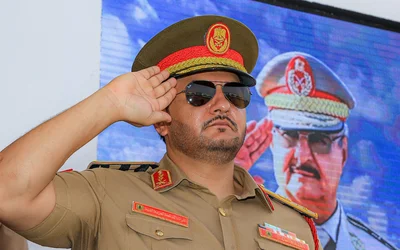
Saddam, one of the six sons of Khalifa Haftar, is widely seen as the frontrunner to succeed his 82-year-old father.
As Boulos began his visit on 7 July in Misrata, 100km east of Tripoli, he was met at the airport by dozens of protesters opposing his visit and denouncing what they described as a "suspicious deal".
Misrata, Libya's commercial hub, and its business and military elites have long been hostile to the Haftar family. The city’s militias were at the forefront of the resistance against Haftar's offensive on western Libya in 2019-2020.
‘The criminal Haftar is responsible for everything happening today, this is reason enough to reject a solution [involving his family]’
- Younes al-Salabi, spokesman for the Misrata Military Council
"The criminal Haftar is responsible for everything happening today," Younes al-Salabi, spokesman for the Misrata Military Council, one of Libya’s largest units of fighters, told Middle East Eye, arguing that “this is reason enough to reject a solution” where Saddam would get an official position.
The latest report by the UN Panel of Experts on Libya reiterated allegations of widespread human rights abuses and corruption involving armed groups and factions aligned with the Haftar and Dbeibah families.
Haftar in particular has been accused of war crimes by organisations such as Human Rights Watch, and a US court ruled that he is responsible for the acts of torture and extrajudicial executions committed by his troops.
Misrata is not the only faction opposing the Boulos initiative on the grounds that it would strengthen the Haftar family.
Hidden in Libya's southern desert, rebel leader Mohamed Wardago, whose armed group has been waging an insurgency against Haftar's forces since January, told MEE that "nobody can accept that Haftar and his sons should hold key sovereign positions within the Libyan state".
"Unfortunately, we have also heard about this US initiative to make Saddam head of the Presidential Council," Wardago added.
Jalel Harchaoui, an analyst focusing on North Africa, confirmed this is "the main element of the deal".
Harchaoui argues that although the powers of the head of the Presidential Council have never been clearly defined by a constitutional framework, Saddam’s appointment could expand the office's influence and "reshape the role", given the “power he already wields, with units under his command”.
Calls for resignation
However, Saddam Haftar's potential appointment is not the only source of tension brought by the Boulos initiative.
Reports, including the Financial Times piece in June, suggest that Prime Minister Dbeibah would also remain in office in Tripoli.
Despite Washington’s long-standing ties to Khalifa Haftar, a US citizen, the State Department has also maintained direct contacts with Dbeibah. Their latest phone call, held on 26 July, was described by Boulos as "productive".
The prime minister, who was appointed by the UN-backed Libyan Political Dialogue Forum in 2021 rather than direct elections, has come under increasing scrutiny over the years.
Since May 2025, protesters have repeatedly called for his resignation. Tensions peaked again at the end of July, when protesters in western Libya, initially mobilised over power cuts, turned their anger towards the prime minister and attempted to storm his office in Tripoli.
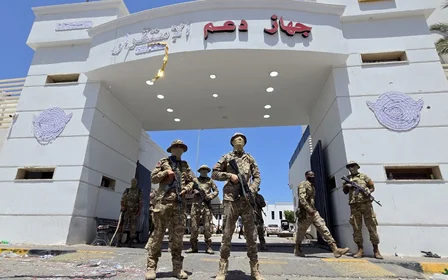
In recent days, protesters have closed the offices of five ministries and the anti-corruption authority to denounce the deterioration of public services, the ongoing electricity crisis and the worsening living conditions.
This makes the prospect of a US-backed deal that would keep Dbeibah in power even more politically sensitive in the eyes of the public, while offering the prime minister a lifeline.
“Dbeibah would gain recognition across the country and would, for the first time, be able to travel to Benghazi,” Harchaoui told MEE.
“Both Saddam and Dbeibah would acquire national legitimacy, with the possibility of remaining in power without elections for at least a year, probably longer.”
Oil and security sideline democracy
Although elections remain an official UN priority, with the Security Council reiterating last month its call to hold them, they have rarely featured among Boulos's stated objectives and do not appear to form part of his initiative.
Salabi stresses that Misrata supports a solution based on "the organisation of a constitutional referendum and elections", while protesters who took to the streets in Tripoli in July repeatedly called for "the fall of all political institutions, without exception", and their replacement through an electoral process.
‘Both Saddam [Haftar] and Dbeibah would acquire national legitimacy, with the possibility of remaining in power without elections for at least a year, probably longer’
- Jalel Harchaoui, analyst
Boulos, an Arabic speaker, has given a series of interviews to regional media in recent weeks to promote Washington's efforts in Libya.
In an interview with Asharq Al-Awsat on 27 July, the US envoy stated that "unity is the basis for legitimacy and democratic elections", suggesting that his roadmap envisions elections only after a deal to unify the institutions has been reached.
This is because the White House's objectives in Libya require stable and reliable partners rather than democratic institutions.
Since January 2025 and announcements of the opening of Libya’s first oil licensing rounds in nearly two decades, the US has sought to push its companies to invest in the country's oil sector. Libya holds Africa's largest proven oil reserves.
Meanwhile, another major US objective has been to strengthen security cooperation with Libya's fragmented military, particularly the Libyan National Army (LNA) commanded by Haftar.
The LNA has received direct support from Russia and its paramilitary companies since the second Libyan civil war.
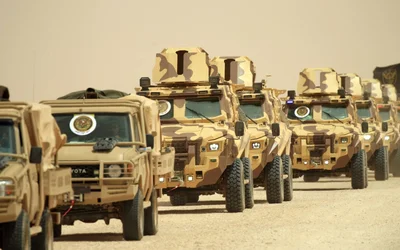
In return, Moscow gained access to airfields and ports in the east and south of the country, areas controlled by the LNA, facilitating its military operations across Africa.
"The Pentagon believes that unifying the military commands would make it harder for Russia to maintain its presence," Harchaoui told MEE.
One of the few tangible US successes in recent months has been the Flintlock 2026 exercise, held in April, the first time that the LNA and Tripoli units trained together on Libyan soil.
During his July visit, Boulos was also careful to meet the country's key security actors: not only the Haftar family in Benghazi, but also Interior Minister Emad Trabelsi and Deputy Defence Minister Abdul Salam al-Zoubi in Tripoli, both of whom command powerful armed groups in the west.
However, several months of high-level diplomacy have so far failed to articulate exactly what his initiative would deliver, including on military reunification.
Above all, this lack of clarity has fuelled growing scepticism over Washington's plans, despite broad public support for the reunification of Libya's institutions.
Middle East Eye delivers independent and unrivalled coverage and analysis of the Middle East, North Africa and beyond. To learn more about republishing this content and the associated fees, please fill out this form. More about MEE can be found here.