'This isn't the Britain I grew up in': The activists raided by police over Palestine Action videos

Marji Mansfield, a 70-year-old grandmother of seven, has been waiting for British counterterrorism police to show up at her door.
The anxiety sharpens between five and seven in the morning, when police usually conduct dawn raids, particularly if she has her grandchildren stay overnight.
“It’s been really, really quite scary not knowing when there's going to be the knock at the door,” Mansfield told Middle East Eye.
“This isn't the Britain that I thought I grew up in at all. We've been scared enough to go and sleep elsewhere.”
Mansfield is among scores of activists, many of them elderly, who are awaiting dawn raids from counterterrorism police after publishing videos of themselves inviting support for the banned direct action group Palestine Action.
New MEE newsletter: Jerusalem Dispatch
Sign up to get the latest insights and analysis on Israel-Palestine, alongside Turkey Unpacked and other MEE newsletters
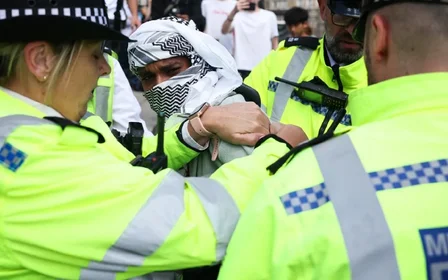
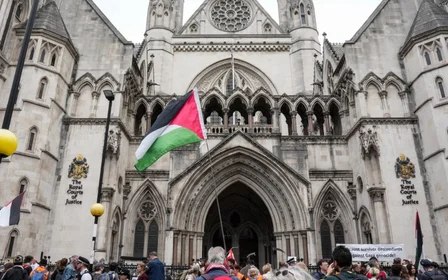
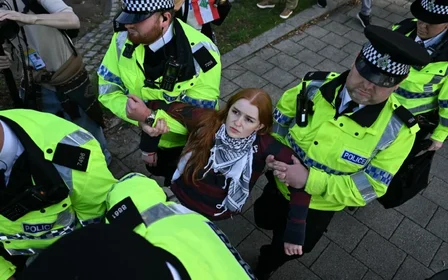
Since the government proscribed the organisation in July 2025, over 3,000 people have been arrested under the Terrorism Act for participating in silent vigils in support of Palestine Action.
But in June, after the Court of Appeal quashed a High Court ruling and found the ban to be lawful, Defend Our Juries (DOJ) - the group helming the campaign to reverse the ban - called for an "escalation" in activism.
This involved activists inviting support for the group rather than simply expressing support, an offence that can carry a 14-year sentence under Section 12 of the Terrorism Act. So far, most activists have been arrested under the lesser charge of Section 13.
Mansfield and around 100 others responded to the call from DOJ, uploading videos of themselves declaring: “Saving lives is not terrorism, I support Palestine Action, and I think you should too”.
Subsequently, some 19 people, many of them retired, have been raided by counterterrorism police across the UK, including in London, the West Midlands, Somerset, Wales, Cornwall and Scotland.
They told MEE that police searched their entire homes, confiscating personal devices - as well as items bearing the Palestinian flag - and rifled through personal diaries.
Two people reported being handcuffed, despite police policy stipulating that officers may only use the restraint when they have “objective grounds” for believing it is necessary, including “where an officer reasonably believes that without handcuffs the subject may escape, attempt to escape or cause harm to themselves or others”.
So far, those who haven’t been raided, like Mansfield, are crippled by the anxiety of the prospect.
According to Mansfield, many activists have reported being unable to sleep, while others, who have sick partners, have said that they feel unable to go out for fear the police will arrive in their absence.
“It really impacts people's lives. It causes great fear and anxiety,” Mansfield said.
Middle East Eye contacted the UK's Counter Terrorism Police for comment but received no response by the time of publication.
‘I just had my shorts on’
At around 7.30am one late July morning, former government worker Asghar Ahmad, 53, opened his door in the town of Telford in Shropshire to find about a dozen police officers, a police van and four police cars parked outside his home.
“I just had my shorts on, but that was it,” Ahmad told MEE. “I wasn't challenging anything because I knew what they were going to do. They were going to go through the whole house.
'I spent 38 years working for the government on their IT systems. I’ve got to a point in my life where I can see things for what they are'
- Asghar Ahmad, activist
“I said: 'Can I just go and get some clothes on?' An officer followed me upstairs. He was present all the time.” Ahmad was then handcuffed and driven to the local police station.
While he was gone, the remaining officers searched the house, confiscating all of his devices. “They went through every single room,” Ahmad said.
When he was interviewed later that day in the presence of his solicitor, the police presented him with all the items they had removed from the house. These included laptops, old phones, hard drives, scraps of paper and “anything that was remotely Palestinian”, like flags and bracelets.
He was released at 5pm that day, with no charges.
“I spent 38 years working for the government on their IT systems,” Ahmad said. “I’ve got to a point in my life where I can see things for what they are.
“I was too busy, like most people are with their lives, just trying to build a family.
“Once I finished work, I realised I could do things without fear of losing my job or my income,” Ahmad said, describing the strength he now feels to speak out on issues he cares about.
Ahmad, who is spending his retirement doing volunteer work in his community, said he’s “got nothing to hide”.
“If they want to put pensioners in prison, it will not go down well,” he said.
‘A bit creepy’
Paul Graves-Brown, a 64-year-old semi-retired archaeologist in Carmarthenshire, said that some 20 police officers searched his home over a period of six and a half hours.
He said they even searched his wife’s underwear drawer and leafed through the diary she kept as a teenager. “They left the diary on the top, highlighting the fact that they've been looking through a teenage girl’s diary, which is a bit creepy,” he said.
Graves-Brown was held at the local police station from 8am and released at 4pm that day with no charge.
'They left the diary on the top, highlighting the fact that they've been looking through a teenage girl’s diary'
- Paul Gravesbrown, archaeologist
“Being raided is quite traumatic, it’s one of those things which hangs around in your mind,” he told MEE.
“Our house was burgled just before the first lockdown, so it’s a similar sort of experience - total strangers wandering around your house.”
Thirty-year-old Allie, a bartender based in Staffordshire who spoke using an alias, was arrested shortly after she came home from a shift at the pub.
She was woken by a series of bangs on her door at around 1am.
“I opened the door and I think the first thing I said was, ‘Oh my God, you actually came’,” Allie told MEE.
Both Allie and Ahmad said that the officers asked for the pin numbers to unlock their devices. Under Section 49 of the Investigatory Powers Act, police should make these requests in writing.
Allie recalled that she had said as she was being handcuffed: “This is a bit much for what this is, isn’t it?” The police then asked her to sign a document stating that she had made this comment during her arrest.
She was then driven to Oldbury police station, near Birmingham, where she was held for about eight to nine hours, and released with no charge.
“I think the worst thing for me is that it really shatters any sense of personal safety,” Allie said.
“You go through life with a belief in the systems that are there to protect you. This is such a heinous overreach and abuse of those systems. I don't think that I'll ever be able to fully reconcile myself with it. It's like having to reconstruct a new reality,” she said.
Middle East Eye delivers independent and unrivalled coverage and analysis of the Middle East, North Africa and beyond. To learn more about republishing this content and the associated fees, please fill out this form. More about MEE can be found here.