Trump administration threatens to cancel all of Harvard University’s federal funding

A Trump administration probe accused Harvard University on Monday of violating Jewish and Israeli students’ civil rights.
Officials from the Joint Task Force to Combat Anti-Semitism wrote in a letter to Harvard’s president, Alan Garber, that the university violated the Civil Rights Act of 1964.
The Civil Rights Act prohibits federal funding to programmes or activities that discriminate based on race, colour or national origin.
The letter said Harvard “has been in some cases deliberately indifferent, and in others has been a willful participant in anti-Semitic harassment of Jewish students, faculty, and staff”.
It also said that “failure to institute adequate changes immediately will result in the loss of all federal financial resources and continue to affect Harvard’s relationship with the federal government”.
New MEE newsletter: Jerusalem Dispatch
Sign up to get the latest insights and analysis on Israel-Palestine, alongside Turkey Unpacked and other MEE newsletters
The letter comes amidst frayed relations between Harvard and the federal government, including the freezing of $2.3bn of Harvard’s federal funds in April.
These funds represented a portion of the nearly $9bn in federal grants and contracts to Harvard that the Trump administration is reviewing.
Harvard University was hit with a $2.3bn federal funding freeze after the Ivy League institution took a stand against the Trump administration’s ongoing demands.
The freeze, representing 35.9 percent of Harvard's $6.4bn operating expenses, immediately followed a letter in April from Harvard University lawyers to the Trump administration, stating that it rejected the government’s demands.
The letter, issued by Emanuel Urquhart & Sullivan and LLP King & Spalding LLP, said that “The university will not surrender its independence or relinquish its constitutional rights.”
Harvard president Garber also issued a public letter soon after, saying the university refused to capitulate to the Trump administration’s demands “to control the Harvard community” and threaten its “values as a private institution devoted to the pursuit, production and dissemination of knowledge”.
Harvard rejected the government’s demands, including reporting foreign students for code violations, reforming its governance and leadership, discontinuing its diversity, equity, and inclusion programmes, and changing its hiring and admission policies, especially for international students.
The university also initiated a lawsuit against the Trump administration in April and expanded that lawsuit in March, challenging the administration's moves to cut off billions of dollars in federal funding to the Ivy League school.
Student protests
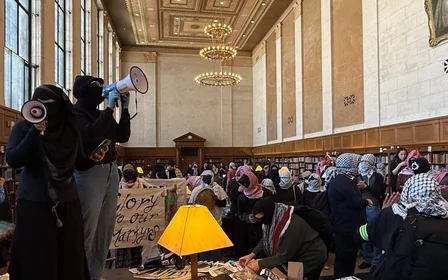
Harvard’s antisemitism allegations have primarily surrounded student protests against Israel’s war in Gaza.
More than 56,000 Palestinians have been killed as a result of Israel’s war on Gaza, which several countries, as well as many international rights groups and experts, now qualify as an act of genocide.
The Trump administration’s letter said Harvard’s pro-Palestine student encampment, one of the five in the Boston area, “instilled fear in, and disrupted the studies of, Jewish and Israeli students”.
However, some Jewish students participated in and held Shabbat services at the encampment.
Harvard has previously attempted to address accusations of antisemitism by adopting a controversial definition of antisemitism that includes Zionism as a protected class and by reportedly dismissing faculty leaders at the university's Center for Middle Eastern Studies.
Harvard also suspended the student group, Palestine Solidarity Committee, in April.
According to Palestine Legal, an organisation that provides legal aid to pro-Palestine activists, these actions represent “extreme censorship of pro-Palestinian speech - which is not required by federal civil rights law and actually risks violating the civil rights of Palestinian and associated students”.
Middle East Eye delivers independent and unrivalled coverage and analysis of the Middle East, North Africa and beyond. To learn more about republishing this content and the associated fees, please fill out this form. More about MEE can be found here.