Trump justifies Iran deal as a way to prevent 'economic catastrophe'

President Donald Trump on Wednesday threatened to “bomb the hell” out of Iran if it does not abide by a memorandum of understanding (MOU) with the US, adding he was concerned the war could spark an “economic catastrophe”, dooming his presidency.
"The one president I did not want to be was the late, great, Herbert Hoover,” Trump said, noting that the stock market rose when he said he was considering ending the war and went down “very big” when he mulled continuing the conflict.
"The stock market is more brilliant than anybody there is, including the people on this stage, other than me, of course,” Trump said, flanked by senior US officials including Secretary of State Marco Rubio, Secretary of Commerce Howard Lutnick and Treasury Secretary Scott Bessent.
Hoover was the Republican president who entered office in 1929, just before the onset of the Great Depression. Historians and economists say his landmark tariff bill exacerbated the years-long economic downturn.
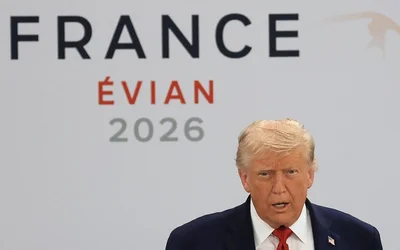
“I didn’t want to see an economic catastrophe,” Trump said at a rambling press conference on the sidelines of the G-7 Summit in Evian, France.
New MEE newsletter: Jerusalem Dispatch
Sign up to get the latest insights and analysis on Israel-Palestine, alongside Turkey Unpacked and other MEE newsletters
Trump’s remarks would appear to confirm that Iran’s blockade of the Strait of Hormuz was inflicting enough economic damage that his administration was jolted into a 60-day ceasefire extension it announced on Sunday. The White House says it will lead to a permanent end to the war through subsequent negotiations.
According to a briefing by officials in Washington, the Strait of Hormuz will remain toll-free for 60 days under the MOU, but its future will be negotiated, leaving the door open to potential fees in the future.
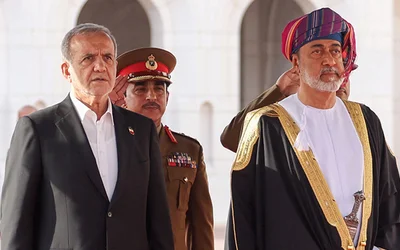
"The Islamic Republic of Iran will conduct dialogue with the Sultanate of Oman to define the future administration and maritime services in the Strait of Hormuz, in discussion with other Persian Gulf littoral states in line with the applicable international law," according to the briefing.
But Trump also remained dismissive about the MOU's strength.
“It's a memorandum of understanding. And if I don't like it, we'll go back to shooting at them, dropping bombs on their head," Trump said.
"If I don't like it, if they don't behave, we'll go right back to dropping bombs right smack in the middle of their head, OK?"
'Whoever sells them a nuke will get nuked'
But Trump defended the deal, which has come under intense criticism from pro-Israel voices in the US, particularly in the Republican Party.
He acknowledged aspects of the deal that are only likely to exacerbate criticism among Iran hawks.
The MOU, which has been reported by several US media outlets, does not address Iran’s nuclear programme in detail, saying that its fate will be decided by negotiators during the ceasefire extension.
Trump also rubbished claims that it was incumbent on the US to obtain Iran's enriched uranium, saying that it was buried deep and only the US and China have the equipment to get it. He added that they have cameras monitoring the sites that they suspect hold the stockpiles.
Trump, who criticised the 2015 nuclear deal with Iran and unilaterally withdrew from it after entering the White House, said his agreement was different because of the threat of military force. He also said that his terms ensured Iran would not be able to purchase a nuclear weapon.
“Whoever sells them a nuclear weapon would get nuked themselves,” Trump said. However, the Joint Comprehensive Plan of Action also did not permit Iran to acquire a nuclear weapon.
But like the JCPOA, Trump appears to be laying the groundwork for Iran to retain a nuclear programme and potentially enriched uranium.
Trump said the US has been “hard” on Iran’s enriched uranium, but that a final deal may leave Tehran space to continue its nuclear programme.
"It's a little hard when other people have it, other adjoining states have it, and you're not letting them have it for purposes of electricity and things like that. You have to use a little common sense,” he said.
Israel and its allies in Washington have long insisted that Iran must have no enriched uranium and end its nuclear programme.
Ballistic missiles, Gulf investment and frozen funds
Trump also dismissed concerns about Iran’s ballistic missile arsenal, which he had characterised as a threat to the US to justify the war in its opening days. Israel and its allies in Washington want any deal to end Iran’s ballistic missile programme.
“I mean, they [Iran] have to have some, because other people have some. You got to have some,” Trump said.
“I like some of these guys, but I…don’t think they’re smart,” Trump said, recalling a conversation with an advisor. “‘Sir. You shouldn’t let them have any missile.’ I said, ‘well, what am I going to do? Am I going to let Saudi Arabia have missiles, but they can’t have them?’ ‘Yes, sir.’”
“Doesn’t work that way,” Trump said, adding that he believes the US has destroyed 80 percent of Iran's missile capacity.
Trump reaffirmed that Washington would not prevent Arab Gulf states from investing in Iran if a final deal is reached, although the US would not take part directly.
“We’re not putting up money in Iran, but if people want to invest, they can invest,” Trump said.
“They need investment…maybe two trillion dollars,” Trump said, referring to the damages caused by US and Israeli strikes. “So, somebody’s going to have to help them out. There’s no guarantee about helping them out. It could be their neighbours will help them out a little bit. I don’t know,” he said.
Trump’s remarks are likely to fuel speculation that Gulf states like the UAE, Saudi Arabia, Kuwait, and Qatar are going to cut economic deals with Iran as it cements its control over the Strait of Hormuz.
Trump also made it clear that he views Iran’s billions of dollars in frozen assets separately from any investment pledge - a distinction that is likely to anger Iran hawks and Israel but be welcomed by Tehran.
"The unfreezing - we have taken a lot of their money. It's not our money. At a certain point in time, I guess we're gonna have to give it back,” Trump said in regard to Iran’s frozen assets.
UAE dropping bombs on Iran
Trump vacillated between a belligerent tone against Iran - which he said had a “primitive culture” - and praising its leadership, whom he said "love their country”.
He also boasted about bombing Iran’s civilian infrastructure and said he was under pressure to continue air strikes. "That was the George Washington bridge of Iran, but we bombed that bridge,” Trump said, referencing a bridge that connects New York and New Jersey over the Hudson River.
The US bombed Iran’s Karaj B1 bridge on 1 April.
'I said, 'who the hell's dropping all those bombs?' It was the UAE'
- President Trump
Trump also acknowledged that China and Russia could have tipped the balance of the war into Iran's favour. Middle East Eye previously reported that China armed Iran. Several news outlets reported that Russia and China provided Iran with intelligence support and arms as well.
"I just want to thank them because they made it a lot better," Trump said, referring to Russian President Vladimir Putin and Chinese President Xi Jinping.
"I want to thank China, President Xi. I was with him, and he stayed neutral, totally neutral, and I appreciate it," Trump said. "And I want to thank Vladimir Putin; he was very neutral. They could have made it much more difficult for us."
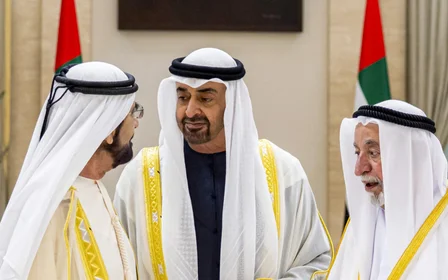
Trump also confirmed that the UAE took a muscular approach during the fighting by participating in offensive strikes. Trump said he was surprised by the level of UAE attacks on Iran.
"He was dropping bombs last week, I said, 'who the hell's dropping all those bombs?' It was the UAE. He's a good fighter," Trump said, referring to UAE President Mohammed bin Zayed.
Middle East Eye delivers independent and unrivalled coverage and analysis of the Middle East, North Africa and beyond. To learn more about republishing this content and the associated fees, please fill out this form. More about MEE can be found here.