
'We will rise again': A new generation of Tunisians prepare for Ennahda's return

They've watched their leaders jailed, their offices closed and their movement repeatedly attacked.
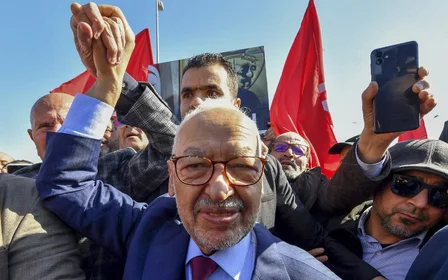
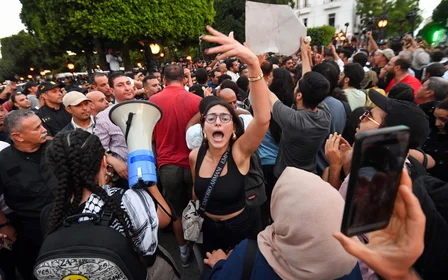
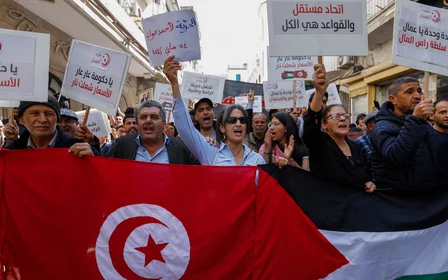
But five years after President Kais Saied seized sweeping powers and dismantled Tunisia's democratic institutions, supporters of Ennahda insist the country's largest Islamist movement is preparing to rise from the ashes.
Rather than seeing the past five years as the movement's final chapter, many of the group's younger members describe the crackdown as another episode in a history marked by imprisonment, exile and political persecution.
They say it has forced Ennahda to confront its mistakes, renew its leadership and prepare for a future beyond Saied's rule.
"The idea that Ennahda has been defeated and that Tunisians no longer want Islamic parties is simply not true," said Ahmed, a 23-year-old resident of Ettadhamen, a working-class suburb of Tunis with a long history of support for Islamist movements.
New MEE newsletter: Jerusalem Dispatch
Sign up to get the latest insights and analysis on Israel-Palestine, alongside Turkey Unpacked and other MEE newsletters
"More and more young people want a movement that is rooted in Islam, a movement that speaks to our identity and will stand up for Muslims being oppressed across the world."
"We are witnessing a resurgence and we will rise again."
'We haven't left the political scene and are still here'
- Mohamed, small business owner
Ahmed's optimism stands in stark contrast to the movement's current predicament.
Since Saied suspended parliament on 25 July 2021, Ennahda leader Rached Ghannouchi and dozens of senior opposition figures have been imprisoned, while much of the movement's leadership has been prosecuted or pushed into exile.
Once the dominant force in Tunisia's democratic transition, Ennahda is today weaker than at any point since the rule of former strongman Zine El Abidine Ben Ali.
Inside the movement, however, few believe its story has ended.
'Muslim democracy'
Founded in the early 1980s, Ennahda emerged as Tunisia's principal Islamist opposition movement under Ben Ali, with thousands of its members imprisoned, tortured or forced into exile.
When the Arab Spring toppled his decades-long rule, the movement returned to public life and won Tunisia's first democratic elections, presenting itself as a model of what its leaders called "Muslim democracy".
Unlike many Islamist movements elsewhere in the region, Ennahda argued that Islam and democracy were complementary rather than contradictory.
Over time it moved away from the idea of an Islamist party towards what Ghannouchi described as a party of "Muslim democrats", committed to pluralism, constitutional rule and peaceful transfers of power.
At its landmark 2016 congress, the movement formally separated its political and religious activities, arguing that mosques should not become arenas for party politics.
Rather than advocating the imposition of Islamic law, Ennahda said religion should provide society with moral guidance while democratic institutions, competitive elections and an independent judiciary remained the basis of government.
Its manifesto committed the movement to civil liberties, equal citizenship and political pluralism, positions that distinguished it from many other Islamist parties across the region.
That evolution won cautious support from Western governments eager to see Tunisia succeed where much of the Arab Spring had faltered.
Following Ennahda's election victory in 2011, the US State Department said it looked forward to working with Tunisia's newly elected leaders as they built "a democratic future".
Britain's Foreign Office likewise welcomed the country's free and fair elections and pledged its support for Tunisia's democratic transition.
For Ennahda's leaders, Tunisia offered an opportunity to demonstrate that political Islam and democratic governance could coexist. That vision, however, was soon tested by the realities of governing.
Although Ennahda governed alongside successive secular coalition partners and never held power alone, Tunisia's economy stagnated, unemployment remained high and governments struggled to deliver the economic improvements many Tunisians had expected after the revolution.
Increasingly, the movement became the public face of the frustrations that accompanied the democratic transition, allowing Saied to cast himself as the outsider who would sweep away the old political class.
His power grab in July 2021 transformed Tunisia's political landscape almost overnight.
Democracy abandoned
Ennahda's supporters argue the movement's greatest mistake was not ideological, but strategic.
They say that years spent trying to build consensus with secular rivals and reassure critics ultimately failed to protect the democratic system the party had worked to establish after the 2011 revolution.
In the 2019 presidential run-off, Ennahda also refused to back media magnate Nabil Karoui, instead throwing its support behind Saied after its own candidate was eliminated.
At the time, many within the party viewed Saied as the safer choice, seeing Karoui, a polarising businessman often dubbed Tunisia's "Berlusconi", as too closely associated with the old political establishment.
Ahmed Gaaloul, a senior Ennahda official, believes the movement underestimated both the determination of its opponents, both local and regional, and the willingness of Tunisia's international partners to accept the dismantling of its democratic institutions.
"We believed that no one would dare overthrow a democratic system that Tunisians had sacrificed so much to build," he said. "We misread the moment."
He said that while regional powers hostile to the Arab Spring sought to undermine Tunisia's democratic transition, Europe and the US also failed to defend it.
"The fragmentation and weakness was mainly in Europe," he said. "They did not defend our democracy."
Instead, Gaaloul said, Western governments increasingly accepted the argument that Tunisia's democratic experiment had failed, while overlooking what he described as an authoritarian rollback.
'We spent years trying to appease everyone at the expense of our own party'
- Hatim, Ennahda member
"The whole democracy that survived for 10 years after the revolution was being let down," he said.
For many younger members, that experience has prompted a broader reassessment of the movement's own approach to power.
The arrests of much of Ennahda's senior leadership have accelerated an internal debate over whether the consensual politics that defined Tunisia's democratic transition ultimately left the movement vulnerable.
"Many of us respect what Ennahda achieved after the revolution, but we also think it compromised too much," said Hatim, a 28-year-old engineer and member of the group.
"We spent years trying to appease everyone at the expense of our own party. Now, the younger generation, including myself, want leaders who are confident enough to pursue their programme instead of always making concessions.
"We don't want endless consensus if it means abandoning our Islamic values."
That view is increasingly common among younger activists, many of whom believe Ennahda spent too much energy trying to prove to its opponents that political Islam could coexist with democracy, only to see those same democratic institutions dismantled.
Former Ennahda MP Maher Madhioub says the movement has spent the past five years reflecting on those failures.
"Ennahda was not born in a government or one of the state's institutions, but out of the huge sacrifices of its members over more than four decades," he said.
"It was born as a civil, public and universal movement. It won some elections and lost others, but it has always stood with the Tunisian people's aspirations for liberty, dignity and justice. Governing was always a means to an end, not an end in itself.”
A different movement
If Tunisia eventually returns to democratic politics, Madhioub believes Ennahda will emerge a different movement.
"There is no doubt that it has learned a lot from what happened," he said. "It will be more confident in itself, its choices and its competent members, and it will take all its responsibilities."
Whether that opportunity comes soon remains uncertain.
Saied continues to enjoy the backing of neighbouring Algeria, whose President Abdelmadjid Tebboune recently described Tunisia's security as inseparable from Algiers' own and pledged to defend it against "any threat".
His remarks, made days after the fifth anniversary of Saied's power grab, underscored Algiers' continued support for the Tunisian president despite mounting criticism of his authoritarian rule.
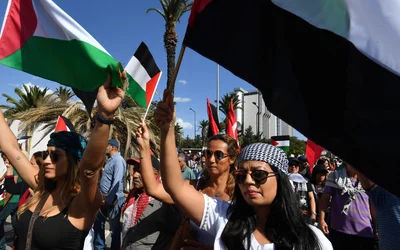
Inside Ennahda, however, there is little expectation of an imminent return to power.
Members say their priority is preserving the movement's organisational networks, supporting imprisoned colleagues and preparing for the day Tunisia's political space eventually reopens.
"We haven't left the political scene and are still here," said Mohamed, a 31-year-old small business owner.
"But in the future we expect the movement to speak more forcefully about what is happening beyond our borders.
"Whether it's Palestine, Sudan or other crises affecting Muslims, Ennahda should have a stronger voice and stand up for people facing oppression," he said.
"We want a leadership that will challenge others that are harming Muslims. We will not accept silence for the sake of diplomacy," he added.
Despite years of repression, Radwan Masmoudi, president of the Center for the Study of Islam and Democracy, believes the movement remains too deeply rooted in Tunisian society to disappear.
"Ennahda specifically, and moderate Islamist parties in general, are here to stay," he said. "Any real democracy in Tunisia or in the Arab world cannot exclude such an important and critical part of society. I do think there will be a place for Ennahda in a new democratic Tunisia, just like there will be a place for all other Islamic and secular political movements."
For supporters, the movement's future will ultimately depend not on whether it returns to government, but whether Tunisia returns to democracy.
"People thought we had disappeared before," Madhioub said.
"If Ennahda wins the first democratic elections held after the end of this terrible coup, it will be because it learned from what happened."
Middle East Eye delivers independent and unrivalled coverage and analysis of the Middle East, North Africa and beyond. To learn more about republishing this content and the associated fees, please fill out this form. More about MEE can be found here.