
Tunisia steps up civil society crackdown as anger mounts over power and water shortages

The Tunisian government is escalating its wide-reaching crackdown on civil society, as public frustration mounts over ongoing power and water shortages amid soaring temperatures.
Human Rights Watch (HRW) warned in a report on Wednesday that the authorities' intensifying repression of NGOs is part of a push to completely shutter civil society.
The 49-page report detailed a raft of measures wielded by President Kais Saied's government - including prosecution, arbitrary detention, financial investigations and mass suspensions - to target local and civil society groups, their members, workers and associates.
According to the report, the crackdown began with the arrests of 14 workers from asylum support groups and anti-racist organisations between May and December 2024.
The watchdog reported that since then, at least 47 people connected with NGOs have been prosecuted following trials in 2025 and 2026, with at least 10 people held in preventive detention for periods exceeding the 14-month maximum under Tunisian law.
New MEE newsletter: Jerusalem Dispatch
Sign up to get the latest insights and analysis on Israel-Palestine, alongside Turkey Unpacked and other MEE newsletters
Among those prosecuted is prominent human rights defender Saadia Mosbah, who was handed an eight-year prison sentence and a hefty fine "based on abusive charges of financial crimes" in March 2026, HRW said.
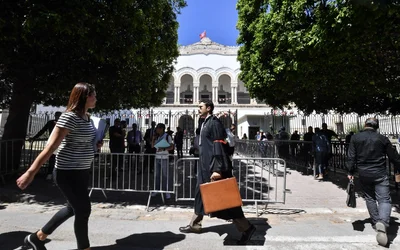
Additionally, the NGO said that five employees of asylum groups have also been convicted on abusive charges in connection with their work.
The targeted organisations have since been forced to halt their work, according to HRW.
Counterterrorism and money laundering laws have also been wielded to criminalise assistance to foreigners with irregular immigration status.
Growing disquiet
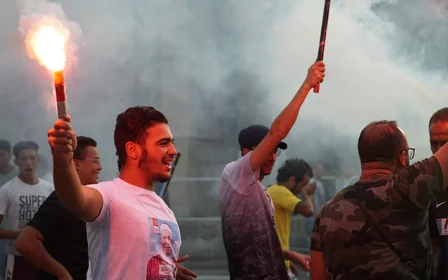
However, the repression has not stifled mounting unrest, as soaring temperatures, power outages and water shortages have driven hundreds of people to the streets to call for the ousting of Saied.
Temperatures in Tunisia have repeatedly neared 50 degrees this summer, sharpening demand for electricity to power air conditioning, as well as water. In response, the Tunisian Company of Electricity and Gas implemented rotating power cuts across several regions.
The outages have in turn impacted Tunisia’s water distribution system, which relies on electrically powered pumping stations, putting pressure on an already fragile water system plagued by drought.
Meanwhile, the power cuts and shortages of raw plastic have also impacted the production of bottled water, and exerted more pressure on emergency departments already scrambling to care for patients in the extreme heat.
On 29 August, the Tunisian Organisation of Young Doctors reported an “unprecedented” surge in heat-related deaths, calling on the government to declare a health emergency.
Responding to mounting public anger, Saied has pinned the water and electricity failures on deliberate acts of sabotage, without providing any evidence for the claims.
Known for his conspiratorial statements, the president claimed that the power outages were "premeditated acts aimed at inflaming the situation by any means necessary, spreading lies and rumours to sow confusion" and "mistreating citizens even in the most basic services".
Since Saied’s July 2021 power grab, civil liberties in Tunisia have reached what several local and international NGOs describe as an “alarming” state, denouncing an “authoritarian drift” and a sharp erosion of rights. Dozens of journalists, politicians and human rights defenders have been arrested, with some handed heavy sentences.
Middle East Eye delivers independent and unrivalled coverage and analysis of the Middle East, North Africa and beyond. To learn more about republishing this content and the associated fees, please fill out this form. More about MEE can be found here.