
UK has still not responded to legal petition detailing colonial-era war crimes in Palestine

A year after it was submitted, the UK government has still not responded to a legal petition laying out evidence that Britain committed war crimes in Palestine between 1917 and 1948.
The Britain Owes Palestine campaign delivered a 400-page petition to the prime minister, foreign secretary, defence secretary and attorney general on 7 September 2025, exactly a year ago.
The document was drafted by leading human rights barristers Ben Emmerson and Danny Friedman, alongside the British-Israeli historian Avi Shlaim, Professor John Quigley and Victor Kattan, a legal academic.
A year later, the British government has not responded to it. The anniversary of the petition’s delivery falls just a fortnight before 21 September, which will mark a year since the UK government formally recognised the State of Palestine.
Backed by 75 MPs, peers and cultural figures, including former shadow chancellor John McDonnell, British-Palestinian MP Layla Moran, writer Robert Macfarlane and actress Juliet Stevenson, the petition calls on the government to acknowledge and apologise for Britain’s unlawful conduct in Palestine when it was the colonial power.
New MEE newsletter: Jerusalem Dispatch
Sign up to get the latest insights and analysis on Israel-Palestine, alongside Turkey Unpacked and other MEE newsletters
In 1917, the Balfour Declaration announced Britain’s support for a “national home for the Jewish people” in Palestine, opening the door to the eventual Nakba - the “catastrophe” that saw around 750,000 Palestinians driven from their homes - and establishment of the state of Israel in 1948.
Britain had 'no legal authority' in Palestine
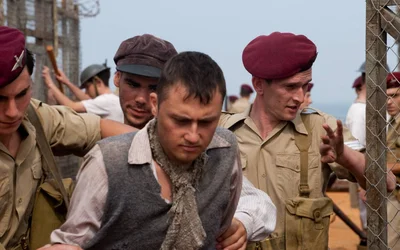
Britain Owes Palestine’s petition documents how, between 1917 and 1948, the British breached international law as it stood at the time.
The British Empire “denied Arab self-determination and had no legal authority to issue the Balfour Declaration or to govern the Mandate that followed”, the campaign said in a statement shared with Middle East Eye.
“British forces also committed war crimes and crimes against humanity, including murder, torture, arbitrary detention and the mass demolition of homes.”
The campaign argues that Israeli settlement expansion, home demolitions, detentions and displacement seen in the West Bank and Gaza today are not a break with the British colonial period but a continuation of it.
“An official apology from the highest levels of the British government and a conversation about appropriate reparations is our main ask,” said Victor Kattan, assistant professor in public international law at the University of Nottingham, who co-drafted the petition.
“The petition sets out findings that engage the government’s obligations and asks for nothing more than the consideration that any claim of this scale should receive. The petitioners are entitled to a proper and reasoned response.”
Over the last year, 45 cross-party MPs and peers have since signed an open letter backing the petition including Layla Moran, as have cultural and business figures including Stevenson, Macfarlane, author and comedian Alexei Sayle and singer Paloma Faith.
“With the government becoming more outspoken on Palestine - including reported plans for more robust measures against Israeli settlements in the West Bank this month - and 21 September also marking a year since the UK recognised the state of Palestine, the campaign is calling on the government to answer the petition and issue a formal apology,” Britain Owes Palestine said.
This apology would, the campaign said, be “the bare minimum if Britain is to play a proper role in peace efforts and reconstruction”.
Middle East Eye delivers independent and unrivalled coverage and analysis of the Middle East, North Africa and beyond. To learn more about republishing this content and the associated fees, please fill out this form. More about MEE can be found here.