UN investigators complete report on misconduct allegations against ICC prosecutor

A long-anticipated United Nations-led inquiry into alleged misconduct by the International Criminal Court’s prosecutor has been finalised and formally handed to the ICC’s governing body, marking a significant step in a process that has been ongoing for more than a year.
In a statement issued on Friday, the Presidency of the Assembly of States Parties (ASP) said it received the fact-finding report from the UN Office of Internal Oversight Services (OIOS) on 11 December, and immediately forwarded it to a panel of judicial experts previously established by the Assembly’s Bureau to examine the report.
The ad hoc panel of judges will provide non-binding advice to the ASP's leadership regarding whether a finding of misconduct has been established, and whether it qualifies as serious or as being of a less serious character.
According to an internal ASP document outlining the communication strategy of the Bureau, seen by Middle East Eye, in the event of a finding of serious misconduct or misconduct of a less serious nature, the Bureau of the ASP may decide to suspend Khan pending the final determination of the matter.
Removal of the prosecutor would require a vote by an absolute majority of the ASP's 125 parties.
New MEE newsletter: Jerusalem Dispatch
Sign up to get the latest insights and analysis on Israel-Palestine, alongside Turkey Unpacked and other MEE newsletters
“The submission of the investigative report to the panel follows the procedure previously established by the Bureau and in no way provides any indication as to the findings of the report,” the ASP presidency's statement on Friday said.
The judges will now review the report under the legal framework of the Rome Statute, the court’s rules of procedure and relevant administrative regulations. Their assessment is expected to take around 30 days, “subject to the complexity of the issues”, before being reported back to the Bureau, the statement added.
Uncertainty
The investigation has cast a long shadow over the court’s leadership, with prolonged uncertainty over the future of the prosecutor raising concerns among diplomats and staff about the court’s ability to fulfil its mandate.
Once the panel completes its work, the Bureau of the Assembly will consider both the experts’ assessment and the OIOS report in line with the court’s legal framework.
The ASP Presidency called on all parties to respect privacy rights and the integrity of the ongoing process.

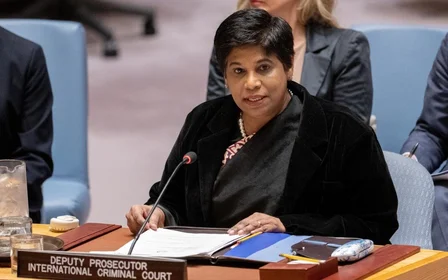
The announcement on Friday comes a week after the conclusion of the ASP's annual conference in The Hague, which was convened in the absence of the chief prosecutor, who took a voluntary leave of absence in May pending the outcome of the UN probe. Khan strenuously denies the sexual misconduct allegations.
His deputy prosecutors have been in charge in his absence. According to a source close to him, Khan has no intention to resign.
The uncertainty over the fate of Khan has left the court in a state of limbo, as his office had been busy investigating atrocity crimes in a dozen situations, including Palestine, Ukraine, Darfur (Sudan), Afghanistan, Libya, the Democratic Republic of the Congo, and the Philippines.
ICC experts and lawyers have complained about the lack of transparency in the process from the time the ASP presidency decided to outsource the investigation last November.
Concerns have been raised, particularly regarding the lack of terms of reference with respect to the panel of judges, and that the process has been improvised, without a legal basis within the court's statute or rules of procedure and evidence.
'The panel of judicial experts will also work under quite some pressure considering how long it took the OIOS, and they must be aware of the frustration among states and be ready to hit the ground running'
- Sergey Vasiliev, ICC expert
In an apparent attempt to address these concerns, in its session last week, the ASP passed a resolution codifying amendments to the process of investigating elected officials for misconduct, establishing better due process guarantees for complainants and those facing misconduct allegations.
The amendments, however, are forward-looking and it remains unclear whether they will apply retroactively to Khan's probe.
Servey Vasiliev, an ICC expert and academic, welcomed the conclusion of the fact-finding phase of the probe. But he said uncertainty still exists. The 30-day estimate is a rough deadline, he explained, which may prove unrealistic in light of the “complexity of the issues” as stated by the ASP statement. “This is some safety cushion built in beforehand to guard against unrealistic expectations, but I do think the examination can realistically be completed within the 30-day period,” he told MEE. “The panel of judicial experts will also work under quite some pressure considering how long it took the OIOS, and they must be aware of the frustration among states and be ready to hit the ground running,” Vasiliev added.
Middle East Eye delivers independent and unrivalled coverage and analysis of the Middle East, North Africa and beyond. To learn more about republishing this content and the associated fees, please fill out this form. More about MEE can be found here.