
Yemen’s child soldiers: How poverty and war are pushing minors to the frontlines

Ibrahim is 17, but he already knows how to handle a Kalashnikov.
He says he is not formally enlisted in the Yemeni government forces, but he fights shoulder to shoulder with his older brother and cousins.
“When the Houthis approached our village, many residents grabbed their personal weapons to resist them, and I was one of them.”
Ibrahim says that he took his father’s rifle and joined the fighting as part of the local resistance groups aligned with the Yemeni government forces.
“As a Yemeni, I know how to shoot because we have a Kalashnikov at home, which I've fired at weddings and other occasions,” Ibrahim told Middle East Eye.
New MEE newsletter: Jerusalem Dispatch
Sign up to get the latest insights and analysis on Israel-Palestine, alongside Turkey Unpacked and other MEE newsletters
He says he has no plans to pursue a military career and views the fighting as temporary, before resuming his studies to become an automotive engineer.
“We joined this battle to recapture our village from the Houthis. Once we achieve our goal, we will stop fighting,” he said.
Ibrahim is not the only child fighting alongside government-aligned forces.
As soon as the latest conflict flared in Yemen, child soldiers resurfaced alongside reciprocal accusations by warring parties over recruiting children and deploying them to the front lines.
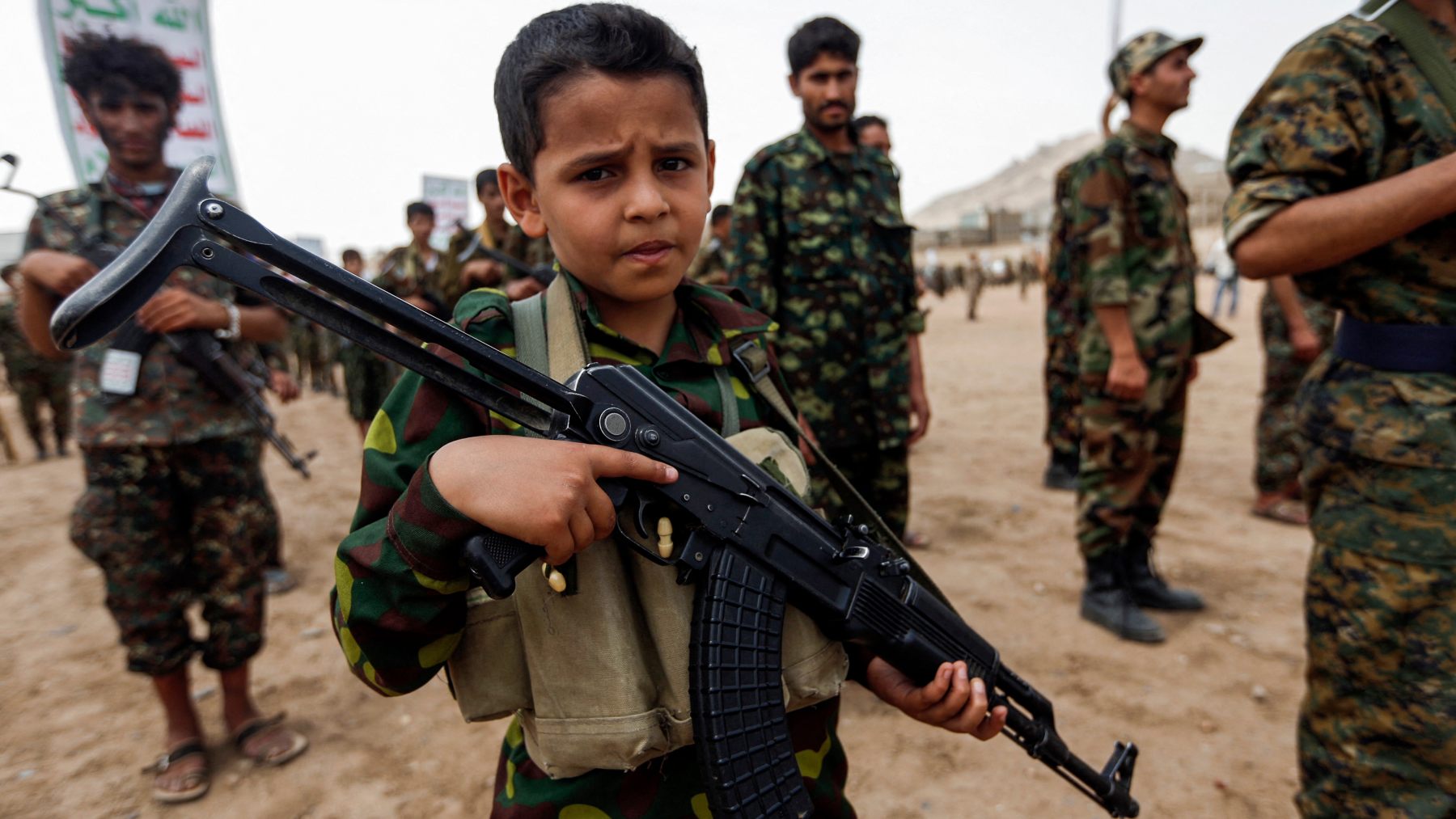

Neither side officially acknowledges recruiting minors; however, the United Nations, media outlets and human rights reports have confirmed that both parties engage in the practice.
A March 2025 report by the UN secretary-general on children and armed conflict documented 564 cases of child recruitment and use in Yemen between 2021 and 2023.
Of those, 345 were attributed to the Houthis and 210 to Yemen’s armed forces and affiliated armed groups. The remaining cases were attributed to unidentified perpetrators and the Islamic State in Iraq and the Levant in Yemen.
The UN said the children ranged from 8 to 17 years old. It verified 293 children being recruited and used in combat, while 187 were used in support roles as guards at military checkpoints, informants and drivers.
Twenty-seven of those used in combat were under 15.
Official denial
Ahmed, Ibrahim’s 41-year-old cousin, said that Ibrahim does not participate in active combat on the front lines. Instead, he performs support tasks positioned behind the troops, arguing that his physical build enables him to handle the duties.
“Fighting on the front lines requires experience - it’s not easy for just anyone to fight there,” Ahmed told MEE.

“Fighters like Ibrahim can provide crucial support behind the main forces and play an important role in such difficult circumstances.”
As fighting between Houthi and government-aligned forces intensified around Taiz last month, a BBC team aired an interview with a 16-year-old fighter associated with government forces who said he had participated in active combat.
Responding to the report, Colonel Abdul Basit al-Bahr, deputy head of the Moral Guidance Department at the Taiz Axis Command, told MEE that the boy was accompanying his father and was not acting as a combatant for government forces.
“We in the armed forces have a clear stance on child recruitment; it is strictly prohibited, and children cannot be accepted into the ranks of the armed forces or thrust into military operations.”
Yet he acknowledged that government forces encounter children on the battlefield, with some as young as 10 years old.
“Appropriate legal and humanitarian measures are taken regarding them, and they are referred to the relevant authorities to handle their situation in accordance with the law,” Bahr said, adding that minors captured while fighting alongside the Houthis are treated as children rather than adult combatants.
Poverty drives recruitment
The SAM Organisation for Rights and Liberties has documented the recruitment of 11,310 children from 2014 to February 2023.
According to the independent advocacy group monitoring violations in Yemen, the figures include 6,269 children aged eight to 11.

Tawfeeq al-Homaidi, president of SAM, said the economic collapse caused by years of war has created conditions in which armed groups can exploit children and their families.
“When a family loses its income, the breadwinner stops receiving a salary, and a child is pushed out of school, the small sum of money, food ration, or stipend offered by an armed group becomes a matter of basic survival rather than a choice,” Homaidi told MEE.
In a joint statement issued on 26 September 2026, the Yemeni Network for Rights and Freedom, alongside 266 Yemeni human rights and civil society organisations, condemned the exploitation of children by the Houthis, highlighting how severe economic distress is weaponised to force minors onto the battlefield.
“Children bore the brunt of these violations through forced recruitment, being thrust into battlefields, and the exploitation of their needs and their families' socioeconomic hardships through ideological and military indoctrination,” the statement read.
“However, reducing recruitment strictly to poverty is a mistake,” Homaidi cautioned.
“There is a broader spectrum of causes, such as ideological mobilisation, the exploitation of schools and summer camps, social and tribal pressure, the lure of status, weapons, and money, interrupted schooling, and in some cases, direct coercion.”
Ideology and promises
Minors were lured to the front lines with promises of a personal Kalashnikov rifle, a one-month military training course, and a monthly stipend of 50,000 Yemeni riyals (approximately $94), a report published last month by Al Jazeera English from Houthi-controlled areas revealed.
Homaidi added that recent UN statements on Yemen have highlighted severe concerns over child recruitment, specifically citing Houthi-run summer camps where thousands of children are subjected to military training and sectarian content.
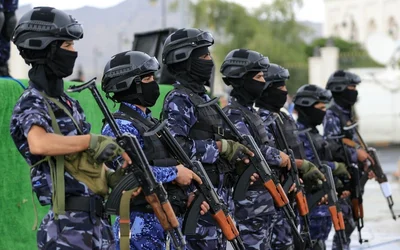
The Houthis have faced particular scrutiny over their recruitment and indoctrination of children, but the phenomenon is not limited to Houthi forces.
“Child recruitment is not confined solely to Houthi-controlled areas,” Homaidi stressed.
“According to the UN, cases have been documented among government forces and affiliated or allied armed formations as well, albeit in far smaller numbers and generally without coercion.”
According to UN Ocha estimates for 2026, over 22 million people in Yemen remain in urgent need of humanitarian assistance and protection services, including 5.2 million internally displaced persons.
The renewed fighting, however, is creating new opportunities for armed groups to draw children into the conflict, whether through formal recruitment, local armed formations, family pressure or economic desperation.
The UN's definition of recruitment is broader than formal enlistment, encompassing children used in combat as well as in support roles.
For Ibrahim, however, the distinction between a formal soldier and a young man carrying a rifle alongside government forces is meaningless.
He says he is fighting to reclaim his village.
The names of child soldiers have been changed on request.
Middle East Eye delivers independent and unrivalled coverage and analysis of the Middle East, North Africa and beyond. To learn more about republishing this content and the associated fees, please fill out this form. More about MEE can be found here.