Palestinian activist Mahmoud Khalil files $20m claim against Trump administration

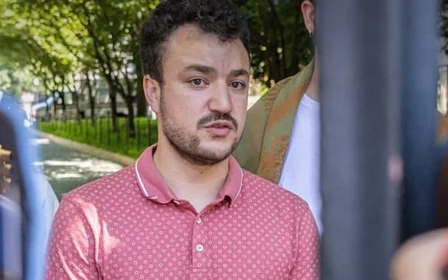
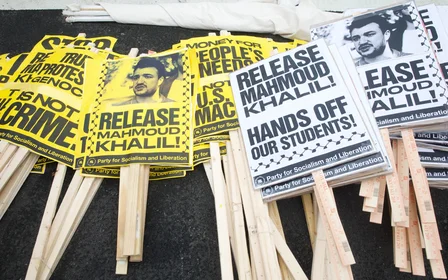
Palestinian activist Mahmoud Khalil has filed a claim against the Trump administration for $20m in damages after spending months in an immigration detention centre and missing the birth of his first child, the Associated Press reported on Thursday.
The Department of Homeland Security, US Immigration and Customs Enforcement (ICE) and the State Department are all named on the claim, which is a precursor to a lawsuit.
“This is the first step towards accountability. Nothing can restore the 104 days stolen from me. The trauma, the separation from my wife, the birth of my first child that I was forced to miss. But let’s be clear, the same government that targeted me for speaking out is using taxpayer dollars to fund Israel’s ongoing genocide in Gaza,” Khalil said in a press release.
The Columbia University graduate, 30, who was one of the lead negotiators during the Columbia University protest encampments against the war in Gaza, is suing for false imprisonment, malicious prosecution and being besmirched as an antisemite for his peaceful pro-Palestinian speech.
When the encampments kicked off at Columbia University in spring 2024, Khalil did not participate in them himself, opting instead to negotiate with administrators and offer guidance to students.
New MEE newsletter: Jerusalem Dispatch
Sign up to get the latest insights and analysis on Israel-Palestine, alongside Turkey Unpacked and other MEE newsletters
Khalil spent 104 days in a detention centre after being detained by ICE agents in plain clothes outside his apartment and taken more than 1,000 miles away to Jena, Louisiana, in the southern US, where his wife, friends and legal team did not have access to him.
On 20 June, a US federal judge in New Jersey ordered the release of Khalil from immigration custody, as the Trump administration continues to try to deport the legal permanent resident who is married to an American citizen.
Khalil said he will distribute any settlement money to other victims of the Trump administration whose constitutional rights to free speech have been violated with regard to advocacy for Palestine. He also said he would be happy to accept a formal apology, in lieu of a settlement, and an overhaul of the government’s deportation policies.
"My goal is not self-enrichment. I don't want this money just because I need money. What I want is actual accountability. Real, real accountability against the injustices that happened against me with the malicious prosecutions that I was targeted for all this," Khalil told the media on Thursday.
'Charade of due process'
After President Donald Trump signed an executive order in January seeking to deport students and faculty for pro-Palestinian speech, Khalil was one of the first students to be detained.
Khalil's lawyers believe the Trump administration finds immigration judges in the south to be more favourable to the US government.

In April, one of those judges said that Khalil could be deported even though he is a green card holder, which makes him a lawful permanent resident of the US.
According to reports, US Secretary of State Marco Rubio had insisted that Khalil's "presence or activities would compromise a compelling US foreign policy interest”.
Marc Van der Hout, one of Khalil's lawyers, said in a statement issued after the judge's ruling to free Khalil, that he had been “subject to a charade of due process”, adding his deportation order was “a flagrant violation of his right to a fair hearing, and a weaponisation of immigration law to suppress dissent”.
The decision was a landmark victory for rights organisations that said Khalil's constitutionally protected freedom of speech was not just trampled upon, but he was "punished".
The immigration court’s refusal to allow Khalil to attend the birth of his son was a double blow to his family.
"Missing the birth of my child was the most difficult thing in my life," he told CNN, "especially like since this could have been avoided". Khalil said he had made multiple requests to be present at the birth of his child.
His release on 20 June meant he was able to hold his son for the first time.
Middle East Eye delivers independent and unrivalled coverage and analysis of the Middle East, North Africa and beyond. To learn more about republishing this content and the associated fees, please fill out this form. More about MEE can be found here.