Leading global academics denounce UK's Palestine Action ban

Scores of leading global academics have signed an open letter denouncing the British government's ban on direct action group Palestine Action as an "attack on fundamental freedoms".
The letter, published in the Guardian on Wednesday, was signed by 52 intellectuals including Judith Butler, Tariq Ali, Angela Davis, Naomi Klein, Rashid Khalidi, Avi Shlaim and Ilan Pappe among others.
"As scholars dedicated to questions of justice and ethics, we believe that Yvette Cooper’s recent proscription of Palestine Action represents an attack both on the entire pro-Palestine movement and on fundamental freedoms of expression, association, assembly and protest," the letter reads.
"We deplore the repressive consequences that this ban has already had, and are especially concerned about the likely impact of Cooper’s ban on universities across the UK and beyond."
The letter further says: "We therefore applaud the growing campaign of collective defiance that aims to overturn the ban."
New MEE newsletter: Jerusalem Dispatch
Sign up to get the latest insights and analysis on Israel-Palestine, alongside Turkey Unpacked and other MEE newsletters
British officials proscribed Palestine Action under anti-terror laws on 4 July.
The move followed an incident in which members broke into RAF Brize Norton and spray-painted two planes they said were “used for military operations in Gaza and across the Middle East".
'Ending flow of weapons'
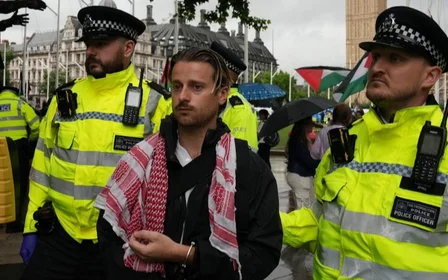
Since Palestine Action was proscribed as a terrorist organisation, more than 200 people have been arrested - including priests, vicars and former magistrates - after they were deemed by police officers to have expressed support for the group.
Supporting the group is now a criminal offence, as is inviting or "recklessly" expressing "support for the group”.
Those found guilty of supporting or inviting support for the group can face up to 14 years in prison under the Terrorism Act 2000.
The letter praises those campaigning against Palestine Action's proscription, saying: "In alliance with thousands of trade unionists, teachers and students throughout the UK and abroad, we affirm our own solidarity with all those who are campaigning against the proscription.

"We fully share the aim of ending the flow of weapons from Britain to Israel and the belief that all participants in the pro-Palestine movement should be free to make our own decisions about how best to achieve that goal."
Last week a High Court Judge ruled in favour of Palestine Action and granted the direct action group a judicial review to oppose the UK government’s ban on the group.
The ruling marks a setback for the government, which has faced escalating criticism over its handling of the proscription and concerns that the ban on the group could be used to stifle criticism of Israel and the right to protest.
The letter declares: "As the organisers of massive national demonstrations face prosecution, as hundreds of people again risk arrest by joining street protests on 9 August, and as students and teachers prepare for the start of another turbulent academic year, we express our full solidarity with those mobilising on their campuses or in their workplaces and communities to put an immediate stop to the escalating genocide and to end all UK complicity with Israel’s crimes."
Middle East Eye delivers independent and unrivalled coverage and analysis of the Middle East, North Africa and beyond. To learn more about republishing this content and the associated fees, please fill out this form. More about MEE can be found here.