Rainstorm floods Gaza tents as UN expert slams Israel's 'slow genocide'

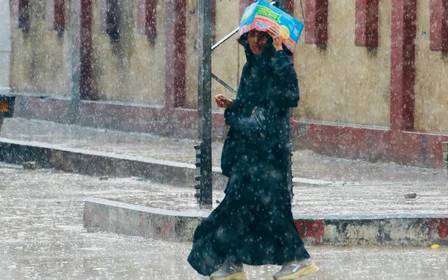
A heavy rainstorm flooded thousands of tents across the Gaza Strip on Wednesday, worsening already dire conditions for hundreds of thousands of displaced Palestinians.
The acute shelter crisis continues more than two years into the genocidal war, as Israel bans the entry of tents and mobile homes in violation of the ceasefire agreement in October.
The downpour began before dawn, submerging tents across the Strip.
Nearly four hours of rain left much of northern Gaza under water, with street flooding reaching almost half a metre.
Low-lying areas, particularly those near the seashore, were completely inundated.
New MEE newsletter: Jerusalem Dispatch
Sign up to get the latest insights and analysis on Israel-Palestine, alongside Turkey Unpacked and other MEE newsletters
Materials to block rainwater from entering tents are largely unavailable, with those on the market reaching exorbitant prices.
According to data from the Government Media Office in Gaza, around 300,000 tents and prefabricated housing units are needed to meet the basic shelter needs of Palestinians, following Israel’s near-total destruction of infrastructure since October 2023.
In an urgent appeal to international actors, the General Directorate of Civil Defence in the besieged enclave called for immediate assistance for tens of thousands of displaced families braving the harsh weather.
“Displaced people in the Gaza Strip are drowning in their dilapidated tents,” the statement said. “Rallying to save their lives is a humanitarian and moral duty.”
More heavy rain, flash floods and strong wind are forecast throughout Palestine until Friday.
'Ceasefire agreement has failed'
Amid worsening conditions in Gaza, the UN Special Rapporteur on the Right to Adequate Housing, Balakrishnan Rajagopal, warned that the situation has become “extremely urgent and critical,” with winter further intensifying the humanitarian crisis.
In an interview with Al Jazeera Mubasher, he said approximately 1.5 million people lack access to proper shelter in the war-torn Gaza Strip.
He added that the UN agency for Palestine refugees, Unrwa, has shelters for around 1.3 million people waiting outside Gaza, but Israel blocks their entry into the Strip.
'It is as if people in Israel enjoy seeing Palestinians suffer'
- Balakrishnan Rajagopal, UN special rapporteur on housing
“Even though Israel had agreed to allow the entry of these supplies under the ceasefire agreement, the reality is that nothing is entering,” Rajagopal said.
“It is clear to me that the ceasefire agreement has failed and has not been adhered to,” he added.
Rajagopal said Israel continues to carry out daily attacks and demolitions of residential buildings, expressing concern that “the world is not doing anything to pressure Israel to adhere to the ceasefire”.
“This failure falls on the shoulders of the international community,” he stressed.
The UN expert described the current starvation and obstruction of aid as a form of “slow genocide.”
“They continue to kill slowly. Unfortunately, this constitutes a level of cruelty and suffering that we have never witnessed in other conflicts.
"This is a systematic enforcement of sadistic conditions, and it is as if people in Israel enjoy seeing Palestinians suffer. This is behaviour we have not seen in any conflict before… I am very shocked.”
Since the ceasefire agreement in October, Israel has committed at least 738 direct violations, including air strikes, shootings, and home demolitions.
At least 379 people have been killed by Israeli forces since 11 October.
Israel has also maintained tight restrictions on the entry of humanitarian aid, allowing only a limited number of trucks, which do not include essential shelter, food and medical items.
Middle East Eye delivers independent and unrivalled coverage and analysis of the Middle East, North Africa and beyond. To learn more about republishing this content and the associated fees, please fill out this form. More about MEE can be found here.