In Syria's Daraa, water is life - and today the land is parched
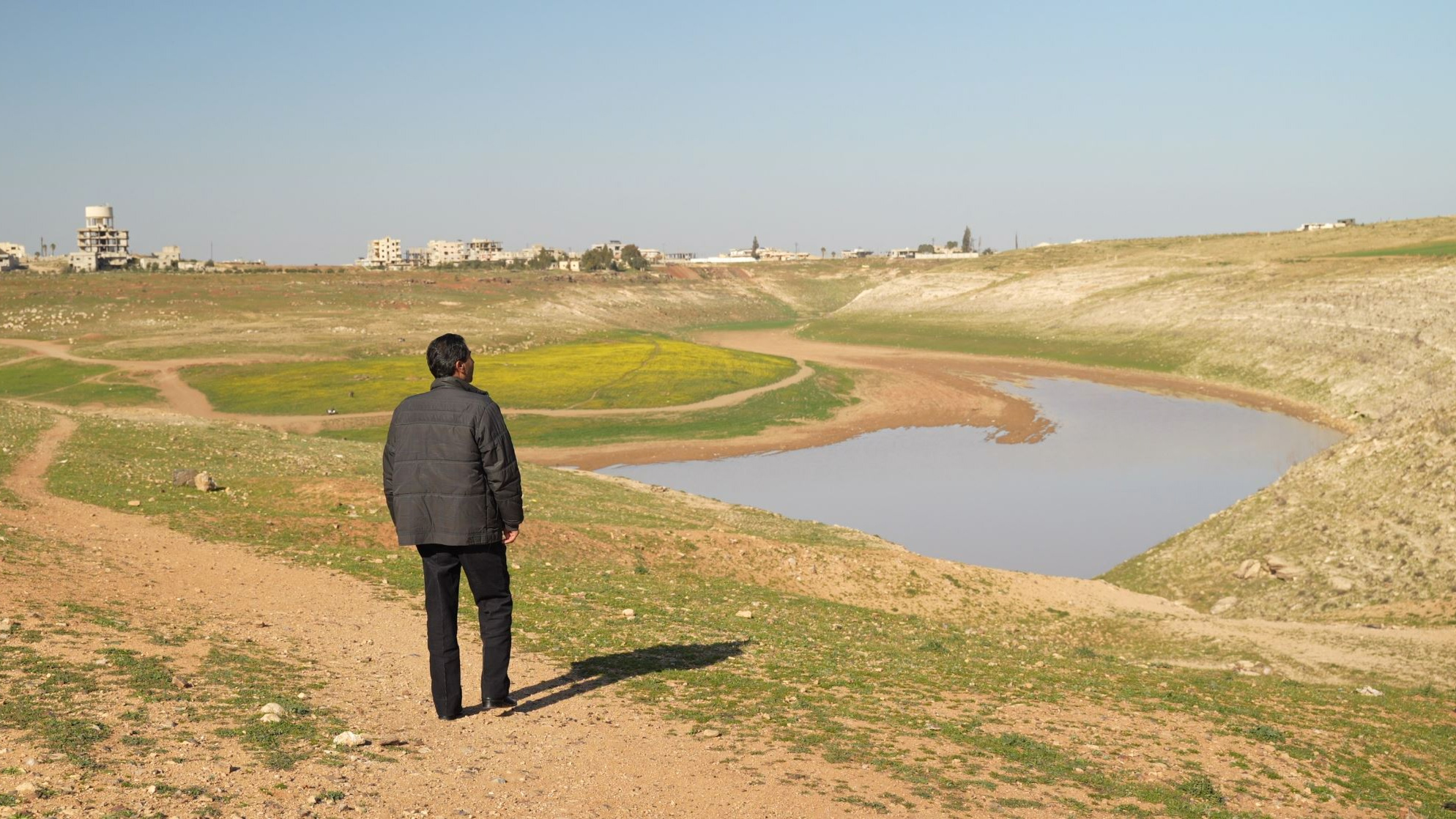
Abdul-Munaf al-Masri stands before a vast, cracked expanse of land in southern Syria, where water once stretched to the horizon.
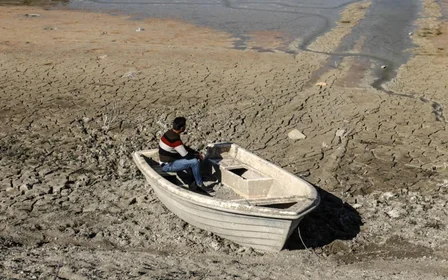
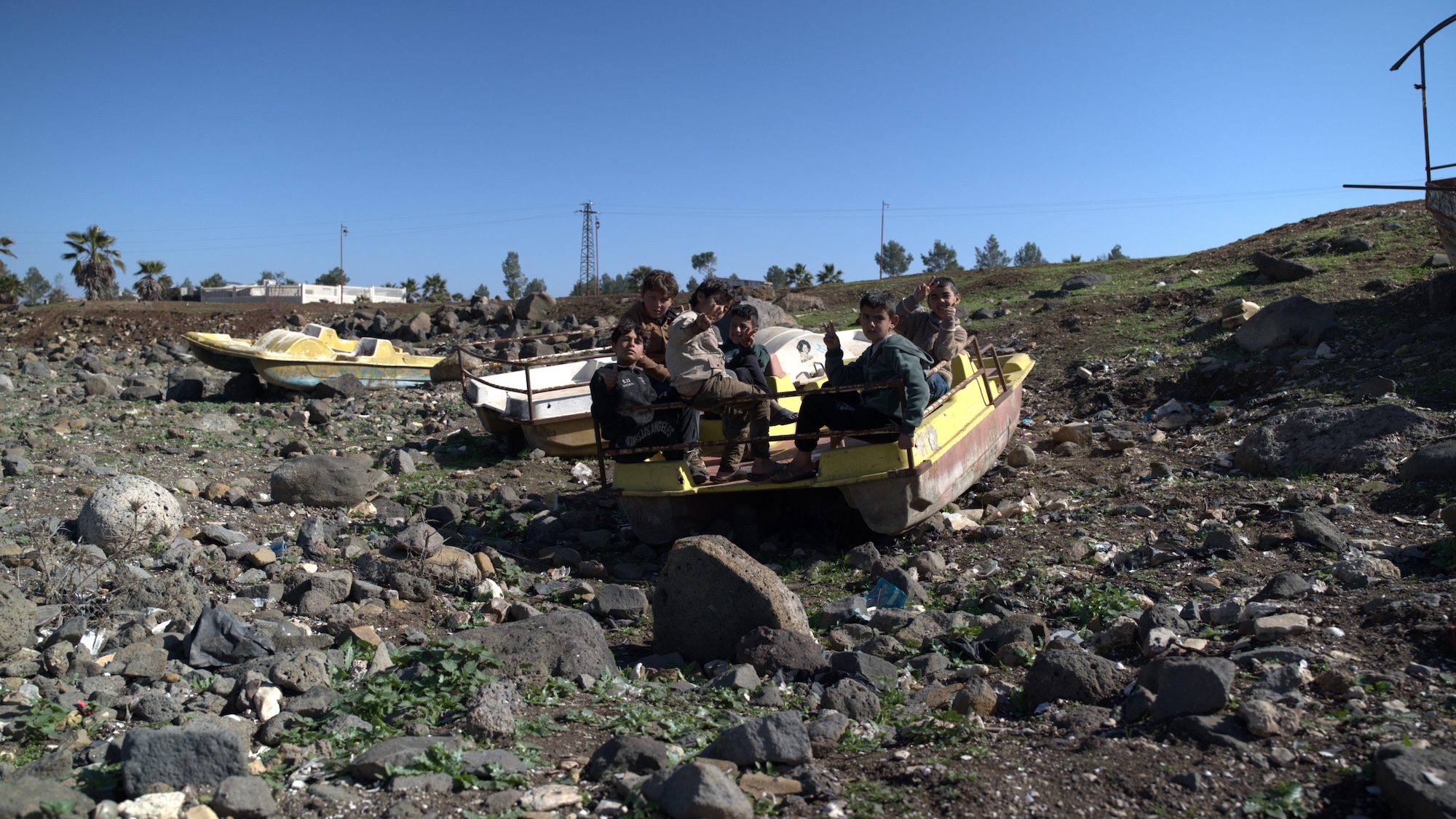
Scattered stones and patches of dry grass cover what used to be Lake al-Muzayrib, while an abandoned boat rests on hardened soil - a remnant of another time.
A few birds strut slowly across the empty basin, breaking the silence of a place that once teemed with life.
“I don’t like to come here,” Masri says quietly, his eyes fixed on the barren land. “The sight of drought saddens me.”
For more than two decades, Masri worked here as a fisherman. From 1993 until just a few years ago, Lake al-Muzayrib was not just a workplace, but the centre of his life.
New MEE newsletter: Jerusalem Dispatch
Sign up to get the latest insights and analysis on Israel-Palestine, alongside Turkey Unpacked and other MEE newsletters
That was until the lake northwest of Daraa city - once the province’s largest natural body of water, offering a vital resource for the local agricultural sector, and a means of survival for fishermen like Masri - began drying up.
For years, researchers studying the Syrian war have been sounding the alarm about the water crisis gripping the country’s south. Prolonged periods of drought have been exacerbated by mismanagement of water resources, including excessive well-drilling in Daraa.
Today, the region faces an unprecedented collapse in both surface and groundwater resources.
'I'm like a fish; if I leave this place, I die. The drought destroyed us'
- Abdul-Munaf al-Masri, resident
In the 1990s, the springs feeding Lake al-Muzayrib flowed at up to 1,000 litres per second; by 2016, that rate had fallen to less than 170 litres, and today, it is at zero, according to the Daraa Water Resources Directorate, a Syrian government agency.
The lake has dried up more than once in recent years, only to partially refill from rainfall - but by the end of 2024, it had entirely disappeared.
Masri’s eyes are sombre as he gazes across the parched lakebed. Forced to stop fishing here in 2021 after fish stocks collapsed, he has since scraped out a living by doing household jobs and plumbing.
Masri is not alone in his predicament: around two dozen men used to fish these waters, but all have either left the country in recent years or had to find other work, he says.
“The lake means my life … I’m like a fish; if I leave this place, I die,” Masri tells Middle East Eye. “The drought destroyed us. I was born and raised here, and it’s hard for a person to lose something so precious.”
Resources dwindling
For millennia, life in southern Syria has unfolded in close relation to the surrounding environment.
The region’s rich volcanic soil and abundant water resources, particularly in the Hauran plains, have enabled generations of Syrians to live off the fertile land, cultivating grains, vegetables and livestock.
Encompassing Quneitra, Daraa and Suwayda provinces, which meet at the borders of Jordan and historic Palestine, the region’s position as a strategic crossroads has also contributed to its geographic and economic value.
But in recent years, the water crisis has come to dominate the local landscape: out of 16 dams in Daraa, 14 have experienced partial or total drying, according to engineer Hani al-Abdullah, the province’s director of water resources.
Once a popular tourist destination known for its lush banks and scenic beauty, Lake al-Muzayrib is symptomatic of this larger trend of decline, which has also seen several key feeder springs dry up or slow to a trickle.
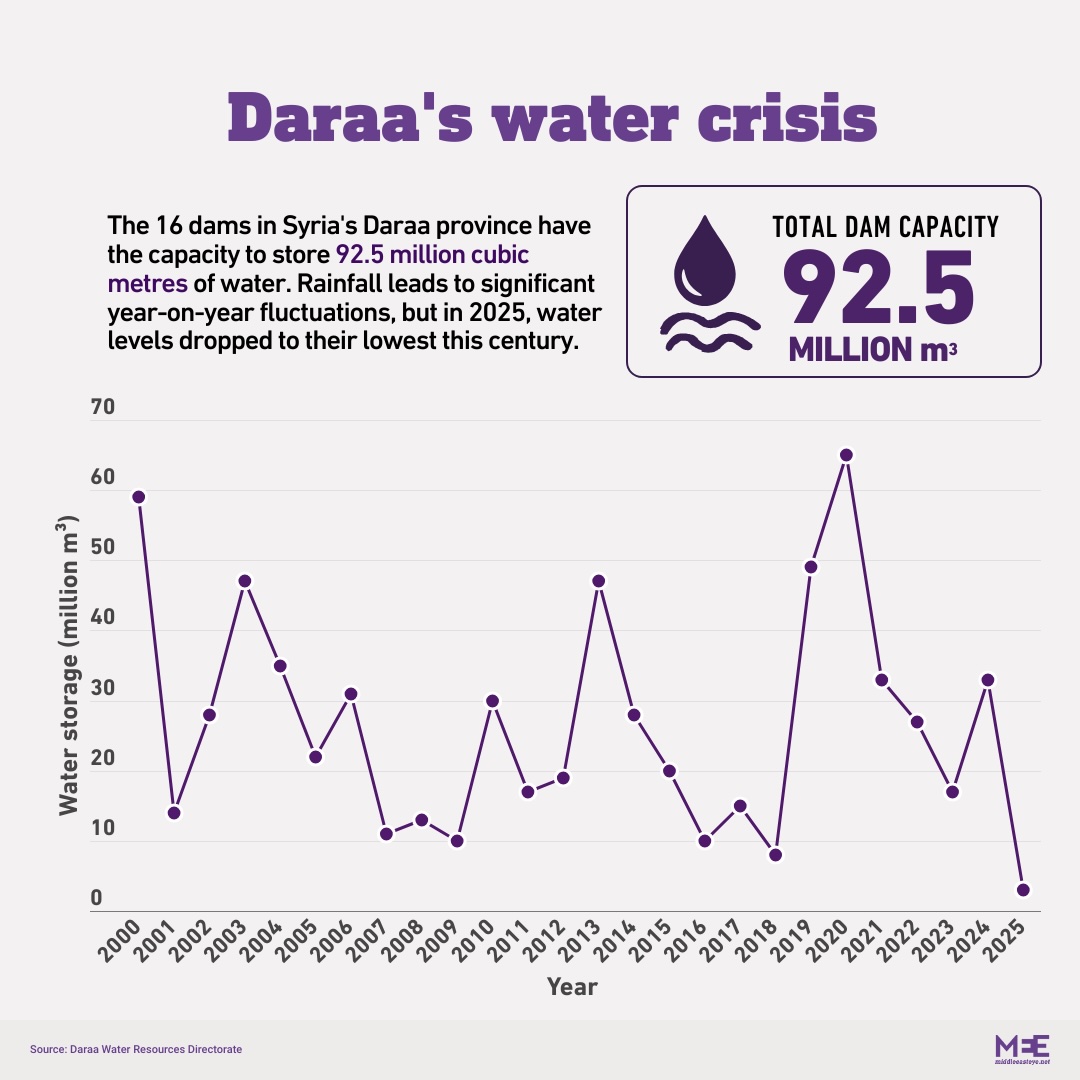
According to the Daraa water directorate, the total storage capacity across the province’s 16 dams is 92.5 million cubic metres, but despite significant year-on-year variations due to rainfall, it now holds only a tiny fraction of that. In 2025, the total amount stored was less than four million cubic metres - the lowest level recorded this century, and a huge drop from 65 million cubic metres just five years earlier.
The critical water situation threatens all aspects of life in the province, with Abdullah citing a continuous decline in this vital resource over the past several decades. He speaks to MEE from the crest of the Daraa Dam, a massive reservoir that today is almost completely dry.
For many years, this dam was a popular destination for local residents, known for its abundance of fish and its crucial role in irrigating surrounding farmland. The scene now is strikingly different: the water has largely receded, and trees have been cut down across the barren landscape.
The dam once echoed with birdsong and the voices of children at play. Today, there is only silence.
Farmers in jeopardy
For many families across Daraa, agriculture is a livelihood passed down through generations. It forms the backbone of the local economy, in a region known for its rich production of tomatoes, olives, pomegranates and grapes, among other produce.
War has ravaged this economy. During more than 14 years of open conflict between government forces and Syrian rebels, farmers watched helplessly as water and irrigation networks were targeted, and trade links cut off.
In the town of Tafas, in the western countryside of Daraa, Abu Mahmoud speaks with quiet frustration as he scrolls through comments on social media blaming farmers for the depletion of freshwater springs used for drinking.
“I own five dunams [0.5 hectares] of land planted with pomegranates,” he tells MEE. “It has always been my family’s main source of income. But in recent years, everything has changed - the war, the drought … nothing is the same anymore.”

Like thousands of other Syrians, Abu Mahmoud, who spoke under a pseudonym for fear of repercussions, found himself breaking the law to survive. Amid a vacuum of governmental authority during the war, he dug an unlicensed well in a desperate attempt to save his crops.
“I had no choice,” he says. “We all did the same. It was the only way to keep working and protect our land. But even that wasn’t a real solution. It cost a lot, and after three years, the well dried up.”
Abu Mahmoud dug the well in 2015, at a time when the collapse of state oversight had led to a surge in unregulated drilling across the region. Thousands of illegal wells have since appeared across western Daraa, according to local authorities - transforming what was once a temporary solution into a widespread phenomenon.
Today, residents increasingly blame these wells for the region’s worsening water shortages.
Water itself has been transformed into a costly commodity, placing a heavy burden on families: the price of 1,000 litres of water has risen in recent years to around $5, an amount that is difficult to afford for many people, in a region where the average monthly salary is roughly between $75 and $150.
Abdullah says his directorate has received dozens of complaints about illegal wells, with residents linking them to the drying up of natural springs and the disruption of drinking water supplies. He says authorities have taken steps to combat the problem - ramping up monitoring efforts, repairing damaged irrigation networks, drilling regulated wells in areas facing shortages, and trucking in water from neighbouring areas - in an effort to further deter unregulated groundwater extraction.
Dozens of drilling rigs have also been confiscated, after the governor of Daraa last year issued a decision mandating the seizure of equipment used to construct illegal wells, alongside fines for those who build them - but the problem has become so widespread that it is difficult to control.
'A well is not a luxury. It's a lifeline - not just for me, but for dozens of families in this town'
- Hatem al-Zoubi, farmer
The same reality unfolds in eastern Daraa, where Hatem al-Zoubi walks slowly across his land, carrying a sickle and an axe. He pauses among rows of olive trees, which he tends with care, as if they were members of his own family.
His land sustains 700 olive trees, while he cultivates legumes, citrus fruits and tomatoes across 20 dunams (two hectares). On the corner of Zoubi’s farm, next to a concrete fence by his vineyard, stands a well he dug in 2020.
“A well is not a luxury,” Zoubi tells MEE. “It’s a lifeline - not just for me, but for dozens of families in this town.”
Beyond irrigation for farmland, the well on his land supplies drinking water to many residents, he says, noting that its closure would cut off a vital community resource.
“Without it, the town would have faced real drinking water crises, especially in the summer,” he says. “This year, with more displaced people and livestock, the need for water has only grown.”
High costs, limited returns
For farmers like Zoubi, wells are both a necessity and a burden - a fragile lifeline in a region where water, once abundant, is becoming increasingly scarce.
Drilling and equipping the well, which depends on solar energy, cost him around $70,000, Zoubi says. Returns are barely covering those expenses, amid low prices for agricultural products and increasing costs for fertilizers and pesticides, alongside frequent technical failures, which can run to thousands of dollars in repairs and losses.
In the area of Lake al-Muzayrib alone, Masri estimates that there are more than 7,000 illegal wells, leading to severe groundwater depletion.
“People don’t realise the danger … Someone may dig a well to water their own trees, but in doing so, they destroy an entire community,” he says.
Abdullah, Daraa’s director of water resources, confirms that local groundwater levels have dropped significantly, by five to 10 metres in some areas, due to excessive pumping and increased demand. The use of solar energy to operate wells has further accelerated extraction rates, worsening depletion.
In western Daraa, student Basel al-Zoubi, who lived as a refugee in Jordan until the fall of the Assad regime, recently returned to the small town of Tseel, where many people now rely on purchasing water delivered by tankers to meet their daily needs.
Zoubi tells MEE that the town urgently need pumping systems capable of transporting water from springs and state-managed wells to residential areas, after much of the existing infrastructure was damaged in the war.
Walking through the streets of Tseel, the destruction is still visible in the crumbling storefronts and ruined roadways, while the hum of generators fills the air.
“Water is a lifeline,” Zoubi says. “There is no alternative, especially given the difficult economic conditions people are facing.”
Along with rehabilitating and repairing the water network to ensure consistent access for residents, Zoubi believes the government should impose a stricter system for regulating wells, “and those that encroach on drinking water sources should be shut down” more swiftly.
Masri also calls for tighter regulation around wells, a campaign to raise community awareness, and the establishment of a fisherman’s union that could focus on restocking dams if water levels recover.
But efforts by water authorities in Daraa to tackle the problem remain limited in scope, underscoring the need for a comprehensive strategy that balances water conservation with sustaining livelihoods in a region where water has become synonymous with survival.
Amin al-Haibi, a fisherman from Daraa, confirms that drought has “destroyed our profession”. Only al-Wehda Dam, located on the Yarmouk River at the Jordanian border, remains as a limited source of local fishing, highlighting the near-total collapse of this sector.
Masri’s face fills with sorrow as he recalls the abundance of the past.
“Sometimes we used to catch 200 or 300 kilograms a day,” he recalls, noting that the bountiful waters allowed him to support his family with ease. “It made you happy.”
Today, that reality has vanished with the water; the boats that once fed around 100 families turned into scrap.
“Nothing encourages me to come here anymore. The drought, the cutting of trees - it’s painful,” Masri says.
“We hope life returns as it was before.”
This article was produced as part of the 2026 Middle East Eye Fellowship.
Middle East Eye delivers independent and unrivalled coverage and analysis of the Middle East, North Africa and beyond. To learn more about republishing this content and the associated fees, please fill out this form. More about MEE can be found here.