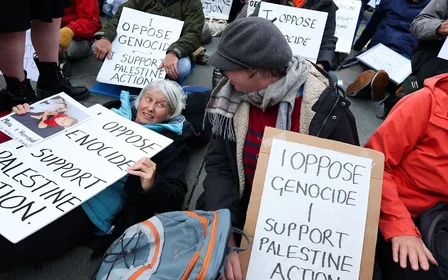
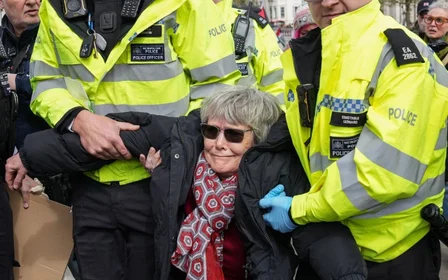
Palestine Action: History will judge Britain for these draconian sentences


There are children in Gaza who shake when they hear that unmistakable buzzing sound, a buzzing sound that many of them have become horribly used to.
It's the sound of Israeli drones, a foreboding hum that has become a daily soundtrack for an entire generation of traumatised Palestinian children.
The machines are a particularly pernicious weapon in Israel's arsenal of ethnic extermination, capable of being modified for a variety of squalid purposes.
Doctors have reported that drones have targeted and shot children. In some cases, those children were already lying wounded on the ground, according to a retired surgeon who volunteered at a hospital in Gaza.
Testifying before a committee at the British parliament, Professor Nizam Mamode broke down as he recalled that he had "fished" small bullets out of children's abdomens. The youngest was just three years old.
New MEE newsletter: Jerusalem Dispatch
Sign up to get the latest insights and analysis on Israel-Palestine, alongside Turkey Unpacked and other MEE newsletters
And in one of the most chilling and twisted war tactics ever conceived, residents reported drones playing the sounds of crying children and screaming women in an attempt to draw Palestinians out into the open so that they could be killed.
It was drones like these, drones built by arms manufacturer Elbit Systems, that activists from the now-banned Palestine Action group took sledgehammers to during a night-time raid on one of the Israeli firm's factories in Britain in August 2024.
Last week, four of the people involved in that act of civil disobedience were handed lengthy sentences in a London court, sentences that the judge decided had a "terrorism connection".
Their prison terms, delivered as Special Custodial Sentence(s) for Offenders of Particular Concern, ranged from four years and eight months to seven years and eight months. Each will also serve a further year on licence and be subject to 15 years of terrorist notification requirements.
Neo-Nazis
One vital piece of context, though, calls that terrorist designation into question.
The convictions returned against the activists ahead of sentencing were for criminal damage, with one of the four found guilty of an additional charge of grievous bodily harm without intent for striking a police officer with a sledgehammer.
Those were the decisions the jury reached and believed would form the basis on which members of Palestine Action, which was not a proscribed organisation when the offences were committed, would be sentenced.
The only solution left, the only way to fight for what everyone now recognises as a righteous cause, was to change tack
But here's the duplicitous part: Judge Jeremy Johnson had not disclosed to the jury his intention to sentence the four as terrorists, reportedly the first time anyone in the UK has been sentenced as a terrorist for a non-violent offence. And, crucially, based on convictions for non-terror-related charges.
There is a page on the British government website that lists every group legally proscribed as a terrorist entity in the UK since the Terrorism Act 2000 was passed, the most high-profile of the first collection of inductees being al-Qaeda in 2001.
Palestine Action was part of the most recent cohort, officially declared a terrorist organisation in 2025 on the same day as an outfit called the Maniacs Murder Cult (MMC).
Yes, really. Let's pause on that for a second and consider just those two examples from the long list of proscribed organisations. Al-Qaeda has carried out multiple mass attacks and killed thousands of people. The MMC has published instructions on how to carry out school shootings, build bombs and develop poisons such as ricin.
Its leader, Michail Chkhikvishvili, known as "Commander Butcher", was last month sentenced to 15 years in prison in the US for plotting to kill children from racial minorities by having someone dressed as Santa Claus hand out poisoned sweets.
Historic picture
Is that a list to which Palestine Action and its activists - people who do not advocate killing but, rather, want to stop it - belong? Or, as many have argued, could they belong to a different lineage: one of the political groups in British history that were demonised in their time but later deemed heroic?
The suffragettes, the now-lauded group of women who fought for the right to vote in the early 1900s, employed significantly more extreme tactics than Palestine Action, including attacks on infrastructure, arson and bombings.
They were condemned as "little short of nauseating and disgusting to the whole sex" by one MP; another said that their actions were "positive disproof of their capacity for the vote", and they were roundly denounced by the mainstream media.
In more recent years, groups that were controversial during the heat of their crusades but are now widely respected include the women of Greenham Common, who set up camp outside a military base to protest nuclear weapons, and the Greenpeace members who took action against nuclear testing and whaling.
Outside Britain, actions castigated when they took place but now considered legitimate include the Boston Tea Party protests in the US in 1773, Mahatma Gandhi's Salt March in India in 1930, Umkhonto we Sizwe's 1960s sabotage campaign in South Africa, and the Act Up Aids activism of 1980s New York.
There are people who would scoff at those comparisons - some wilfully, but also others who do not have the ability to take a step back from the day-to-day headlines of their own times and see both a historic picture, and a future one.
Only solution
Underlining this, in a moment of staggering hypocrisy, female MPs gathered in Britain's parliament on 2 July 2025, posing for photos wearing suffragette-style sashes, to mark the 97th anniversary of women winning the right to vote.
One MP, Stella Creasy, who wore a T-shirt bearing the words "daughter of Pankhurst" in reference to suffragette leader Emmeline Pankhurst, even defended her double standards in testy arguments on X (formerly Twitter).
Perhaps Pankhurst's most famous motto was this: "Deeds not words."
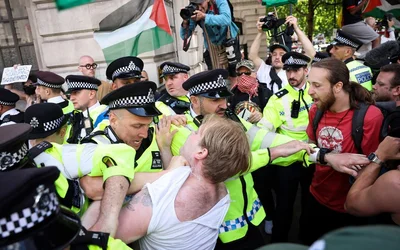
She was convinced by that point that campaigning through conventional means was not working, and that the resistance from entrenched powers was too stubborn.
The only solution left, the only way to fight for what everyone now recognises as a righteous cause, was to change tack. And, she believed, to break the law.
That was also clearly the conclusion of the four defendants branded terrorists last week. Up against some of the most powerful nations in the world, against an unyielding British government and against a hostile media, they felt that marches and social media posts were no longer enough.
So they acted.
Their names are Charlotte Head, Samuel Corner, Leona Kamio and Fatema Rajwani. They are remarkable young people. And history will judge them as such.
The views expressed in this article belong to the author and do not necessarily reflect the editorial policy of Middle East Eye.
Middle East Eye delivers independent and unrivalled coverage and analysis of the Middle East, North Africa and beyond. To learn more about republishing this content and the associated fees, please fill out this form. More about MEE can be found here.