World Cup 2026: Iraq returned, but it will take years to bridge the gulf with football's elite

Iraq ended a 40-year wait and returned to football's biggest stage this summer, but the scale of their World Cup defeats showed just how far they still have to go to compete with the game's elite nations.
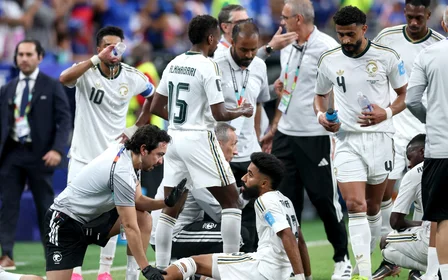
The Lions of Mesopotamia began their campaign with a 4-1 defeat to Norway, followed by a 3-0 loss to France, before they crashed out of the tournament with a 5-0 defeat to Senegal.
No team conceded more goals in the group stage.
The results exposed the gulf Iraq still has to bridge, a challenge that many fans say could take years to overcome.
Despite the losses, however, there were some fleeting positives.
New MEE newsletter: Jerusalem Dispatch
Sign up to get the latest insights and analysis on Israel-Palestine, alongside Turkey Unpacked and other MEE newsletters
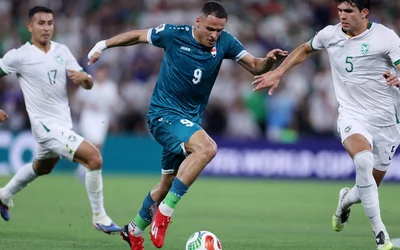
Talismanic striker Aymen Hussein's goal against Norway – celebrated in front of 60,000 fans and millions more watching worldwide – provided a rare moment of joy.
"It is hard to describe what it was like to see the flag, hear the songs and just be together," New York resident and Iraq fan Zainab Hassan told Middle East Eye.
"The team lost but it wasn't about winning, it was just about being there and feeling the excitement. I never thought I would see it."
Few within Iraqi football expected an easy ride, but the scale of the defeats has sharpened scrutiny. Emotions may have carried supporters through qualification, yet cooler analysis is now required.
Iraq's Olympic Committee has said it will launch a review with the Iraq Football Association (IFA), to look at what happened and what needs to be done.
'Competing at the highest level of international football requires experience, continuous development, and thorough preparation'
– Ahmed Oudah Zamil, Iraq Football Association
"We tried, but it was hard," Baghdad-based TV sports commentator Nawar Faeq al-Rikabi told MEE.
"We didn't do that well. We were supposed to play a little better and not lose that badly. We were losing 2-1 to Norway then made a mistake and couldn’t come back. Against France and their stars, we just don’t have the experience. Senegal was a disaster, we should have looked better than this. We have some good players, but didn’t look good."
For the federation, qualification itself marked a significant milestone after a 40-year absence.
"The primary objective of qualifying for the Fifa World Cup was achieved after a 40-year absence," Ahmed Oudah Zamil, the spokesperson for the IFA, told MEE.
"At the same time, the IFA recognises that returning to the Fifa World Cup after four decades presented a new challenge."
Facing Norway, France and Senegal – all established powers with deep talent pools – underlined Iraq's current standing. The task now is not simply to qualify again, but to become a force to be reckoned with.
"Competing at the highest level of international football requires experience, continuous development, and thorough preparation," Zamil said. "Therefore, the focus is now on ensuring the team is fully prepared to represent Iraq with pride and to use this historic qualification as the foundation for long-term success."
Building foundations
Attention quickly turns to what comes next. The eight-nation Gulf Cup in September and the 24-team Asian Cup in January, both to be held in Saudi Arabia, offer immediate opportunities for progress, and continuity on the bench is seen as important.
A first key question is whether Graham Arnold remains as head coach.
Appointed in March 2025, the Australian guided Iraq to qualification and has the backing of the federation.
"Technical stability is one of the key factors behind success, so renewing the coach's contract reflects the federation’s confidence in the current project and its commitment to maintaining continuity," Zamil said.
Arnold’s future is not yet certain, amid reported interest from the United Arab Emirates. For some observers, however, his influence has already been significant.
"The FA needs to keep Arnold, as he gave the team a personality," said Rikabi. "Even though we lost badly, if they keep him, he has the chance to create a new young team."
Beyond the immediate, there is a broader structural issue: developing Iraqi coaching.
"We have to improve in this field," Rikabi added. "The local coaches need to train, to go on courses and go and see European teams and how they operate at a youth level. In modern football, coaches at the under-17 level are the essence of everything."
More and better coaches will improve youth development in a country with a deep football culture.
"We are a nation of 46 million, so it's not possible we don't have good players, but we can’t see them," Rikabi said. "Iraqis have a huge passion for football, so if we give attention to players from the age of 12 to 16, then we have great talent; but if no one sees them, they will vanish."
Focus on the league
While Iraq has increasingly drawn on its diaspora, a growing trend in football that has been reinforced at this World Cup, the country's long-term progress will really depend on the domestic game.
The Iraq Stars League remains central, but requires structural reform and investment.
"We don’t have a lot of training pitches, which is a huge problem, and there is not enough forward planning," Rikabi said.
"There is too much thinking about this year's results. The fans' voices are strong and the clubs are afraid of them. We don't have the right structure for local leagues, we don’t have an under-17 league, we don't have organised under-20 teams."
'It was so fantastic to see Iraq on the world stage. We would love to do it again'
– Zainab Hassan, Iraq fan
Unlike neighbours such as Saudi Arabia and Qatar, Iraq lacks comparable financial resources. Still, the federation says it is committed to strengthening the league’s foundations.
"The federation is committed to strengthening the commercial and marketing value of the league, improving club governance and financial sustainability to increase overall competitiveness of the league to produce more players capable of competing at the international level," said Zamil.
"A stronger domestic league will ultimately strengthen the Iraqi national team. Improving stadiums and football infrastructure, raise the professional standards of clubs, invest in youth development and academy systems."
Whether Iraq's return proves to be a milestone or merely a fleeting achievement will only become clear over time. A place at the 2030 World Cup would suggest the lessons of this year's campaign have been learned – and that qualification after 40 years was the start of a longer journey.
For supporters, however, the return alone was unforgettable.
"It was so fantastic to see Iraq on the world stage," Hassan said. "We would love to do it again."
Middle East Eye delivers independent and unrivalled coverage and analysis of the Middle East, North Africa and beyond. To learn more about republishing this content and the associated fees, please fill out this form. More about MEE can be found here.