
World Cup 2026: How Fifa is publicly endorsing US imperialism


Last Friday, Egypt’s national football team made history. The Pharaohs narrowly dispatched Australia to become the second Arab nation to reach the 2026 World Cup round of 16.
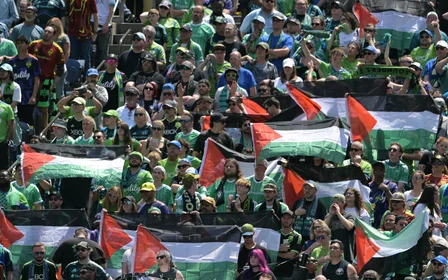
Draped in the Palestinian flag, Egyptian coach Hossam Hassan dedicated his squad’s victory to the people of Gaza, many of whom watched live amid the rubble.
Football, for the Uruguayan writer Eduardo Galeano, was a “mirror of everything”. The beautiful game, he argued, has always reflected the character of the world in which it is played - in both sun and shadow.
This year’s World Cup has been no different, legitimising the emergence of renewed imperial barbarism, while simultaneously reaffirming our common humanity with collective joy.
Just days before the Palestinian people celebrated Egyptian captain Mohamed Salah’s Panenka in Dallas Stadium, Israeli forces fatally shot Saleem al-Ashqar, a 32-year-old Palestinian goalkeeper who was searching for cooking fuel for his pregnant wife.
New MEE newsletter: Jerusalem Dispatch
Sign up to get the latest insights and analysis on Israel-Palestine, alongside Turkey Unpacked and other MEE newsletters
He was among 567 Palestinians in the football sector killed by Israel since October 2023.
The competition is the perfect metaphor for a world system that wreaks carnage, depletes resources, and denies sovereignty across the Global South
These crimes - for which Fifa has yet to sanction the Israel Football Association - have not deterred the Palestinian people.
On Tuesday, crowds gathered in Gaza City to watch Egypt take on Lionel Messi’s Argentina. With Israel’s genocide having damaged or destroyed 90 percent of the enclave’s structures, while decimating Gaza’s power grids, screenings of the game relied on small electrical generators.
Children waved flags atop the wreckage of flattened buildings, and fans cheered Yasser Ibrahim’s opening goal on the ground where their homes had once stood.
Colonial racism
Yet even this brief reprieve was too much for occupying Israeli forces to allow. An hour before kick-off, Mohamed al-Wahidi, the aid worker who organised Gaza City’s livestream, was killed in an Israeli strike on his way to watch the match.
Israeli Prime Minister Benjamin Netanyahu has chosen the weeks of the World Cup to escalate his war on Palestinian football - but Fifa is not prepared to let that distract from “the most successful event in history”.
The “beautiful” tournament heralded by Fifa President Gianni Infantino has seen top-tier referees detained and deported, players interrogated for hours on end, and the head of the Palestinian Football Association denied a visa entirely. All of this is allowed as a result of the impunity Fifa affords to Israel’s crimes against humanity.

By comprehensively failing to hold its member association to account, football’s governing body has licensed the resurgence of the colonial racism that has been meted out to fans, coaches and athletes alike by American authorities in recent weeks.
This is not sportswashing. It is a public endorsement of Washington’s imperial project, in full view of the watching world.
Infantino, who once insisted that “football should stay out of politics”, has carefully carved out Fifa’s place as a reliable accomplice to US President Donald Trump’s assault on international law.
Nothing is off limits when it comes to appeasing the 2026 tournament’s primary host, even on-field decisions. With little more than a phone call, Trump - to whom Infantino awarded the inaugural Fifa Peace Prize in December 2025 - reportedly convinced football authorities to overturn the suspension of US striker and leading goal scorer Folarin Balogun.
While many have focused on the sordid nature of this decision, doing so assumes that Fifa retains any commitment to the principle of sportsmanship. The Iranian national team, which was barred from setting up a base camp within US borders, knows otherwise.
And they are far from alone. On the eve of Haiti’s opening fixture, Fifa demanded that the team amend its designated kit to remove a reference to the revolution that created the world’s first Black republic, proclaiming that “political messages” are prohibited.
Mexico, which will not host a single World Cup match after the Round of 16, is similarly familiar with the tournament’s shamelessness - not to mention the millions of fans left unable to attend due to “dynamic pricing”.
Collective identity
Fifa, like the World Cup’s main host country, has dispensed with the illusion of fair play, and even provoked the condemnation of its infamous ex-president, Sepp Blatter. Galeano was right: imperialism’s shadow hangs over the tournament.
The competition is the perfect metaphor for a world system that wreaks carnage, depletes resources, and denies sovereignty across the Global South to fuel development in the North. In return for transforming the World Cup into a show of Trumpian theatre, Fifa expects to extract record revenues of $13bn.
In moments, however, the sun has shone too. Simplistic portraits of national identity contingent on creed or colour have crumbled on the pitch. More than half of the US squad members, for example, hold dual citizenship; six were born outside the US, while others come from immigrant families.
Football, the 'mirror of everything', has reflected the ever-growing gulf between those who love the beautiful game - and those who run it
National football teams, argued British historian Eric Hobsbawm, represent countries in the public consciousness: “The imagined community of millions seems more real as a team of eleven named people,” he wrote. That’s why the presence of multicultural teams has dealt a blow against the ethnonationalism of Trump and his ideological allies.
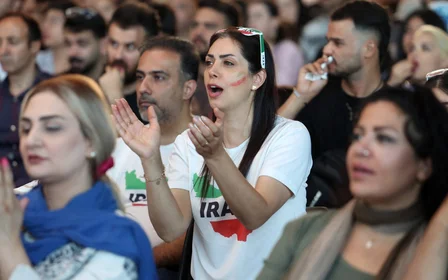
Having declared an illegal and unprovoked war on Iran in February, the US president had hoped the Iranian team would not turn up at all. The squad was instead welcomed with open arms to locate its base camp in Mexico, itself the target of repeated threats of American invasion.
Locals in the city of Tijuana organised watch parties for Iran’s fixtures, and earned the grateful thanks of the team: “Your act will stay in our hearts,” the squad wrote on social media after their controversial group stage exit.
Away from the headlines, football fans’ solidarity has reaffirmed what the world has long known to be true. While Fifa’s corporate leadership might be content to transform the game into one long TV commercial, the sport itself can remain a rare antidote to alienation and contempt.
In the age of the individual, football remains what Galeano identified as a “primordial symbol of collective identity”. It is a symbol far more powerful than the venality of Infantino; a symbol that still brings the people of Gaza together for 90 minutes in defiance of their attempted erasure.
Football, the “mirror of everything”, has reflected the world’s contradictions once more, reiterating the ever-growing gulf between those who love the beautiful game - and those who run it.
The views expressed in this article belong to the author and do not necessarily reflect the editorial policy of Middle East Eye.
Middle East Eye delivers independent and unrivalled coverage and analysis of the Middle East, North Africa and beyond. To learn more about republishing this content and the associated fees, please fill out this form. More about MEE can be found here.