

Why Turkey's new opposition party is both good and bad news for Erdogan

Turkish opposition leader Ozgur Ozel announced on Tuesday that he will launch a new political party after a court removed him as chairman of the Republican People's Party (CHP) in May, deepening a split within the country's main opposition.
The announcement follows months of prosecutions targeting the CHP through a series of investigations that have led to the arrest of 26 opposition mayors on corruption charges, including Istanbul's popular mayor, Ekrem Imamoglu.
A separate case alleged that Ozel was elected party chairman through bribery and irregular lobbying. The court subsequently annulled the party congress that brought him to power and reinstated former chairman Kemal Kilicdaroglu as interim leader pending an appeal.
Despite repeated calls from party figures, Kilicdaroglu has refused to convene an extraordinary congress. Instead, he has focused on removing senior officials aligned with Ozel and Imamoglu.
The investigations began after the CHP swept Turkey's major cities in the 2024 local elections and emerged as the country's largest party by vote share. The judicial campaign has since weakened the opposition and deepened internal divisions.
New MEE newsletter: Jerusalem Dispatch
Sign up to get the latest insights and analysis on Israel-Palestine, alongside Turkey Unpacked and other MEE newsletters
Many political insiders in Ankara believe Kilicdaroglu's return was quietly backed by the government as part of an effort to fracture the opposition.
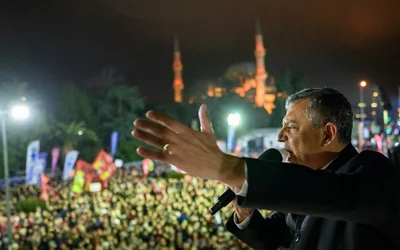
The prosecutions have already prompted several CHP mayors to defect to the ruling Justice and Development Party (AKP).
Last month, one of Kilicdaroglu's advisers, Bulent Kusoglu, said in an interview that "state interest", or raison d'etat, was driving the construction of a new political order that would outlast the rule of 72-year-old President Recep Tayyip Erdogan.
He suggested the upheaval within the CHP formed part of that broader process.
Reports indicate that 94 of the CHP's 135 MPs and 74 of its 81 provincial chairs are expected to join Ozel's new movement, effectively hollowing out Turkey's main opposition party.
Some lawmakers and officials loyal to Ozel are nevertheless expected to remain within the CHP to prevent Kilicdaroglu from consolidating complete control.
According to Ozel's aides, the new party will be called Yeni Parti ("New Party") and is expected to be formally launched on Monday.
A divided opposition
For Erdogan, the emergence of a new opposition party presents both opportunities and risks.
In the short term, it could strengthen his prospects ahead of the 2028 presidential election.
The opposition has already lost momentum following months of legal pressure on the CHP, and the split leaves Turkey's largest opposition force divided into rival camps.
Government strategists are expected to benefit if the opposition fields multiple presidential candidates, potentially allowing Erdogan to secure victory in the first round.
'Instead of being a machine that plans everything from the central office, the party can become a platform that opens up space for social initiatives'
- Kemal Buyukyuksel, analyst, George Mason University
Meanwhile, Erdogan's peace process with the Kurdistan Workers' Party (PKK), launched in 2024, has already drawn the pro-Kurdish Dem Party away from the broader opposition alliance, giving the government greater political space as it pursues corruption cases against Imamoglu.
Polling suggests only between five and 10 percent of CHP voters would remain with the party under Kilicdaroglu.
Several surveys indicate Ozel's new party could attract more than 30 percent of the vote, surpassing the AKP. The CHP won 37 percent in the 2024 local elections.
One pollster who works with the ruling AKP told Middle East Eye they expected the new party to lose momentum once the initial excitement faded.
The pollster also argued that the opposition split could prove particularly costly in parliamentary elections, where narrowly contested constituencies could swing to the ruling coalition.
Sources familiar with the AKP's internal thinking say the party's preferred presidential opponent would be Ozel himself. Despite his growing popularity, they believe he would struggle against Erdogan in a nationwide contest.
Kilicdaroglu is also expected to field his own candidate, further fragmenting the opposition vote and making the race easier for Erdogan.
One unknown in this equation is Mansur Yavas, the popular mayor of Ankara.
According to the same pollster, surveys conducted by several firms consistently show Yavas leading Erdogan by between 15 and 20 percentage points, making him the opposition's strongest potential presidential candidate.
For now, reports suggest Yavas intends to remain within the CHP. However, figures close to Ozel's camp privately fear he could face corruption investigations should he emerge as the opposition's presidential frontrunner.
A second pollster, who conducts regular surveys for private clients, told MEE that Erdogan's approval rating currently fluctuates between 35 and 40 percent, but said the president could still push his support closer to 50 percent through a successful populist campaign.
Can a new party succeed?
The creation of a new party, however, also carries risks for Erdogan.
For years, the president successfully campaigned against the CHP by tying it to issues that resonated with conservative voters, from the university headscarf ban to the conversion of Hagia Sophia into a museum
He portrayed the CHP as an elitist, statist and bureaucratic movement disconnected from ordinary voters and incapable of governing effectively. That message proved highly effective among conservative and Islamist constituencies.
Ozel's new party would not carry the same historical baggage.
If he succeeds in building a broad centre-left movement that appeals across Turkey's political spectrum while offering a credible programme for restoring the country's institutions and economy, it could emerge as a serious long-term challenger.
A poll conducted by the IstanPol think tank and Rawest Research between 3 and 10 July, surveying 1,985 people across 20 cities, found that 55.9 percent of respondents believed the new party could succeed.
Support was particularly high among opposition voters, with 81 percent of CHP supporters expressing confidence in the project, alongside 72 percent of Dem Party voters and 61 percent of supporters of the nationalist opposition IYI Party.
Notably, the survey also found that 67 percent of voters from the Nationalist Movement Party (MHP), the AKP's coalition partner, and 45 percent of AKP voters believed the new party could be fully or partially successful.
Kemal Buyukyuksel, a PhD student at George Mason University, argues that the movement should avoid repeating what he sees as the CHP's longstanding organisational weaknesses, including an overreliance on tightly controlled local branches that struggle to engage with broader society.
"The new party can be conceived not as a classic organisation participating in elections, but as a broad political space possessing some characteristics of civil society and social movements," he wrote for the independent website Progresif.
"It can be a structure that doesn't merely call on people to support a ready-made programme, but allows them to act around their own problems, take initiative, and develop new activities.
"Instead of being a machine that plans everything from the central office, the party can become a platform that opens up space for social initiatives emerging in different places, connects them, and gives them a common political direction."
Middle East Eye delivers independent and unrivalled coverage and analysis of the Middle East, North Africa and beyond. To learn more about republishing this content and the associated fees, please fill out this form. More about MEE can be found here.