US-Saudi strikes test Iraq's balancing act between Riyadh and Tehran

The unprecedented joint US-Saudi strikes on Iran-linked militias in Iraq last week have done more than raise the prospect of retaliation.
They have exposed the fragile foundations of Baghdad's effort to balance closer ties with Riyadh and Washington while containing powerful armed groups aligned with Tehran, potentially forcing Iraq to make difficult choices that it has long sought to avoid.
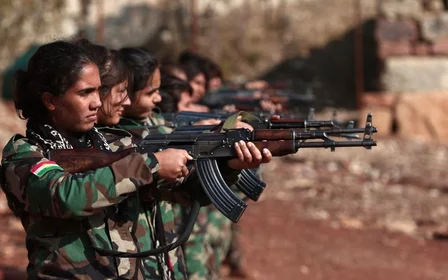
On 29 July, US and Saudi forces launched joint strikes on bases belonging to Iraq's Popular Mobilisation Forces (PMF), killing at least 20 members of the paramilitary and four advisers from Iran's Islamic Revolutionary Guard Corps, according to Iraqi and Iranian media.
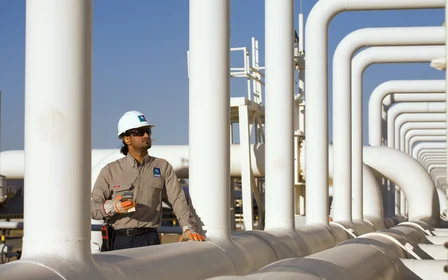
The strikes, which marked the first time Riyadh has publicly joined strikes alongside the US, were in retaliation for drone attacks on Saudi oil facilities launched from Iraqi territory.
However, neither Riyadh nor Iraq's Iran-linked militias currently appear to want a sustained military confrontation. Saudi Arabia's foreign ministry described the joint attacks as an act of "self-defence" while signalling that the kingdom would carry out further strikes if attacks on its soil resumed.
New MEE newsletter: Jerusalem Dispatch
Sign up to get the latest insights and analysis on Israel-Palestine, alongside Turkey Unpacked and other MEE newsletters
These strikes also come at a sensitive moment for Iraq as it moves to bring weapons held by non-state armed groups under state control and deepen political and economic ties with the US and Saudi Arabia, placing renewed pressure on Baghdad to balance internal security with regional relations.
Saudi deterrence
Riyadh’s statement suggests it is seeking to avoid opening a new front with Iran-linked militias in Iraq while continuing to face Houthi threats from Yemen targeting its oil facilities and maritime trade.
The strikes therefore appear aimed primarily at restoring deterrence against Tehran and its Iraqi allies, rather than opening a new front.
“The strikes were targeted at specific militia sites linked directly to drone attacks on Saudi oil facilities, to deter these groups,” Dr Hesham Alghannam, a Carnegie Middle East scholar based in Riyadh, told Middle East Eye.
“But killing Iranian military advisers alongside militia fighters was not accidental. This was a message to Tehran that Saudi Arabia holds Iran responsible for what its personnel direct from Iraqi soil, regardless of which formation pulls the trigger.”
Similarly, while the Islamic Resistance in Iraq (IRI), an umbrella group of Iran-backed militias that includes the PMF, has vowed retaliation for the strikes, its rhetoric towards Riyadh has been more measured than its stance towards Washington.
In a statement released on its Telegram channel on 29 July, the IRI said its “response to the American enemy is inevitable” while adding that it may target Saudi Arabia “if circumstances require”.
Sending a message
The IRI has given Baghdad until 7 August to respond to the US-Saudi strikes, but the deadline and threats of further escalation may also be aimed at influencing the government’s domestic policy.
Some IRI-linked groups, including Harakat Hezbollah al-Nujaba and Saraya Awliya al-Dam, have called on Baghdad to sever ties with Saudi Arabia, suggesting that the pressure is also intended at shaping Iraq’s broader political response rather than signal an imminent escalation.
'Killing Iranian military advisers alongside militia fighters was not accidental. This was a message to Tehran that Saudi Arabia holds Iran responsible'
- Hesham Alghannam, Carnegie Middle East scholar
“These factions typically don’t set deadlines for retaliation or attacks, rather they launch surprise attacks,” Mustafa Alsaray, director of research at Al-Bayan Centre for Research and Planning, told MEE.
“When they set such deadlines, they intend to send a message and achieve something, perhaps politically or in terms of security,” he added.
Still, the groups may also be holding off until they can coordinate their response with Tehran.
“Another possibility is that the groups are waiting for developments in the Iran-US conflict before coordinating their response with the wider Axis of Resistance,” Alsaray said.
The Iran-US war has shown signs of de-escalation in recent days, with US President Donald Trump saying that direct negotiations with Tehran are under way. He also warned that the latest round is Iran's “last chance” to secure a deal.
However, a renewed confrontation could prompt these groups to launch further attacks on Saudi Arabia, and potentially Jordan or other Gulf states.
Complicating reform efforts
The recent developments are likely to test whether Baghdad can advance its long-stalled security reforms and preserve growing economic and political ties with Riyadh.
The US-Saudi attacks come as Baghdad seeks to further integrate the PMF, which is formally part of Iraq’s security apparatus but includes factions that retain significant autonomy.
The government is also pursuing its disarmament plan, setting a 30 September deadline for armed groups to comply. However, the recent strikes on PMF bases, and Baghdad’s perceived inability or unwillingness to prevent them, have hardened some factions’ refusal to disarm.
Abu Hussein al-Hamidawi, secretary general of Kataeb Hezbollah, said that the US-Saudi attacks on Iraq have “reinforced the group’s commitment to retaining and developing its weapons”.
Likely in a bid to maintain public support, the IRI has also explicitly linked the strikes to Baghdad's disarmament push, challenging the government, which has "called for the Resistance's disarmament" to prove it can defend Iraq.
As resistance to disarmament grows, the economic costs of Iraq’s stalled security reforms are becoming increasingly apparent.
During an official visit to Washington in mid-July, Iraqi Prime Minister Ali al-Zaidi signed 48 partnerships and agreements with US firms. However, US officials have indicated that deeper economic ties will depend on Baghdad’s ability to constrain or disarm militias involved in recent attacks on US military and diplomatic facilities.
The Islamic Resistance in Iraq claimed responsibility for dozens of such attacks during the US-Israel war on Iran.
Saudi Arabia could adopt a similar approach to investment in Iraq. Prime Minister Zaidi has said Baghdad is seeking an “economic partnership with Saudi Arabia”, but a failure to constrain these groups could undermine prospects for Saudi investment.
“September 30 is the real test. If the disarmament process fails - on the same day US forces are set to withdraw from Iraq - Riyadh and even Abu Dhabi will quietly conclude that Baghdad cannot deliver, and their willingness to invest in Iraq will be reconsidered accordingly,” Alghannam said.
Middle East Eye delivers independent and unrivalled coverage and analysis of the Middle East, North Africa and beyond. To learn more about republishing this content and the associated fees, please fill out this form. More about MEE can be found here.