What's driving the rising unrest in Pakistan-administered Kashmir?

For decades, global attention on Kashmir has focused overwhelmingly on the Indian-administered side of the Line of Control (LoC), the heavily militarised de facto border that divides the disputed Himalayan region between India and Pakistan.
International headlines have largely revolved around repression, insurgency, military deployments, and diplomatic confrontation.
Far less attention has been paid to the political currents unfolding across the LoC in Pakistan-administered Kashmir, officially known as Azad Jammu and Kashmir (AJK).
Long portrayed by Islamabad as a model of self-governance in contrast to Indian-administered Kashmir, the territory is now witnessing some of the most significant popular unrest in recent decades.
What started as frustration over soaring electricity bills and flour prices has rapidly transformed into a systemic challenge to Islamabad’s authority in the region. Rather than rehashing the old geopolitical tug-of-war with India, this new wave of unrest reflects deep-seated frustration with local governance.
New MEE newsletter: Jerusalem Dispatch
Sign up to get the latest insights and analysis on Israel-Palestine, alongside Turkey Unpacked and other MEE newsletters
Protesters are demanding genuine political participation, arguing that while Kashmir’s international fate hangs in limbo, their basic political and economic rights cannot remain frozen. In a region long treated as a geopolitical pawn, domestic disillusionment is now taking centre stage.
From economic grievances to political awakening
The protests have been led by the Joint Awami Action Committee (JAAC), a loose coalition of traders, lawyers, students, civil society activists, and local political figures that emerged in 2023 outside the traditional party structure.
Rejecting established Pakistani political parties as ineffective or overly dependent on Islamabad, the JAAC focused directly on basic issues: high electricity bills, rising flour prices, heavy taxation, and poor public services.
'What we need to know is who will provide us with jobs and a fair life today'
- Mujtaba Naqvi, JAAC supporter
This message quickly united a region facing serious economic hardship.
Youth unemployment in the area sits at roughly 27 percent, nearly triple Pakistan’s national average, while fewer than eight percent of women are in the formal workforce, Danish Khan, co-director of ‘The Inequality, Poverty, Power and Social Justice Initiative’ at Franklin & Marshall College, recently wrote in a piece for The Friday Times.
As he noted, the region was generating a growing “reserve army of young unemployed people”.
Development in the mountainous region continues to lag behind the rest of the country. Substandard roads severely restrict access to essential public services like healthcare and education, a situation that becomes especially dire during its harsh winters.
Meanwhile, many communities still bear the visible scars and lingering devastation of the 2005 earthquake that killed tens of thousands of people.
What began as a fight for affordable living soon sparked massive demonstrations across major towns, shutting down markets and forcing officials to negotiate. By 2024 and 2025, the government yielded to key demands: lowering electricity rates and subsidising wheat compared to the rest of the country.
But many activists view these concessions as temporary quick fixes.
“The price reductions addressed immediate grievances,” says political economy researcher Faisal Mir, “but they did not address the deeper structures of economic exclusion.”
The campaign against inflation has now mushroomed into a broader critique of governance, linking daily hardship directly to political arrangements that concentrate power away from the region.
A younger generation, weary of traditional rhetoric about competing nationalisms, is now demanding accountability, transparency, and genuine representation. Rather than debating Kashmir’s future status, they are asking who governs them today and whose interests those leaders truly serve.
“No one knows when the Kashmir dispute will finally be resolved,” Mujtaba Naqvi, a JAAC supporter in the regional capital of Muzaffarabad, told Middle East Eye. “What we need to know is who will provide us with jobs and a fair life today.”
Battle over refugee representation
These questions have led directly to one of the most contentious features of Pakistan-administered Kashmir’s constitutional framework: the legislative seats reserved for Kashmiri refugees living outside the territory.

On paper, AJK, with a population of around five million, functions under a semi-autonomous structure complete with its own president, prime minister, parliament, and supreme court. Candidates must swear allegiance to Pakistan to run for office.
The core of the current disputes lies in how the assembly is structured.
Out of 53 total seats, 33 are elected by residents living inside the territory. The remaining 12 are reserved for Kashmiris who migrated to Pakistan from Indian-administered Kashmir during and after the 1947 and 1965 wars. Although these voters reside across Pakistan’s four provinces rather than in AJK, they continue to elect representatives to the regional assembly.
Supporters maintain that these 12 seats safeguard the political rights of displaced families and uphold Islamabad’s diplomatic argument that the entire former princely state remains disputed internationally.
Stripping refugee representation, they contend, would weaken Pakistan's position in a high-stakes standoff with India - a conflict that has triggered multiple wars since British India's partition in 1947, as well as a brief four-day military confrontation last year.
The region’s supreme court in early June ruled that the 12 refugee seats are constitutionally protected.
However, the JAAC and other local critics view the arrangement as a backdoor for federal meddling. Federal parties frequently use these 12 constituencies to swing majorities in Muzaffarabad. This setup has fuelled acute political turbulence, leaving AJK with four different prime ministers in the current regional assembly in rapid succession.
“These 12 seats continuously dictate government formation,” political activist Raja Nafees, who supports JAAC's demands, told MEE. “Voters who don't even live here end up deciding who rules us.”
A crisis of legitimacy
For decades, mainstream political parties in AJK, acting largely as extensions of Islamabad, dominated regional politics unchallenged. Today, that status quo has shattered.
Unsettled by widespread unrest and informal boycott calls led by the JAAC over the 12 reserved refugee seats, authorities staggered the regional elections across three phases between 27 July and 10 August.
The strategy backfired: voter turnout plummeted during the first two phases, leading analysts to declare the election null and void, and warning that the resulting assembly will lack a credible mandate.
Political infighting has further eroded trust, with the Pakistan People’s Party, led by President Asif Ali Zardari, accusing the ruling Pakistan Muslim League-Nawaz (PML-N) and Prime Minister Shehbaz Sharif of rigging the polls.
At the same time, the nationalist slogan “Kashmir Banega Khudmukhtar” (Kashmir will be sovereign), promoted by groups like the Jammu Kashmir Liberation Front (JKLF), has gained unprecedented public traction in the protests. This reflects an emerging political vocabulary that moves beyond the traditional choice between India and Pakistan.
Negotiation, crackdown and uncertainty
Since protests flared up in 2024, authorities in Islamabad and Muzaffarabad have tackled the uprising using a volatile mix of concessions and coercion.
While early negotiations yielded subsidies on electricity and flour, the government adopted a harsher stance as demonstrations expanded into demands for structural political reform.
When the JAAC announced a protest march from Rawalakot to Muzaffarabad on 9 June, Pakistani authorities accused the group of disrupting public order. On 5 June, the movement was banned under anti-terrorism laws, and key leaders, including JAAC leader Shaukat Mir, were arrested.
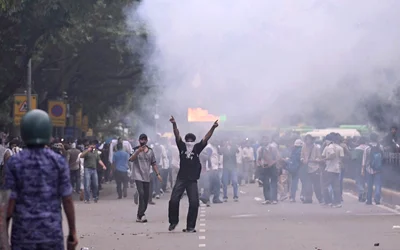
After negotiations failed again on 26 July, the JAAC called for a renewed march. However, the group accused state forces of using lethal violence to stop protesters.
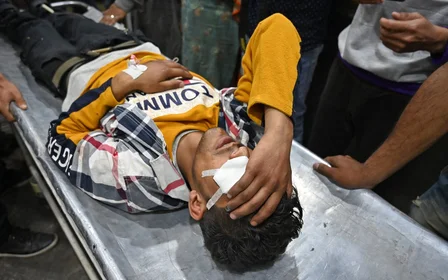
Independent estimates indicate over 45 people, primarily protesters, alongside law enforcement personnel and bystanders, have been killed in clashes since 5 June.
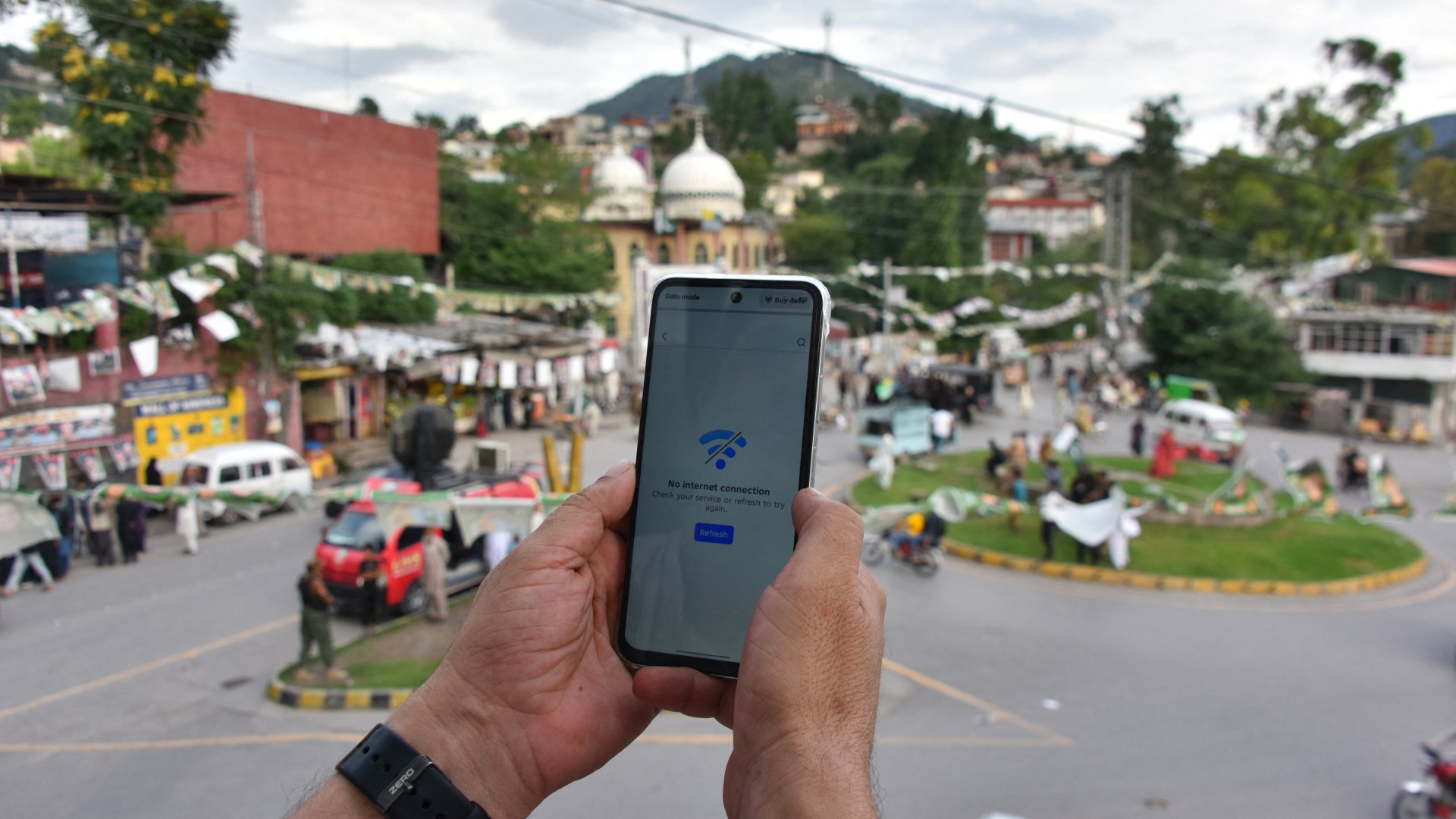
Official details remain scarce as widespread internet blackouts and strict curfews severely hinder independent verification.

Government officials maintain that constitutional disputes should be handled through legal avenues rather than through street protest.
In a press briefing on 31 July, military spokesperson Lieutenant General Ahmed Sharif Chaudhry stated that the region has historically received state attention, care, and resource allocation.
He said that authorities had “wholeheartedly” urged the JAAC to contest elections and pursue reform through courts and parliament.
“But they want to pursue this by force, but only the state has the monopoly of violence," he added.
Other government ministers went further, dismissing the JAAC as an “armed mob” and levelling unfounded accusations that the group had ties to India and Taliban militants.
JAAC leadership firmly denies these claims, maintaining that their campaign remains peaceful and rooted in basic democratic rights.
Amid the standoff, locals are bearing the brunt of the consequences. Continuous internet network blackouts have crippled daily commerce and tourism. In Rawalakot, the movement’s stronghold, where leaders called for a mass march, heavy curfews and road blockades brought the peak summer season to a halt.
Local traders face mounting financial ruin, while residents endure severe communication outages and disrupted basic services, leaving the region locked in deep uncertainty.
Fallout from Article 370 in India
The constitutional debate in AJK has also unfolded against the backdrop of India's August 2019 revocation of Article 370.
By ending the limited autonomy and erstwhile "special status" of Indian-administered Kashmir and placing it under direct federal control, New Delhi fundamentally transformed the political landscape across both sides of the LoC.
The move sparked widespread criticism from Pakistan and ignited major local demonstrations. When protesters, organised by groups like the JKLF, attempted to march toward the LoC in solidarity, Pakistani authorities forcibly stopped them. Analysts note that key organisers of those marches now help lead the JAAC.
Perceiving Islamabad’s diplomatic response as inadequate, many AJK residents began questioning Pakistan’s commitment to preserving their distinct identity.
Crucially, the region’s unresolved status complicates major infrastructure investments, particularly under the China-Pakistan Economic Corridor. This has fuelled widespread speculation that Islamabad might eventually redefine AJK's legal status, potentially merging it with neighbouring Pakistani districts or converting it into a province.
Although the government has never voiced those ambitions, this pervasive anxiety has reshaped public discourse, deepening institutional distrust and strongly reinforcing local demands for greater regional autonomy.
Middle East Eye delivers independent and unrivalled coverage and analysis of the Middle East, North Africa and beyond. To learn more about republishing this content and the associated fees, please fill out this form. More about MEE can be found here.