
Christopher Nolan remakes the Odyssey as an Anglo-American imperial fantasy


By sheer serendipity, I watched Christopher Nolan's new film, The Odyssey, far from the madding crowd of Hollywood hype, in a small Greek town called Markopoulo Mesogaias.
A historic little municipality in the East Attica region of Greece, it is a 15-minute ride from the temple ruins of the fifth-century BCE Sanctuary of Artemis at Vravrona (ancient Brauron), dedicated to the goddess of wild nature and childbirth.
Artemis is also the name of the cinema where we sat to see Sir Christopher Nolan's new film, located right behind the splendid Saint John Orthodox Church of Markopoulo, built in 1904. You can't get more Greek than this!
We sat there with about two dozen local Greeks in a splendid theatre, nowhere near the Imax hyperbole marketed through millions of dollars in advertising, trying to turn the film into a historic spectacle.
Entirely unfazed by the grand hoopla, this little cinema in this little Greek town actually gave an old-fashioned "intermission" in the middle of the film, for bathroom breaks and popcorn.
New MEE newsletter: Jerusalem Dispatch
Sign up to get the latest insights and analysis on Israel-Palestine, alongside Turkey Unpacked and other MEE newsletters
There and then, Nolan's obsession with size and magnitude was cut down to human scale: the spectacle was made to behave, brought down from its mightier-than-the-Trojan-Horse heights and forced to smell truth and reality. Nolan's juvenile obsession with the size of his Imax camera is a Trojan Horse. We should not take it to heart.
Upon my return to New York, just to make sure, I saw the film at the largest Imax cinema in the city, as I had with all his previous spectacles. I infinitely prefer what I saw in that little Greek town - it was real.
Whose Homer?
Do Homer and his two classical masterpieces, the Iliad and the Odyssey, belong to the people with whom I sat in a dingy theatre in Markopoulo and watched Nolan's Odysseus? Or do they belong to a manufactured classical antiquity, code-named "the West", which a whole generation of European racist scholars, like the Austrian Jakob Philipp Fallmerayer (1790-1861), invented for themselves?
Through that deliberate ideological project, contemporary Greeks were systematically alienated from their own linguistic, literary and philosophical heritage.
All of this was done by way of rewriting the fact of Greece as the fictional foundation of "western civilisation", while actively erasing its geographical, historical and cultural ties to its own natural habitat in Asia Minor - in Anatolia, where Greece, Turkey, the Levant, Egypt and North Africa form a far more rooted historical truth.
This treacherous ideological manoeuvre - the same one at the root of the racist thuggery of white supremacists - has robbed Greece of its legacy, taken it literally stone by stone to the British Museum or the Louvre, to serve modern colonial and Eurocentric agendas, fabricating a thing that never existed.
Nolan's film is entirely in the domain of this massive project of cultural appropriation - Europeans finding themselves a classical antiquity for their manufactured cultural authenticity
The infamous Fallmerayer thesis claimed modern Greeks were not related to the ancient Hellenes, arguing that the population had been completely replaced by Slavic and Albanian migrations - as if any such migrations to any land were wrong, or exclusive to Greece.
They liked the ancient Greeks and their arts and philosophy, and colonised them for themselves - textually and archaeologically stole and museumised them.
A significant project of decolonising Greek cultural history - reclaiming it for the Greeks themselves - has long been at work. Nolan's take on Homer's Odyssey pulls in the opposite direction: it is integral to the prolonged cultural appropriation project of which Hollywood has been a mighty Trojan Horse.
The fact is that Homer was not British, American or German. He lived in the eighth century BCE in the region of Ionia, on the western coast of Asia Minor, in modern-day Turkey.
However you slice it, he would be far more at home in the lovely little theatre in the small Greek town where I saw Nolan's Odysseus than he would be anywhere in western Europe or North America.
Nolan's film, judging by the plethora of praise it has garnered, is entirely in the domain of this massive project of cultural appropriation - Europeans finding themselves a classical antiquity for their manufactured cultural authenticity.
Is it accidental, then, that Nolan's Odyssey features only one confirmed actor of Greek descent in its massive ensemble cast - Michael Vlamis, who is of Greek, Serbian and Lebanese ancestry, and who appears in a brief supporting role? The rest are mostly Hollywood boys and girls of the Matt Damon and Anne Hathaway type.
The limitations of these actors, Damon's in particular, could not possibly be unknown to a gifted and perfectionist filmmaker such as Nolan. So why would he give his Odyssey such a palpably Anglo-American look and feel? Unless this is precisely his purpose: to produce a decidedly Anglo-American Odyssey for our own time.
The film's diverse supporting cast has meanwhile drawn fire from the opposite direction: Elon Musk generated much nonsense when objecting to Lupita Nyong'o being cast as Helen.
But such choices are entirely within the purview of studio executives seeking to cover all demographic bases for their own financial reasons - whereby we see the British-Indian actor Himesh Patel cast as Eurylochus, John Leguizamo as Eumaeus, Lupita Nyong'o as both Helen of Troy and Clytemnestra, and the transgender actor Elliot Page as Sinon.
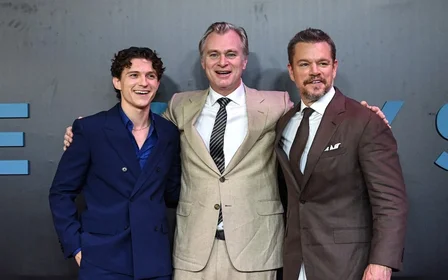
These are not "politically correct" decisions. These are financially opportune choices to touch base with various demographic audiences - which is why Nolan and his stars Damon and Tom Holland went to Mumbai on 10 July 2026 to promote their film in a vastly populated market where Himesh Patel is a known commodity.
Imperial cinema
It is hardly a secret that I am not a fan of Nolan's cinema. The louder the propaganda his studios and the launch for each of his new films, the more suspicious I become.
Despite the enormous positive and occasionally negative spin around his version of the Odyssey, I kept my peace until I actually saw the film.
The propaganda machinery spinning the film intentionally amplified Musk's racist reaction to increase its appeal to precisely the demographic landscape the production studios had originally targeted.
If I were to fall for all the hype that Hollywood studios generate around every new film, what would be the use of all those years I spent teaching Adorno and Horkheimer's groundbreaking idea of mass media as mass deception?
Forget about The Odyssey or Oppenheimer for a moment, and ask yourself about Nolan's fixation with time and memory in his other films - Memento (2000), Inception (2010), Tenet (2020) - where his fans think he is crafting "cinematic time machines" through mind-bending narratives to show how time and memory define identity.
Why would he do that, and to what effect? What an astounding hubris, to take the very elemental force of time to task!
The French phenomenologist Paul Ricoeur conducted a rigorous philosophical inquiry into the matter in his pioneering three-volume Time and Narrative (1983-1985). For any serious curiosity, we can just go there.
In Nolan's hands, time and memory have a whole different purpose and texture. His take is the most astoundingly arrogant wish to colonise time and subjugate the mimetic registers of our working memories.
Time, memory and being - the very stuff of which our fragile and vulnerable lives are made - he wishes to command and control, manipulate, massage and reorder in the living memory of a protagonist with whom no ordinary human being could possibly identify.
Remember the Project for the New American Century (PNAC), the neocon chicanery that wanted to designate an entire century as "American" (by which they meant Israeli) - namely, to lay claim to the very measure of time and memory?
Nolan's cinema, like Samuel Huntington's "Clash of Civilisations" thesis, Francis Fukuyama's "End of History" idea and Benjamin Netanyahu's "Greater Israel" insanity, is part of the same demented and diseased way of imperial thinking.
Nolan's cinema of time and memory is the ideological foregrounding and after-effect of PNAC. They both fume and fumble, but ultimately fail.
To confess the obvious: my thinking on cinema is the product of the masters of world cinema - the exact opposite of the Hollywood blockbusters towards which I have an allergic aversion, despite the fact (or perhaps precisely because) I have in the past been a consultant to renowned Hollywood directors, and have some sense of how they work.
By concentrating on Odysseus's PTSD, the film is in fact pro-war, not anti-war. It humanises the warmongers while dehumanising their victims
I am most at home with the cinema of the masters of the art: Yasujiro Ozu, Satyajit Ray, Abbas Kiarostami, Nuri Bilge Ceylan, Elia Suleiman and Ousmane Sembene, among scores of other visionaries.
The cinemas of Quentin Tarantino and Christopher Nolan I particularly dislike, for in every frame, every shot and every sequence of their films - in every superstar character they make, in the very tenor of their filmmaking - they carry the arrogance and conceit of their respective imperialisms up their sleeves.
Nolan basks in and flaunts the power and wealth of pulling off a film of this magnitude. Every time I see this much power and arrogance, I run for cover.
I was born and raised on the Soviet formalism of Sergei Eisenstein, and on the Italian neorealism of Roberto Rossellini, Vittorio De Sica, Luchino Visconti and others.
Give me a single glorious shot of La Strada (1954) or Bicycle Thieves (1948) in exchange for the entirety of these arrogant, in-your-face, over-manly shots of Nolan and Tarantino. Give me a single shot of the Apu Trilogy (1955-1959), and I live happily without ever glancing at so much unbridled pomposity. Give me a single shot of Tokyo Story (1953) or Ran (1985), and I will forgo the entirety of Nolan's affected imperial filmmaking.
The Imax spectacle
They say Nolan's Odyssey is anti-war. I don't think so - and even if it were, it would be anti-war from the perspective of a nuclear-powered white-saviour fantasy. People around the globe do not like such fantasies, and find them entirely offensive.
Nolan's Odysseus has PTSD: having first come up with the idea, then built the Trojan Horse, then caused the slaughter of his enemies, he has nightmares recalling what he has done - which is exactly how his Oppenheimer worked.
First you cause and stage the mayhem and murder of fragile humanity at your mercy; then you go and make a film about the traumas of the mass murders you have inflicted upon the world.
Israel is a master of this kind of cinema, with films such as Lebanon (2009), Waltz with Bashir (2008), and Beaufort (2007). The world must first endure Israel's criminal atrocities, and then have sympathy for the perpetrators when they have nightmares remembering what they have done to human beings.
By concentrating on Odysseus's PTSD, the film is in fact pro-war, not anti-war. It humanises the warmongers while dehumanising their victims. It focuses on the hero's psychological trauma, not on the transmutation of his murderous arrogance into hubris.
To be sure, Nolan is entitled to his version of the Odyssey, as is any other reader of Homer's epic. The excellent scholar and Odyssey translator Emily Wilson is barking up the wrong tree: a film must be judged as a film, not by the English translation of a Greek original.

The problem is the overbearing bravura propaganda seeking to make Nolan's film into a unique cinematic event - which it certainly is not.
Why would I, or any other sane human being, leave the glorious masterpiece of the late Greek master Theo Angelopoulos - Ulysses' Gaze (1995), a bold and brilliant take on Homer's epic - to come and be beholden to this gargantuan, one-eyed Polyphemus of an Imax camera developed for Nolan's production, and try to see the world from that frightful perspective?
Audiences enter Imax theatres like Odysseus's comrades: once trapped there in darkness, they cannot wait to escape from a cave where they are transformed into food for Nolan's insatiable ego, acting like a man-eating Cyclops with his one-eyed camera.
To watch this, as with all of Nolan's films, is to enter the opulent palace of a rich and arrogant British lord showing off his wealth and power. I don't like it - and I don't wish to be there.
Imagine the power and wealth at your disposal: that you can have a new Imax camera developed for your production, to make a film that is supposed to defy the logic and rhetoric of the digital age and CGI, and feign reality!
And then to do what, exactly, with that technology and that manufactured reality? Lionise Odysseus as a prototype of European imperialism, through one of the most racist, pro-war and reactionary readings of Homer's Odyssey?
All of that for what? So that every single human being entering that theatre, sitting in front of that gigantic screen while the creatures that come out of it speak colloquial American English like gods and immortals, should feel - frail, fragile and mortal as we are - smaller than a dispensable sailor at the mercy of the Cyclops?
I have read countless reviews by professional film critics, one more awash and mesmerised than the other, beholden to this deeply anti-human spectacle deliberately designed so that everyone sitting in front of that gigantic screen would feel smaller than dust. This is obscene.
No doubt we should feel like dust, as master poets like Omar Khayyam taught us, in the face of the fragility of life and the uncertainty of the purpose of our very existence. But what superior poetry, wisdom or philosophy does an unabashedly British imperialist, piggybacking on American imperialism, have to share with us fragile mortals? Absolutely nothing.
Odyssey and colonialism
Generations of postcolonial scholars have read the Odyssey as a foundational text of "proto-colonialism", in which the coloniser's gaze is cast on unfamiliar lands and indigenous peoples, who are subjugated and treated like savages and cannibals.
But more humanely, Odysseus can be read as a refugee fleeing a war-torn land in search of his home, carrying the trauma of exile, forced migration and the disorientation of the diaspora. Nolan's Odysseus is far more the former than the latter.
Against all such infinitely superior readings of Homer's epics, Nolan opts for the most prosaic white supremacist reading
Consider, for example, Omeros (1990), the epic poem in which the Saint Lucian poet and playwright Derek Walcott recasts Homer's story in the postcolonial Caribbean, exploring the African diaspora and the trauma of the transatlantic slave trade, where displaced people are forced to redefine the concept of "home".
In the same vein, Toni Morrison's novel Sula (1973) has been read as a postcolonial subversion of the epic hero's journey, centring the experience of African-American women.
Equally related is Suzan-Lori Parks's 2014 epic drama Father Comes Home From the Wars (Parts 1, 2 & 3), which adapts Homer's Odyssey to explore the African-American experience, following an enslaved Texan named Hero who is promised his freedom if he joins his master to fight for the Confederacy during the American Civil War.
Against all such infinitely superior readings of Homer's epics, Nolan opts for the most prosaic white supremacist reading, precisely as his Batman trilogy opts for the demonisation of the Wall Street uprising, as indeed his Interstellar (2014) is a dangerous fantasy of US planetary colonialism.
Greek voices
For those who have never seen a Theo Angelopoulos film, watching one is like seeing the source of light in Plato's allegory of the cave - the best metaphor for Nolan's obsession with Imax and the cave-like theatre it creates for his audiences.
Consider his absolute masterpiece, Ulysses' Gaze, a war drama also based on Homer's Odyssey.
Without giving away too much, it is worth sitting down with one quiet evening at home, simply to marvel at the way a caring and competent Greek filmmaker turns a Greek literary masterpiece into a cinematic meditation on the history of his homeland, his continent and, through them, our world. The result is a profoundly meditative reflection on the genocidal massacres in the Balkans.
Was there a genocide under way as Nolan was shooting his Odysseus, to which he might perhaps have referred?
The Mediterranean Sea, the scene of Homer's Odyssey, is today the site of perilous journeys of a vastly different kind: African immigrants boarding sinking boats to reach a livable life; courageous activists boarding flotillas to reach Gaza and save its people from Israeli-imposed starvation, only to be kidnapped and raped by Israeli forces; and Jared Kushner and Ivanka Trump trying to take over a whole island to "develop" it for other insanely rich parasites like themselves.

There is no sign of the real Mediterranean Sea in Nolan's testosterone-infested, adolescent take on the Odyssey.
Angelopoulos is not the only one who will give you a superior reading. The Greek Nobel laureate George Seferis considered Homer not a relic of the past but the living voice of our world.
He, too, used Homeric myth to frame the trauma of modern Greek history, in his Log Book trilogy (1940-1955), which uses the form of a ship's log to explore exile and identity against the Mediterranean landscape during times of war and turmoil.
Another example is The Odyssey: A Modern Sequel (1938), the epic poem by the Greek poet, philosopher and novelist Nikos Kazantzakis, again based on Homer's epic. Other examples abound in the works of James Joyce, Margaret Atwood and others.
Nolan's Odyssey is neither the best nor the worst take on the original, and must be placed in the context of countless other takes on a literary masterpiece the world has known and embraced for generations and millennia.
As it stands today - and I have seen it from a small screen in a beautiful little town in Greece to the largest Imax theatre in New York - it is a vastly overrated distraction from the real world, lacking the insight into that world's fragility that a masterpiece like Theo Angelopoulos's Ulysses' Gaze leads us to consider and contemplate.
The views expressed in this article belong to the author and do not necessarily reflect the editorial policy of Middle East Eye.
Middle East Eye delivers independent and unrivalled coverage and analysis of the Middle East, North Africa and beyond. To learn more about republishing this content and the associated fees, please fill out this form. More about MEE can be found here.