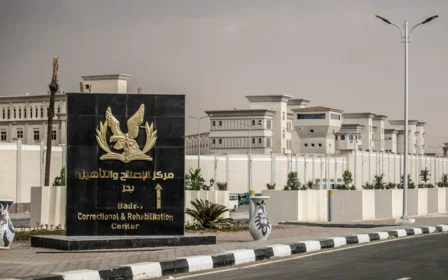
Thirteen years after Rabaa massacre, families urge Egypt to free political prisoners

The Families of Egyptian Detainees Association (Feda) on Friday called on the Egyptian government to release political prisoners on the 13th anniversary of the Rabaa massacre.
Feda, which represents the families of political detainees held in Egypt, urged "Egyptian authorities to release those imprisoned in connection with the Rabaa events, as part of efforts to turn the page on this painful chapter in Egypt’s history".
"Those who took part in a peaceful sit-in to express their views were transformed from victims into defendants and accused persons," the group said.
"Large numbers were subsequently referred to trial, including 51 defendants in what became known as the 'Rabaa Operations Room' case and 739 defendants in the case concerning the dispersal of the Rabaa sit-in."
On 14 August 2013, six weeks after then-Defence Minister Abdel Fattah el-Sisi seized power from Egypt's first democratically elected president, Mohamed Morsi, Egyptian forces stormed Cairo's Rabaa and al-Nahda squares and massacred at least 900 pro-democracy protesters in one of the largest killings of demonstrators in a single day in the country's modern history.
New MEE newsletter: Jerusalem Dispatch
Sign up to get the latest insights and analysis on Israel-Palestine, alongside Turkey Unpacked and other MEE newsletters
The group added: "13 years after the tragedy that shook Egypt, we call for justice to be restored and for those still imprisoned in connection with the two Rabaa cases to be released as part of a sustained process leading to the release of all political detainees."
Rights groups estimate that more than 60,000 prisoners of conscience are held in Egyptian jails, including more than 1,000 women.
The prisoners include students, youths and activists from across the Egyptian political spectrum.
According to the Arabic Network for Human Rights Information, the total number of prisoners in Egypt in March 2021 was 120,000, with an estimated 65,000 political prisoners, at least 26,000 of whom were being held in pre-trial detention.
Many, including former President Mohamed Morsi and several opposition figures, have died as a result of medical neglect and other inhumane prison conditions, according to documentation by multiple rights groups.
Feda said: "We remain hopeful that this anniversary can mark a different beginning on the path towards comprehensive national reconciliation and transitional justice, as stipulated in Article 241 of the Egyptian Constitution."
"The article requires the House of Representatives to enact a transitional justice law that ensures truth-seeking, accountability, reconciliation and compensation for victims."
Rights groups have long documented violations faced by Egyptian detainees, including inadequate medical care, poor nutrition and ventilation, denial of family visits, overcrowded cells, denial of access to books and newspapers and denial of exercise.
In September 2021, Cairo launched a national human rights strategy that included provisions concerning prisoners’ rights.
The framework included goals for humane treatment, protection from torture and abuse, judicial oversight of prisons, and inspections of conditions by the National Council for Human Rights.
Feda aims to liaise with institutions and authorities inside and outside Egypt in the hope of helping secure the release of political detainees.
Middle East Eye delivers independent and unrivalled coverage and analysis of the Middle East, North Africa and beyond. To learn more about republishing this content and the associated fees, please fill out this form. More about MEE can be found here.