
Saudi Arabia opposed Egypt's inclusion in Mecca agreement, sources say

Saudi Arabia opposed Egypt joining the security pact signed with Turkey and Pakistan last week, despite Ankara's push for Cairo to be included, three Saudi sources familiar with the discussions told Middle East Eye.
One of the sources, a former senior adviser to the Saudi monarchy, said Riyadh did not want Egypt to join the agreement "at least for now".
All three sources, who spoke on condition of anonymity due to the sensitive nature of the issue, said the Saudi position was driven by a growing frustration with President Abdel Fattah el-Sisi's government and a belief in Riyadh that Egypt no longer offered the strategic or military value it once did.
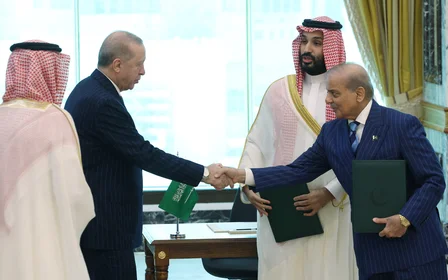
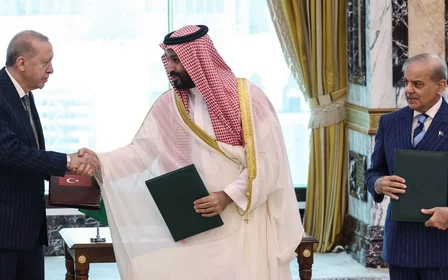
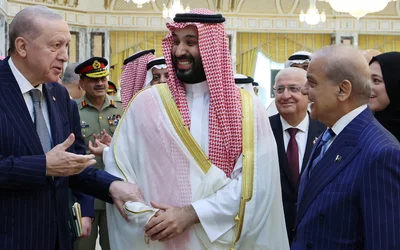
The Mecca Joint Defence Agreement, which was signed in the Holy Muslim city of Mecca on Friday, commits Saudi Arabia, Turkey and Pakistan to regard an armed attack against any one of the three countries as an attack against all three.
Saudi officials have described it as a mechanism to strengthen joint defence capabilities, despite the agreement being vague on operational mechanisms, specific triggers, and how joint military assistance would actually be executed in a crisis.
New MEE newsletter: Jerusalem Dispatch
Sign up to get the latest insights and analysis on Israel-Palestine, alongside Turkey Unpacked and other MEE newsletters
According to the sources, the Saudi decision to oppose Egypt's entry was due to simmering tensions between Riyadh and Cairo.
They said the kingdom was the biggest financial supporter of Sisi's government after he seized power in a 2013 coup, initially spending around $25b to shore up Cairo's flagging economy, but Riyadh had become frustrated by what it regards as a lack of reciprocal support on key security issues.
One of the sources pointed to Egypt's "minimal and unreliable" role in Saudi Arabia's lengthy war with Yemen's Houthis and its position during the US and Israeli war on Iran.
They also cited growing unease over Cairo's "subordination" to the United Arab Emirates, specifically after the fallout between Riyadh and Abu Dhabi over the latter's support for Southern Yemeni separatist groups that "threaten Saudi's national security and interests".
'Egypt has always been a dependent on us, on the US, and it does not give back, it just takes and takes with no return'
- Former senior adviser to the Saudi monarchy
Two of the sources noted that while Egypt sent air defence systems and fighter jets to Abu Dhabi in response to Iranian attacks, and Sisi visited UAE President Mohamed bin Zayed more than once during the war, no such steps were taken towards Saudi Arabia. They concluded that Riyadh had become increasingly alarmed by Sisi's alignment with Abu Dhabi.
The sources said this was also due to Riyadh seeing several Emirati policies as running against Egypt's own strategic interests. These include the UAE’s involvement in Somaliland, its strategic relationship with Israel, its support for Ethiopia during disputes over the Grand Ethiopian Renaissance Dam and its backing of the Rapid Support Forces in Sudan.
One of the sources said that Cairo's continued engagement with Abu Dhabi had deepened doubts in Riyadh about Egypt's reliability as a strategic partner.
Another source described the relationship under Sisi as increasingly one in which Saudi Arabia sees Egypt as "dependent" on Gulf support rather than as a reliable partner.
The former senior adviser said Egypt had historically been dependent on the kingdom, the United States and other outside powers while providing little in return.
"Egypt has always been a dependent on us, on the US, and it does not give back, it just takes and takes with no return," the adviser said.
Turkey wanted Egypt in the pact
On Saturday, Turkish Foreign Minister Hakan Fidan suggested that Cairo was a "natural partner" for Ankara and that there was no reason it could not eventually become part of the alliance once technical issues were resolved.
Several Turkish sources subsequently told MEE that Ankara had made considerable efforts to include Egypt in the treaty and had formally proposed its participation.
However, once it became clear that Cairo was not prepared to join, the other countries decided to proceed without it, according to the Turkish sources.
The Saudi sources, however, disputed the suggestion that Egypt itself had rejected the pact.
The former senior adviser, who is still close to the country's decision-making, described it as "laughable" to suggest Cairo had decided not to participate.
"The matter of fact is, Sisi would have been eager to join so he can reap the financial gains of this agreement, as he usually does," the adviser said.
The adviser said Saudi decision-makers had serious concerns about Sisi’s loyalty and did not believe he could be trusted in the same way as the Turkish and Pakistani leaderships.
"We understand that the Turks wanted Egypt to be included, and understand why," he said. "Maybe in the future, if we see that there is change or improvement."
The other sources said that Turkey and Pakistan offered more to the alliance militarily than Egypt.
Turkey has an increasingly sophisticated defence industry, while Pakistan has an established weapons manufacturing sector and a large standing military.
In contrast, the sources said Egypt's military manufacturing capacity is concentrated heavily on civilian production and does not offer the same level of advanced defence technology.
"The role of the military should be to invest in its military manufacturing capabilities, rather than busy itself in investing and managing food factories," one of the sources said.
They also questioned the combat readiness and effectiveness of the Egyptian armed forces.
The sources said the decision was therefore not simply about Egypt's political alignment but about what Riyadh believes Cairo could tangibly contribute to a new regional security architecture.
Egypt's diminishing role
The Saudi assessment comes amid a broader debate over Egypt's diminishing role in the region.
The Economist reported on Monday that Egypt, which had long presented itself as a pillar of the regional order, had been "sidelined as a mediator and military power".
For decades, Egypt was a central military partner for Gulf states, including during the US-led coalition that expelled Iraqi forces from Kuwait in 1991. In contrast to now, where the sources pointed out that Kuwait is now more keen to join the Makkah agreement rather than having the military alliance it once had with Egypt for its protection.
But the Saudi sources argued that under Sisi, Egypt had become increasingly dependent on outside financial support while offering less in return on major regional security issues.
The former senior adviser said the kingdom regarded its relationships with Ankara, despite being turbulent in recent years, as being more reliable than its relationship with Cairo.
"The decision makers in the leadership have serious concerns about Sisi's loyalty," the adviser said.
"He is simply seen that he cannot be trusted, and rightly so."
The adviser contrasted that with Saudi Arabia’s relationships with "the Pakistanis and the Turkish brothers".
Saudi social media has also reflected opposition to Egypt's inclusion in the pact, with several accounts supportive of the kingdom’s leadership posting material suggesting Cairo was not wanted in the agreement.
The anonymous social media account @Columbuos, widely believed to belong to Saud al-Qahtani, a former senior aide to Crown Prince Mohammed bin Salman, who is still considered to be close to the young royal, echoed this sentiment.
"The door of the alliance is not open to those who only want to address their problems and benefit from it without participating in the same secure mission for the region," he said.
"Whoever wants to join must share the same common interests of the three countries.
"The era of illusory entitlements, charity, and one-sided giving has passed, and the time of 'my fate alone' has ended, giving way to the phase of 'our single fate'," he added.
Despite this, all three sources stressed that the agreement did not necessarily close the door to Egypt joining in the future, but Riyadh’s position was that Cairo should remain on the outside for now.
Middle East Eye delivers independent and unrivalled coverage and analysis of the Middle East, North Africa and beyond. To learn more about republishing this content and the associated fees, please fill out this form. More about MEE can be found here.