
Former UAE presidential aide's post mocking Pakistan exposes unease over Mecca pact

A prominent Emirati political analyst and former aide to UAE President Mohammed bin Zayed has sparked backlash after mocking Pakistan over its economic and social challenges while also questioning its role in defending Saudi Arabia under a new regional security arrangement.
Abdulkhaleq Abdulla wrote on X on Friday that it was “one of the paradoxes of time” that a country where “a quarter of its population is poor” and “a third” is illiterate could “opportunistically” position itself to defend a country among the world's 20 largest economies.
The Emirati political analyst also referred to Pakistan's estimated national income and nuclear arsenal, arguing that the country had endured decades of internal instability and military rule while presenting its nuclear capability as its principal strategic qualification.
Abdulla said Pakistan had “suffered from corrupt military rule since its founding, chronic internal unrest and wars with its closest neighbours”, adding that the country’s main qualification was its “170 nuclear bombs”.
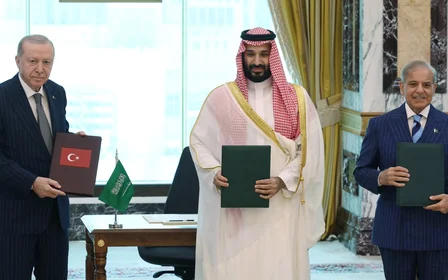
The former presidential aide was apparently referring to the Strategic Mutual Defence Agreement between Pakistan and Saudi Arabia, signed on 17 September 2025, which treats any act of aggression against one as an act against both.
New MEE newsletter: Jerusalem Dispatch
Sign up to get the latest insights and analysis on Israel-Palestine, alongside Turkey Unpacked and other MEE newsletters
However, his post, which has since garnered more than 1 million views, also indicates the anxieties that the broader Mecca Joint Defence Agreement among Pakistan, Turkey and Saudi Arabia has triggered in his native United Arab Emirates.
Abdulla’s disparaging remarks about Pakistan - where nearly 1.6 million Pakistanis reside in the UAE and remain a major source of remittance flows to their country - have sparked a backlash, with one user commenting: “Comparing poverty and the size of the economy with the political stance is misleading."
من مفارقة الزمان ان دولة ربع سكانها فقراء وثلث سكانها لا يعرف القراءة والكتابة ودخلها القومي 400 مليار $ وتعاني من حكم عسكري فاسد منذ تأسيسها واضطرابات داخلية مزمنة وحروب مع اقرب جيرانها وكل مؤهلاتها 170 قنبلة نووية، تتنطع بشكل انتهازي للدفاع عن دولة ضمن 20 اكبر اقتصاد في العالم
— Abdulkhaleq Abdulla (@Abdulkhaleq_UAE) August 15, 2026
"Pakistan is a sovereign state with interests and alliances, and its eligibility for international positions is not conditioned on its wealth. Moreover, reducing its qualifications to nuclear weapons ignores its demographic and geopolitical weight and its economy, which has exceeded $400bn,” the user added.
Several users posted his older remarks to point out contradictions in his stances over relations with Pakistan and Israel, including the one in which he wrote: “Damn every Gulf Arab tweep who calls for normalisation with the Israeli enemy.”
Another X user posted Abdulla's 2015 comments on the military intervention led by Saudi Arabia in Yemen, in which he said: “Gulf and Saudi diplomacy should have moved with force and weight, been convincing, and utilised all its capabilities to win the vote for Pakistan's participation in Operation Decisive Storm.”
Abdulla had previously questioned the logic of the new agreement.

"Congratulations on the establishment of this alliance, but strengthening Gulf military and political cooperation and unifying the Gulf house is far more important than investing in regional military and political cooperation that includes countries whose credibility and ability to confront the Iranian-Israeli threat are not taken seriously," Abdulla wrote in one of several posts on the matter on 7 August, the day the Mecca agreement was signed.
"One of the conditions for the success of any alliance is identifying the common enemy. So who is the enemy for the countries of this alliance?"
Abdulaziz Altwaijri, former head of the Islamic World Educational, Scientific and Cultural Organisation (Isesco), the OIC's Rabat-based cultural and educational body, had replied to the post on X by hinting at the UAE's ties with Israel, stating: "Anyone who betrays and collaborates with the Zionists will never find security."
Reacting to Abdulla's Pakistan post on X, Altwaijri wrote: "It seems that the Mecca Agreement syndrome has left you dizzy."
Rivalry spills into regional alliances
The recent exchange points to a deeper rift as relations between the UAE, the first Gulf country to officially recognise Israel, and Saudi Arabia, which has refused to recognise Israel despite American pressure, have soured over Abu Dhabi’s support for southern Yemeni separatist groups.
Analysts also see the Mecca agreement as a counter to UAE-Israel military cooperation, which remains unpopular outside Israeli and American circles.
Theodore Singer, a former US intelligence officer, told Middle East Eye: "At first glance, the UAE-Israel bloc delivers more tangible gains for both parties, but the Mecca pact may ultimately resonate more broadly and less transactionally.”
In May, after Israeli Prime Minister Benjamin Netanyahu announced that he visited the UAE at the height of the war on Iran, Abu Dhabi moved to deny the official statement.
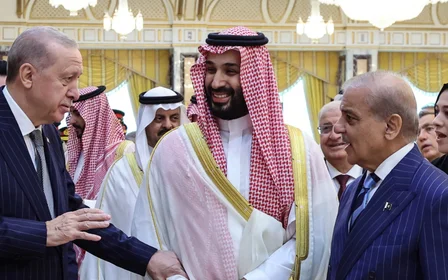
In contrast, the Mecca pact was celebrated in public. It was announced that Saudi Crown Prince Mohammed bin Salman, Pakistani Prime Minister Shehbaz Sharif and Turkish leader Recep Tayyip Erdogan attended Friday prayers together in Islam's holiest city.
Some analysts say that the very fact that three countries have publicly codified their agreement gives it room to grow, potentially in ways the UAE-Israel alliance cannot.
The UAE-Saudi rivalry that appears to underpin Abdulla's remarks is also evident in the debate over who was left out of the pact, as Riyadh has grown increasingly wary of Egyptian President Abdel Fattah el-Sisi's alignment with Abu Dhabi.
Saudi Arabia reportedly opposed Egypt’s entry into the new defence pact, citing growing unease over Cairo's "subordination" to the UAE.
Egypt sent air defence systems and fighter jets to Abu Dhabi in response to Iranian attacks, while Sisi visited Mohammed bin Zayed more than once during the war. No such steps were taken towards Saudi Arabia.
Riyadh sees several Emirati policies as running against Egypt's own strategic interests, including the UAE’s involvement in the breakaway state of Somaliland and its strategic relationship with Israel. Other points of contention include Abu Dhabi's support for Ethiopia during disputes over the Grand Ethiopian Renaissance Dam and its backing of the Rapid Support Forces paramilitary in Sudan.
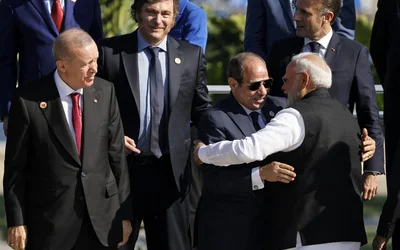
According to earlier MEE reporting, Egypt does not want to choose sides between emerging blocs comprising Turkey, Saudi Arabia and Pakistan on one side, and Israel, the UAE and India on the other.
Egypt also has a defence treaty with Abu Dhabi and deployed Rafale fighter jets in response to Iranian strikes against the UAE in May, leading Saudi Arabia to view Egypt as unreliable.
Middle East Eye delivers independent and unrivalled coverage and analysis of the Middle East, North Africa and beyond. To learn more about republishing this content and the associated fees, please fill out this form. More about MEE can be found here.