Israel probably committed war crimes in Gaza hospital double-tap, investigation finds

Israel may have committed war crimes in a double-tap attack on a Gaza hospital that killed Palestinian journalists, medics and first responders, an investigation by The Independent has found.
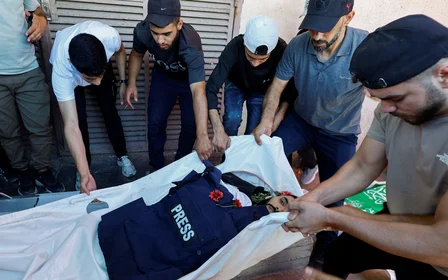
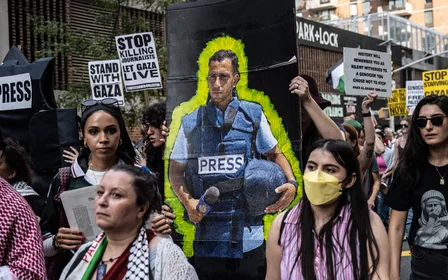
The strikes on Nasser Hospital in southern Gaza on 25 August 2025 killed 20 people, including Middle East Eye contributors Mohamed Salama and Ahmed Abu Aziz, and The Independent correspondent Mariam Abu Dagga.
The first strike hit Reuters cameraman Hussam al-Masri as he operated his camera, killing him.
Journalists, medics and first responders rushed to the scene to report on the attack and help the wounded. Eight minutes later, as a large crowd gathered, two more projectiles were fired from Israeli tanks at the group.
The second strike, which killed 19 people, was captured on live television.
New MEE newsletter: Jerusalem Dispatch
Sign up to get the latest insights and analysis on Israel-Palestine, alongside Turkey Unpacked and other MEE newsletters
International law experts told The Independent that the attack raised serious concerns over potential war crimes, including the intentional targeting of civilians and the launching of a disproportionate attack. They said the second strike was of particular concern.
Israel denies committing war crimes in Gaza and has repeatedly said it does not target journalists.
At the time, Israeli prime minister Benjamin Netanyahu, who is wanted by the International Criminal Court (ICC) over alleged war crimes, described the incident as a “tragic mishap”.

Israeli whistleblowers told The Independent that an attack on a hospital would have required approval at least at battalion level, as well as advance planning.
The Israeli military said at the time that it had targeted a camera “positioned by Hamas” to monitor Israeli troops. It claimed that six “terrorists” had been killed in the attack.
The Independent identified two of those six as a hospital worker and a member of the civil defence team who had been helping with the rescue operation.
The Israeli military has repeatedly made broad claims about alleged military activity in Gaza to justify strikes, including attacks that have killed civilians.
The Independent’s investigation also found that the military did not contact the hospital about its concerns over the camera, despite having phone numbers for hospital staff.
UK urged to take action
British MPs have urged their government to hold Israel to account following The Independent’s investigation.
“Where is our outrage over journalists seemingly becoming a legitimate target? Is this the new reality - that killing civilians, medics and humanitarian workers no longer has consequences?” Sarah Champion, the Labour chair of the International Development Committee, told The Independent.
“The Geneva Conventions were written 77 years ago to provide some order and agreed responsibilities during the chaos of conflict. It is the international community’s responsibility to make sure those conventions are upheld.”

Liberal Democrat MP Layla Moran said she was concerned Britain could be “sitting on evidence that they haven’t put forward” in investigations and potential international trials into allegations of genocide and war crimes involving Israel.
“They should hand it over willingly and be proactive in making sure that that information gets to the right people so that it can be properly considered at the right level,” she said.
Labour MP Rachael Maskell also called for the Israeli military to be held accountable through international courts.
“Having spoken to medics working in Gaza, they have reported to MPs that they have identified targeted war crimes, with precision targeting of humanitarian workers including with sniper fire and drone use,” Ms Maskell said.
“The UK government must take the strongest measures, including ceasing all trade and increasing sanctions against the Israeli government to hold it to account for the actions of the IDF [the Israeli military].”
Middle East Eye delivers independent and unrivalled coverage and analysis of the Middle East, North Africa and beyond. To learn more about republishing this content and the associated fees, please fill out this form. More about MEE can be found here.