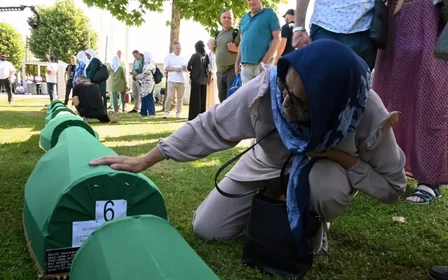
Ratko Mladic, architect of Srebrenica genocide and ‘Butcher of Bosnia’, dies aged 84

The former Bosnian Serb commander Ratko Mladic, who led the genocide of Bosnian Muslims at Srebrenica and the years-long siege of Sarajevo, has died aged 84.
Serbia’s public broadcaster RTS announced his death, while his lawyer separately confirmed it to Reuters.
Known as the “Butcher of Bosnia”, Mladic commanded Bosnian Serb forces during their campaign to carve an ethnically homogeneous Serb territory from Bosnia and Herzegovina in the 1990s.
The International Criminal Tribunal for the former Yugoslavia convicted him in 2017 of genocide, crimes against humanity and war crimes.
Judges found him responsible for the mass killing of more than 8,000 Bosniak Muslim men and boys at Srebrenica in July 1995 and for terrorising civilians during the siege of Sarajevo.
New MEE newsletter: Jerusalem Dispatch
Sign up to get the latest insights and analysis on Israel-Palestine, alongside Turkey Unpacked and other MEE newsletters
Despite his conviction, Serbian nationalists and senior political figures continued to glorify Mladic and deny or minimise the crimes committed by Bosnian Serb forces.
Mladic evaded justice for nearly 16 years while elements of the Serbian state helped shield him from capture.
Serbian authorities finally arrested him on 26 May 2011 in a village north of Belgrade, bringing one of modern history’s longest manhunts to an end.
When, in 2017, Mladic was sentenced to life in prison, presiding judge Alphons Orie said his crimes ranked “among the most heinous known to humankind”.
Project of Greater Serbia
Yugoslavia’s collapse became a campaign of conquest as Serbian President Slobodan Milosevic pursued a Greater Serbia across the crumbling federation.
His nationalist project inflamed ethnic and religious divisions and fuelled wars against Slovenes, Croats, Bosniaks and Kosovo Albanians.
The violence killed about 100,000 people in Bosnia alone and forced more than 2.5 million people from their homes.
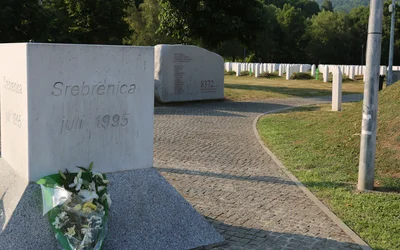
Mladic, formerly an officer in the Yugoslav People’s Army, took command of the Bosnian Serb army in the early 1990s and became one of the principal enforcers of that project.
Shortly before the Srebrenica genocide, Mladic invoked the medieval defeat by the Ottoman state of Serbian tribes as justification for revenge against Bosniaks more than six centuries later.
Over the following days, his forces hunted down and captured thousands of Bosniak men and boys before binding and executing them.
Serb forces also subjected women and girls to widespread sexual violence as international powers failed to stop the slaughter.
The perpetrators buried their victims in mass graves, later using heavy machinery to exhume and scatter the remains across secondary burial sites in a systematic attempt to conceal the crime.
Mladic later faced one of the final major trials before the International Criminal Tribunal for the former Yugoslavia in The Hague. The court prosecuted nearly 100 people over atrocities committed during the wars.
Middle East Eye delivers independent and unrivalled coverage and analysis of the Middle East, North Africa and beyond. To learn more about republishing this content and the associated fees, please fill out this form. More about MEE can be found here.