
US missile interceptor shortfall 'beyond critical' due to war on Iran: Report

The US war on Iran has caused a "beyond critical" shortage of advanced missile interceptors, especially Patriots, which have been used to shoot down Russian ballistic missiles, a Nato official and US official told the Associated Press (AP) in a report published on Thursday.
The US military in Europe "definitely" does not have enough Patriots to stop a sustained ballistic missile attack, the US official said, and would have "very limited" capability to defend against a single ballistic missile strike.
The US and Israel first attacked Iran on 28 February. Fighting has flared throughout the summer despite a June ceasefire brokered through the Islamabad Memorandum of Understanding between the two sides.
Many experts say that US President Donald Trump appeared to expect a quick victory against Iran, energised by Israeli promises of regime change and the US's capture of Venezuelan President Nicolas Maduro earlier this year.
But Iran responded to the attack by unleashing drones and missiles on Gulf states. Amid the fighting, the US pulled some air defence systems and troops from East Asia.
New MEE newsletter: Jerusalem Dispatch
Sign up to get the latest insights and analysis on Israel-Palestine, alongside Turkey Unpacked and other MEE newsletters
The AP report could raise concerns about the vulnerability of European states to a Russian attack. The Wall Street Journal reported this week that CIA Director John Ratcliffe traveled to Moscow in part to warn Russian President Vladimir Putin against a potential attack on Nato members.
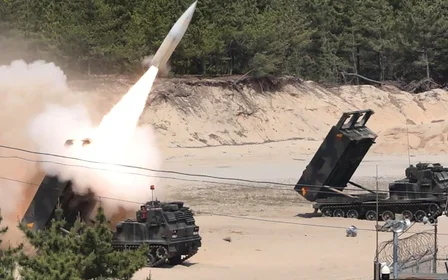
Ukraine, which is battling a Russian invasion, has used US-supplied ATACMS to target Russia. These are medium-range ballistic missiles designed to strike behind enemy lines.
The US military is running low there too, the AP report noted.
Surface-to-surface weapons
The revelations follow a Reuters report from earlier this month that said the US had exhausted its stockpile of sophisticated long-range missiles during the war on Iran. Trump threatened earlier this month to subject Iran to the "biggest attack" since World War II, but then pivoted to threatening economic sanctions.
The US drained its supply of surface-to-surface weapons, including ATACMS and Precision Strike Missiles (PrSM), Reuters said, citing two sources who said the US had used "virtually all" of these munitions.

These long-range missiles are a critical part of the US’s arsenal, allowing it to accurately target foes from a distance without relying on warplanes that are vulnerable to air defence systems.
Reuters reported that US Central Command - which oversees military operations in the Middle East - has had to replenish its stock of surface-to-surface missiles from other theatres of operation.
In addition to offensive munitions, the US was running low on missile and drone interceptors before the war. The shortage was a reflection of US efforts to defend Israel during a war in June 2025 that culminated in the US bombing Iran’s nuclear facilities.
The Trump administration boasted for months during the height of the war that Iran’s air defence systems have been obliterated, but Middle East Eye and other outlets reported that Iran has received new systems from China and Russia.
Drones
The US-Israeli war on Iran has further depleted or destroyed more than $1.3bn worth of the US's MQ-9 Reaper drones, roughly translating to 25 percent of the country's pre-war fleet of unmanned aerial vehicles, The Washington Post reported some two weeks ago.
The story revealed a slightly higher number of MQ-9 Reaper drones were destroyed compared to a Bloomberg report published in May, which put the figure at 20 percent of the pre-war inventory.
The MQ-9 Reaper drone is valued between $30m and $50m, depending on its sensor, radar and ordnance configuration. The unmanned aerial vehicle serves as a high-altitude platform for surveillance, reconnaissance and targeted precision strikes, as documented by the US Air Force.
It is capable of carrying Hellfire missiles or Joint Direct Attack Munition guided bombs.
Middle East Eye delivers independent and unrivalled coverage and analysis of the Middle East, North Africa and beyond. To learn more about republishing this content and the associated fees, please fill out this form. More about MEE can be found here.