Trump's Africa envoy condemns Chad strikes, 'external support' in Sudan war

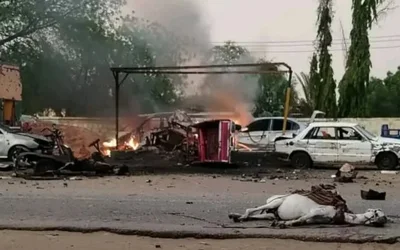
US President Donald Trump's Africa envoy on Thursday condemned the air strikes by Sudan's military inside the territory of Chad, after Chadian authorities reported bombings in the eastern Ennedi region last week.
"The United States condemns the SAF’s recent air strikes inside Chad," Massad Boulos wrote on X of the Sudanese Armed Forces.
"The violence must stop in Sudan and beyond. There is no military solution to this conflict—and absolutely no justification for expanding the violence beyond Sudan’s borders."
Boulos said the SAF and the breakaway paramilitary Rapid Support Forces (RSF) "must immediately accept a humanitarian truce, protect civilians, and allow unhindered humanitarian access".
He called on the United Nations Security Council, where the US wields veto power, to strengthen the arms embargo and sanctions packages.
New MEE newsletter: Jerusalem Dispatch
Sign up to get the latest insights and analysis on Israel-Palestine, alongside Turkey Unpacked and other MEE newsletters
Boulos demanded that "external financial and military support to the warring parties must stop", but he did not mention the United Arab Emirates or explain why the SAF would have bombed its African neighbor.
The UN has said that the UAE routes weapons shipments to the RSF via Chad.
Middle East Eye has revealed how Chad is central to the UAE's logistics network supplying the RSF.
The Gulf state has played such an outsized role in prolonging the now three-year-long civil war that last year, Sudan's ambassador to the US, Mohamed Abdulla Idris, told reporters that his country would not accept any peace proposal that involves Abu Dhabi as a mediating party.
"It's unacceptable to us," he said.
"The United Arab Emirates is a party to the conflict, so it cannot play both roles - become a party, and then become a mediator, no."
Diplomacy
The SAF said it was protecting its "sovereignty, security, and safety" when it struck a military convoy in Chad one week ago.
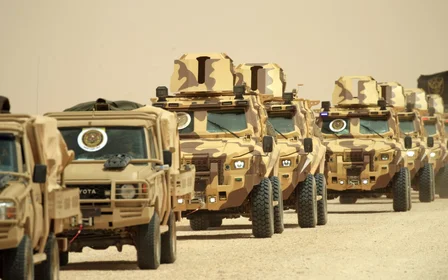
A Chadian security source told the Reuters news agency that "the alert level has been raised to the maximum" as the country deployed 100 armoured vehicles and signal-jamming trucks to its eastern border with Sudan to ward off incoming drones.
Responding to Boulos's post on X, Cameron Hudson, an Africa expert and former State Department official, wrote: "Why hasn’t he condemned Chad allowing its territory to be used to arm the RSF for the last several years? Statements like this do absolutely nothing to advance a diplomatic solution."
Boulos promised a diplomatic solution in February, but it has not materialised.
The US, he said, had readied the text of a peace plan for Sudan's civil war that included the approval of the members of the "Quad".
The Quad, comprising the US, Saudi Arabia, the UAE and Egypt, was formed to coordinate efforts to end the conflict in Sudan. The group initially unveiled a roadmap in September aimed at ending the fighting between the SAF and RSF.
"We've been working on this comprehensive peace plan for at least three months now that should be acceptable to both sides," Boulos said at a fundraiser held to gather pledges for immediate humanitarian aid for Sudan.
He indicated the text would be unveiled in mid-February. It never came.
What he would not specify - despite being pressed by reporters - is exactly what, or who, is the obstacle to the plan's implementation, only saying that it is "quite comprehensive".
The US has largely avoided straining its relations with the UAE over the Sudan conflict.
The text, Boulos explained at the time, is built on five pillars: addressing the humanitarian crisis; protecting civilians and coordinating their safe return; transitioning to a permanent ceasefire; instituting a political process towards a civilian-led government; and reconstruction, for which a fund would be set up.
He named the UK, Norway and Egypt in particular as working on the government transition process.
Middle East Eye delivers independent and unrivalled coverage and analysis of the Middle East, North Africa and beyond. To learn more about republishing this content and the associated fees, please fill out this form. More about MEE can be found here.