
UK trade ban on illegal settlements is a welcome first step to justice for Palestinians


The UK government decision to ban all trade with illegal Israeli settlements has all the hallmarks of a major rebalance on international affairs, from a foreign secretary finally willing to listen and show leadership.
Two months ago, I led a debate in parliament on the gravity of the situation in the occupied Palestinian territories, and the gap between our principles and action.
I laid out the ties of complicity that bind the UK to businesses operating in illegal settlements, often given advantages by the Israeli government.
An Al Jazeera investigation later found that the UK has £2.1bn ($2.85bn) in contracts with firms tied to illegal Israeli settlements.
So today’s shift from the government is both welcome and long overdue.
New MEE newsletter: Jerusalem Dispatch
Sign up to get the latest insights and analysis on Israel-Palestine, alongside Turkey Unpacked and other MEE newsletters
In my view, there were three questions that should have been guiding the scale of the UK’s actions since we came into government. Are we legally obliged to act? Are we morally obliged to act? And would we already have acted had the victims been Ukrainian or Israeli?
Today, we can begin to meet these three tests.
The right side of history
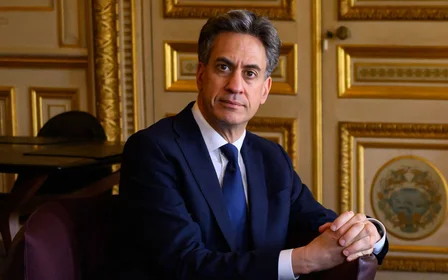
From Mike Huckabee, the US ambassador to Israel, to Benjamin Netanyahu, the Israeli prime minister, Foreign Secretary Ed Miliband is facing a host of detractors today, but he has done the right thing.
By recognising that Israel’s illegal expansion and impunity in how it treats the Palestinians are the biggest threats to a two-state solution, his actions today will firmly place him on the right side of history.
Some mistakenly believe that this move will hand the far right in Israel yet another election victory this autumn, but perhaps they’ve not fully appreciated the rightward trend in Israeli society, or the shift from dangerous rhetoric to full-on genocidal intent that we have seen more recently from Israeli ministers.
Asking Palestinians to wait until the elections are over in the hope that a moderate Israeli government grants them their rights is unthinkable, particularly when most political parties, while distinct in policy, are united in the belief that Palestinians should be denied the very basics of statehood.
Indeed, whatever the outcome of the upcoming Israeli election, the facts being created on the ground with the rollout of the E1 settlement are intended to survive it.
The largest settlement expansion in Israeli history has already got cabinet approval, the maps have been redrawn, and the end of a viable Palestinian state is all but confirmed.
Others question the usefulness of the measure, saying that it will never amount to enough pressure to change Israel’s policies.
A serious ban
There were significant threats from Huckabee this morning about a response from the US that punishes UK businesses in Florida, where they sustain around 70,000 jobs.
Perhaps Huckabee is willing, but it seems unlikely that he would follow through and cut one out of every 226 jobs in the state just to teach the UK a lesson.
Every commercial relationship that rewards settlement expansion without accountability undermines all our efforts towards a two-state solution
Then there are those who say that a ban is not specific enough, that it will be impossible to differentiate settlement goods from Israeli goods, and that this will turn into a de-facto ban on Israeli goods.
It’s welcome that people understand the scale of obfuscation that happens at the borders where goods are mixed to pass off settlement produce as Israeli produce, but do they have a better idea on how to enforce the existing agreement on preferential trade, or would they rather the settlements continue to strangle the Palestinian economy, costing it billions?
A serious ban must reach beyond the supermarket shelf. It must cover the goods, services and investment that sustain settlements, with proper supply-chain checks and serious consequences for evasion.
From today, businesses can no longer be allowed to carry on through a different intermediary or by simply ignoring the rules.
The system as it stands is no accident.
Settlements have beneficiaries; they need finance, construction, transport, access to markets. Every commercial relationship that rewards settlement expansion without accountability undermines all our efforts towards a two-state solution.
A good start
We know that a British trade ban will not end an illegal occupation on its own, but no single measure should be expected to meet that test before we act.

Economic pressure, as it did when used historically for apartheid South Africa, will restrict resources, change business decisions and encourage other countries to follow.
Even if it takes decades, the UK is right to start unpicking our own contribution to injustice, regardless of whether others follow immediately.
Finally, I have heard many commentators wrongly characterise this as an attempt to "pander" to certain communities.
This is a shameful attempt to disregard widely held convictions that Israel’s settlements are illegal under international law, that we have an obligation not to aid or assist them under the International Court of Justice ruling in 2024 that Israeli settlements are unlawful.
I regularly hear the concerns of colleagues, and of British Jewish and British Palestinian communities across the UK. They are clear that the actions of the Israeli government cannot be equated to the British Jewish community here.
Whatever communities people belong to, they deserve safety, dignity and the right to determine their own futures.
Today’s decision is not about pitting communities against each other; it is a recognition that dignity should go both ways.
The views expressed in this article belong to the author and do not necessarily reflect the editorial policy of Middle East Eye.
Middle East Eye delivers independent and unrivalled coverage and analysis of the Middle East, North Africa and beyond. To learn more about republishing this content and the associated fees, please fill out this form. More about MEE can be found here.