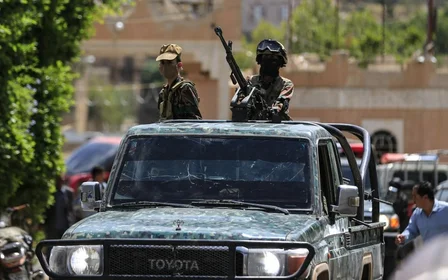
Houthi leader denies Yemeni group targeted Mecca with drone

The leader of Yemen's Houthis has denied the group targeted the city of Mecca in Saudi Arabia.
Abdul-Malik al-Houthi said the claim his group attacked the holy city with a drone was a "major lie" and said they were committed to defending Islamic holy sites.
In a televised address, he said that the real threat to Mecca came from the "Zionist enemy", referring to Israel, and said the latest claim was an attempt to shore up support for "military measures imposed on Yemen".
"The real threat is the Zionist enemy, which seeks to target all Islamic holy sites, including Mecca, Medina, and Al-Aqsa Mosque," Houthi said.
"We are ready to confront it as an Islamic alliance."
New MEE newsletter: Jerusalem Dispatch
Sign up to get the latest insights and analysis on Israel-Palestine, alongside Turkey Unpacked and other MEE newsletters
Houthi advancement
Ansar Allah, known as the Houthis, took over stretches of Yemen’s coast near the Bab-el-Mandeb strait over the weekend, followed by attacks on the East-West Pipeline, which carries nearly four percent of the global oil supply through Saudi Arabia.
The Saudi government may need five to six weeks to repair damage from a drone attack on the pipeline, according to Reuters.
The price of oil had already soared last week as a result of a lightning Houthi offensive that put the group in control of Yemen’s side of the Bab el-Mandeb, a key Red Sea chokepoint for Saudi oil shipments.

The Houthis have said their current offensive is a response to Saudi attacks, including a drone strike on the capital Sanaa.
"At every stage, it has been the one that began the aggression," Houthi said in his speech.
"We are in a defensive position. We are not the ones who initiate aggression."
The International Organization for Migration (IOM) on Friday said that at least 112,000 people have been displaced inside Yemen over the past two weeks.
According to the United Nations migration agency, nearly 3,000 residents from the Gulf of Aden have also crossed to neighbouring Djibouti by sea.
Djiboutian authorities are preparing to receive as many as 10,000 refugees as the influx puts additional pressure on already stretched health, education and humanitarian services, UN agencies said.
The latest displacement figures represent a sharp rise from earlier this month, when the IOM had reported more than 100,000 people displaced inside Yemen since renewed fighting.
Middle East Eye delivers independent and unrivalled coverage and analysis of the Middle East, North Africa and beyond. To learn more about republishing this content and the associated fees, please fill out this form. More about MEE can be found here.