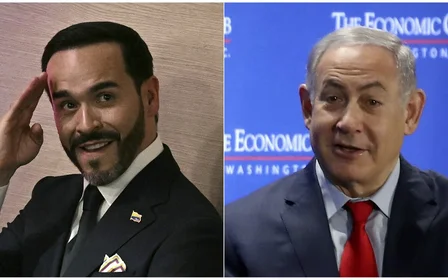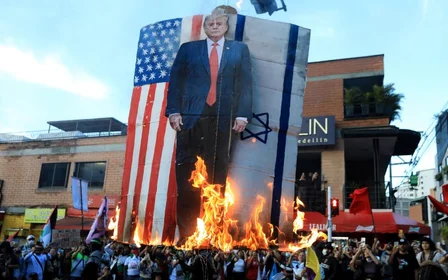

Netanyahu's man: How Israel is betting on a Bolsonaro comeback in Brazil

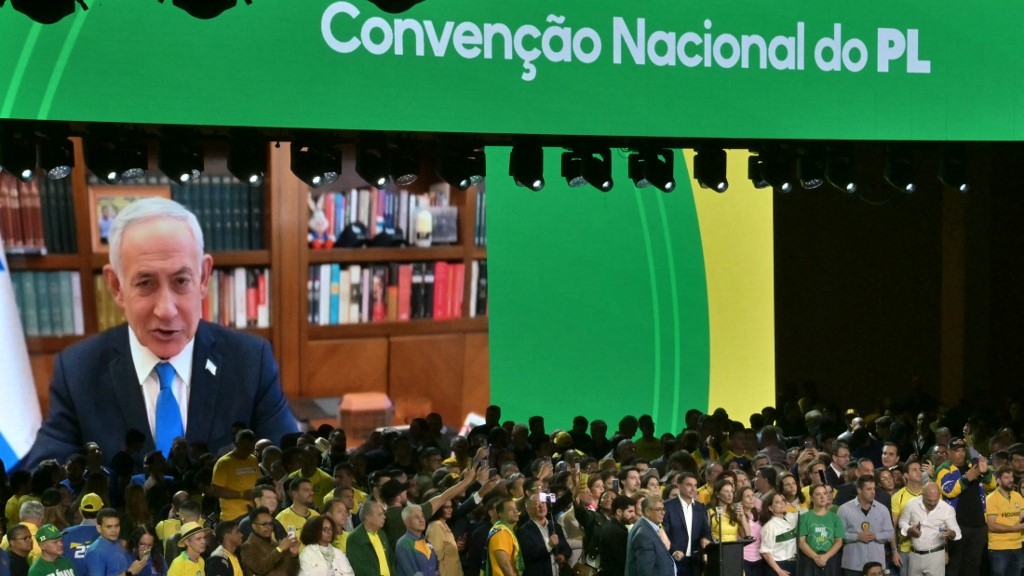
At the launch of his presidential campaign in Sao Paulo, Brazil, in July, an emotional Flavio Bolsonaro looked up at a giant screen as a video from Israeli Prime Minister Benjamin Netanyahu suddenly began playing.
“Flavio, my friend, I want to congratulate you on the official launching of your campaign,” Netanyahu said in a pre-recorded video, looking down at the crowd.
“You’re a great champion of Brazil, you’re a great champion of the friendship between our peoples,” he went on.
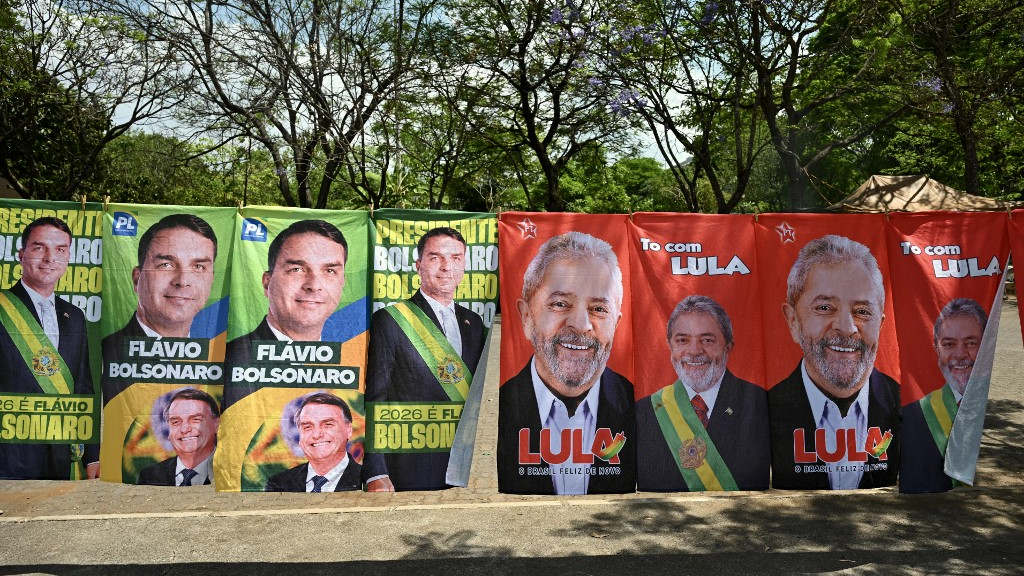
Bolsonaro, the son of imprisoned former far-right president Jair Bolsonaro, had just launched his presidential campaign to unseat incumbent President Luiz Inacio Lula da Silva.
Brazilians go to the polls on Sunday, 4 October. If neither candidate wins 50 percent of the overall vote, a second round will follow on 25 October.
New MEE newsletter: Jerusalem Dispatch
Sign up to get the latest insights and analysis on Israel-Palestine, alongside Turkey Unpacked and other MEE newsletters
Lula has warned against foreign interference in Brazil’s election, directly telling Trump in June to stay out of the contest.
According to Brazilian newspaper Folha de S.Paulo, his warning about foreign influence at the UN General Assembly also targeted Netanyahu and Argentina’s staunchly pro-Israel President Javier Milei, although he did not name them then.
“Netanyahu stands to gain” from a Flavio victory, said David Magalhaes, a professor of international relations at the Federal University of Uberlandia in Sao Paulo, Brazil.
“[In particular] at a time when Israel is increasingly isolated within the international community, a situation that has worsened because of the indications of extermination or genocide in the Gaza Strip,” he told Middle East Eye.

In what would be a break with the majority of the international community, Flavio has promised Israel that he would transfer the Brazilian embassy to Jerusalem. Israel occupies Palestinian East Jerusalem.
He has also promised to join the so-called “Isaac Accords”, an initiative Argentina’s president announced earlier this year on a visit to Israel alongside Netanyahu. It seeks to embed Israel in Latin American countries’ economic, political and security architecture.
Flavio has also adopted Israel’s messianic vision of its occupation of Palestinian land as a fulfilment of biblical prophecy.
He not only seeks to revive the Israeli-Brazilian partnership of his father’s presidency, from 2019 to 2022, but to expand it on his own terms.
The Israeli relationship with Brazil's political right runs through its military and police, its evangelical bloc, and the defence industry - ties that have deepened under left and right governments alike.
Magalhaes notes that Brazil underwent a “profound shift by abandoning its historical equidistance between Palestinians and Israelis and adopting a strongly pro-Zionist orientation” during Jair Bolsonaro's presidency.
With Netanyahu facing his own electoral test on 27 October, a return to that relationship “would be highly convenient for Netanyahu”, Magalhaes added. It would signal to Israeli voters that their isolation is not hermetic.
Current polls put Lula and Flavio neck and neck. In the first round, Lula polls at 39.4 percent and Flavio at 38.4 percent. According to some polls, a runoff would see Lula win a close second-round vote.
Israeli influence inside Brazil
Eduardo Bolsonaro, Flavio’s brother, is one of the pillars of influence cultivated by Israel in Brazil. That relationship came in handy in January 2025, when the Hind Rajab Foundation filed a case against Yuval Vagdani, an Israeli soldier on holiday in Brazil, accusing him of war crimes while serving in Gaza.
The Israeli soldier had to flee the country after a Brazilian judge ordered an investigation. Eduardo immediately worked with the Israeli Diaspora Affairs Minister Amichai Chikli to pressure Brazilian authorities to drop the investigation, which they did.
“I recorded the first video defending the Israeli soldier,” Eduardo boasted in an interview.
“Thanks to our efforts with Minister Chikli, the decision not to investigate set a precedent,” he said.
Israel’s relationship with the Bolsonaro clan is one part of a broader relationship built over a quarter of a century through Brazil’s military and police.
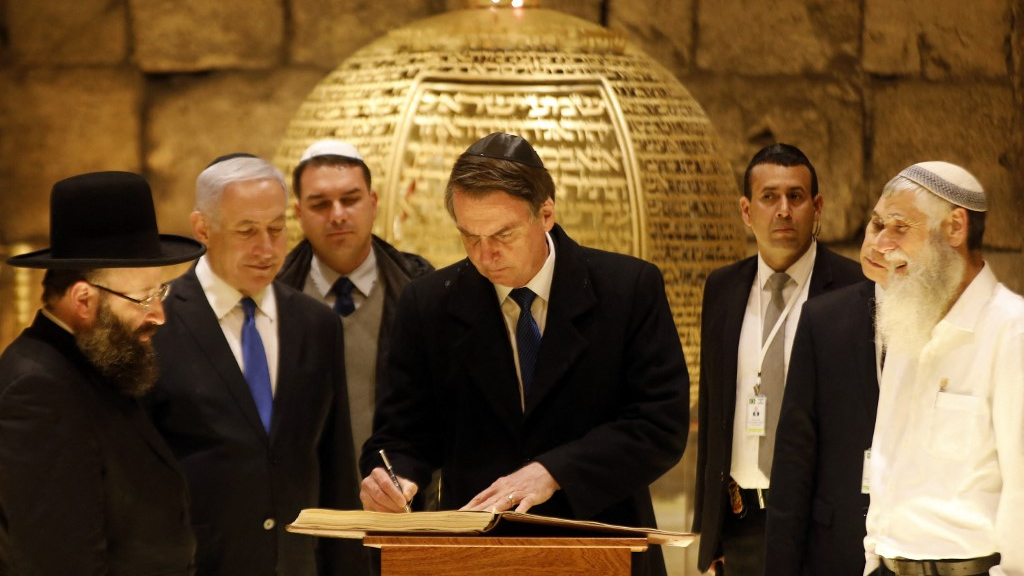
Israeli influence in Brazil was “built mainly through the armed forces and the police, and from there it extends to far-right parties and movements,” said Bruno Huberman, a professor of international relations at the Pontifical Catholic University of Sao Paulo in Brazil.
But, perhaps somewhat ironically, the relationship with Israel “began to change” under Lula’s first stint as president, between 2003 and 2011, he says.
As Brazil moved closer to the Global South and Arab countries in particular, it also created a “counterweight” through its relationship with Israel, Huberman said. It did so by “importing weapons, which created a relationship of technological dependence”.
The shift was also ideological. The military and police shared what Huberman called an “ideological identification” with Israel, underpinned by “Islamophobia, counterterrorism”.
“These unelected public servants thus become a channel of pressure within the state, pushing Brazil closer to Israel not for technical reasons, such as Israeli weapons being better, but for ideological ones,” he said.
Israeli arms diplomacy
When Jair Bolsonaro came to power in 2019, he immediately leaned on the military to shore up his power.
Military officers served as chief of staff and health minister and held about half the ministerial posts in Bolsonaro’s federal government. More than 6,000 active and reserve military personnel took up roles in the country’s civil service.
Bolsonaro’s ideological alignment with Israel rested on military ties that predated his presidency. Research by Huberman and Isabela Agostinelli dos Santos, a professor of international relations at FECAP, a higher education institution in Brazil, found that “continuities outweigh ruptures”, with “arms diplomacy” underpinning and stabilising the relationship despite periodic diplomatic spats.
'The Bolsonaro family is far more open to Israeli interests, in Brazil and across Latin America as a whole'
- Professor Isabela Agostinelli dos Santos
Defence and security ties between the two countries date back to 1964, during Brazil’s military dictatorship. The current arms industry relationship took shape in the early 2000s, with Israeli defence company Elbit Systems playing a central role.
Israel’s foothold has steadily expanded since then, with deals reaching “almost $190 million by 2014,” Santos told MEE, adding that “much of it with Elbit, and the arrival of Israeli security firms in Brazil, all took place under the [the Workers' Party],” which Lula leads.
“So Bolsonaro didn’t usher in a 'new era'. In fact, he intensified structural dynamics that were already under way,” she added.
Any single government would struggle to untie those military dependencies quickly, giving Israel a lasting role in Brazil’s defence industry.
Elbit took control of Brazilian avionics company AEL in 2001 and joined Brazilian aerospace company Embraer on a fighter upgrade programme valued at tens of millions.
Elbit later supplied equipment for armoured vehicles through AEL, while state-owned Israeli defence company Rafael sold Brazil its Spike anti-tank missiles.
“The Bolsonaro family is far more open to Israeli interests, in Brazil and across Latin America as a whole, and that has a lot to do with their alignment with the United States and its special relationship with Israel,” said Santos.
Those ties leave Lula balancing his criticism of Israel with the delicate relationship between his party and Brazil’s military, which leans towards the right and is closer to Israel.
In August 2024, five months after the Brazilian military signed a $210m deal with Elbit for 36 Atmos 2000 self-propelled howitzers, Lula suspended the contract. Crucially, he did not cancel it.
Lula has called Israel’s war on the besieged Gaza Strip a "genocide and an attempt to exterminate the Palestinian people".
Brazil has joined the legal proceedings South Africa initiated against Israel at the International Court of Justice. After Lula compared the killings in Gaza to the Holocaust, the Israeli government declared him "persona non grata".
Against this backdrop, Brazil withdrew its ambassador from Tel Aviv in 2024. Today, the two countries maintain diplomatic relations only at the level of charge d’affaires.
'Foreign policy rarely decides elections in Brazil'
Despite Lula’s stance on Israel over Gaza, three powerful caucuses operate at the parliamentary level. Known as the three Bs, they represent bullets, referring to legislators with a military background; beef, representing powerful agribusiness interests; and the Bible, representing evangelicals.
Many evangelicals share the attachment to Israel that their co-religionists in the US hold, and wield similar political power as a voting bloc.
Even as the executive branch under Lula tilted modestly against Israel, the legislature created the Brazil-Israel Parliamentary Front in November 2025, reviving a parliamentary vehicle documented as far back as 2004.
Flavio Bolsonaro, one of its members, used its launch to signal that a government he led would restore close ties with Israel.
“Even with a president who is more critical of Israel, the legislative base is becoming increasingly pro-Israel, largely because of the alliance between the evangelical caucus and the so-called ‘bullet caucus,’” said Santos.
'For most voters, the Israel-Palestine issue mainly reinforces existing loyalties, since the issue now follows Brazil's left–right divide'
- Professor Feliciano de Sa Guimaraes
In Brazil, the evangelical vote amounts to an estimated 40 million voters. Flavio Bolsonaro had 52 percent support among evangelical voters, against Lula’s 26 percent. In a second-round scenario, the figures were 62 percent and 32 percent respectively.
“These religious groups have been the most fervent defenders of the State of Israel, or rather of an imagined Israel, conservative and deeply religious," said Magalhaes.
“Foreign policy rarely decides elections in Brazil,” notes Feliciano de Sa Guimaraes, a professor at the Institute of International Relations at the University of Sao Paulo.
“Jobs, living costs and public security matter far more to most voters. But international issues do affect presidential popularity,” said Guimaraes, who has been polling Brazilians on their stances on international relations, speaking to MEE.
According to the latest Pew research earlier this year on international views of Israel, just over half of Brazilians had an unfavourable view of Israel, and more than 60 percent lacked confidence in Netanyahu.
At the start of Israel’s war on Gaza, the “median Brazilian voter leaned pro-Israel”, Guimaraes noted. Since then, he said, it has been the “voter who moved closer to Lula, not the reverse”.
“For most voters, the Israel-Palestine issue mainly reinforces existing loyalties, since the issue now follows Brazil's left–right divide,” said Guimaraes.
Middle East Eye delivers independent and unrivalled coverage and analysis of the Middle East, North Africa and beyond. To learn more about republishing this content and the associated fees, please fill out this form. More about MEE can be found here.