
Why Hamas believed the status quo was more dangerous than its 7 October gamble


The events of 7 October cannot be understood outside the long history of Palestinian dispossession, occupation, siege and struggle. They cannot be examined seriously by beginning with the premise that Palestinians must justify their right to resist a system that has dispossessed them for generations. That right is not in question.
What is open to question is why Hamas chose this particular course of action at this particular moment, and whether the decision was rational given what its leaders knew and could reasonably have anticipated before 7 October.
It also raises the question of whether it was the right strategic choice among the alternatives available to them, and what strategic assessment led them to take such an extraordinary risk.
These questions are inevitably viewed through the devastation that followed. Gaza has endured a genocide, as concluded by Amnesty International, B'Tselem, the International Association of Genocide Scholars and the UN Independent International Commission of Inquiry, while Human Rights Watch has documented extermination and acts of genocide.
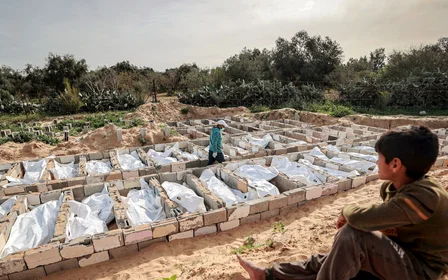
For three years, Gaza has suffered destruction and losses on a scale few could have imagined before 7 October.
New MEE newsletter: Jerusalem Dispatch
Sign up to get the latest insights and analysis on Israel-Palestine, alongside Turkey Unpacked and other MEE newsletters
Hindsight is no substitute for analysis. Rationality must first be judged on what decision-makers knew, feared and reasonably expected at the time. Whether the decision was ultimately correct is a different question, and one whose answer may still be premature.
Hamas's internal discussions in the years preceding 7 October reveal a leadership increasingly convinced that the status quo itself had become a strategic threat.
Most of the internal documents on which that picture rests, captured by the Israeli army in Gaza, have been published by the Meir Amit Intelligence and Terrorism Information Center, an Israeli research centre tied to the military intelligence establishment, and they offer an insight into the thinking of Hamas's Gaza leaders in the years before the attacks.
Five developments shaped that calculation: the siege of Gaza; the accelerating colonisation of the West Bank; the struggle over Jerusalem and Al-Aqsa Mosque; Palestinian prisoners inside Israeli prisons; and normalisation, particularly the prospect of a Saudi-Israeli agreement.
Each of the five pointed to the same conclusion that time was not neutral. Waiting was itself a choice, and one that Hamas increasingly believed was steadily eliminating Palestinian options.
Siege, settlers, Al-Aqsa
Gaza came first. By 2023, the siege had lasted more than 16 years, and more than 2.2 million Palestinians were confined to a narrow coastal strip, with movement, trade, and economic and social life heavily restricted. Movement into and out of Gaza remained tightly controlled.
Even before the current war, unemployment stood at around 44 percent in the second quarter of 2022, and youth unemployment exceeded 60 percent later that year.
More than 80 percent of Gaza's population lived below the poverty line, and 1.2 million Palestinian refugees depended on emergency food assistance from Unrwa, the UN agency for Palestinian refugees, to meet their most basic needs.
Hamas governed Gaza but could not end the siege. Periodic confrontations imposed costs on the Zionist regime but failed to alter the basic equation. Destruction was followed by limited reconstruction, negotiations produced temporary easing and the blockade remained.
The choice, therefore, was never simply between war and peace. The existing situation itself involved continuing violence, strangulation and deterioration.
The West Bank presented a different but equally urgent danger. Settlement expansion was steadily destroying what remained of the territorial basis for a Palestinian state. By 2023, roughly 750,000 Israeli settlers were living in the occupied West Bank, including East Jerusalem, in settlements that are illegal under international law.
The choice was never simply between war and peace. The existing situation itself involved continuing violence, strangulation and deterioration
The government formed by Benjamin Netanyahu in late 2022 brought figures such as Bezalel Smotrich into positions of unprecedented influence over the West Bank. Smotrich had openly presented Palestinians with three choices: accept Israeli rule and domination without national aspirations, emigrate, or face deadly force if they resisted.
For Hamas, the strategic implication extended beyond the settlements themselves. Time was not necessarily working in the Palestinians' favour. Every additional year brought greater territorial fragmentation, more Israeli control and fewer possibilities for reversing the process. Under such circumstances, strategic patience could eventually become strategic paralysis.
Jerusalem and Al-Aqsa further raised the stakes. The May 2021 confrontation, Saif al-Quds, had demonstrated Al-Aqsa's extraordinary capacity to mobilise Palestinians, as well as Muslims worldwide, across geographical and political divisions.
For Hamas, the confrontation represented something larger than another war between Gaza and the Zionist regime. It appeared to demonstrate the possibility of connecting Gaza, Jerusalem, the West Bank, Palestinians inside the 1948 territories, prisoners and the diaspora within a single national struggle.
Events in 2022 and 2023 sharpened Hamas's fears for Al-Aqsa. Repeated Israeli incursions into Al-Aqsa, confrontations with worshippers and increasingly assertive demands by Israeli religious-nationalist forces concerning the compound raised fears that the existing arrangements were being gradually dismantled.
The experience of the Ibrahimi Mosque in Hebron, first divided and then placed increasingly under Israeli control, provided an ominous precedent. For Hamas, another Palestinian red line appeared to be eroding.
Prisoners and normalisation
The prisoners added a fourth pressure. More than 5,000 Palestinians were being held in Israeli prisons before 7 October, including women and children, while more than 1,200 were detained without charge.

Soon after becoming national security minister, Itamar Ben Gvir began imposing additional restrictions on Palestinian prisoners.
The history of prisoner exchanges offered a different lesson. The 1985 Jibril agreement secured the release of 1,150 prisoners held by Israel, and Hezbollah's exchanges with Israel in 2004 and 2008 reinforced the same principle.
Most importantly for Hamas, the 2011 Gilad Shalit exchange resulted in the release of 1,027 Palestinian prisoners for a single captured Israeli soldier.
The conclusion was difficult to miss. Prisoners created leverage where diplomacy often did not, so capturing Israeli soldiers belonged to an established strategic logic rather than being an objective invented on 7 October.
The fifth development, normalisation, may have been the most consequential of all. By 2023, Hamas was increasingly concerned about a regional transformation that threatened to marginalise the Palestinian question altogether.
 The 2020 Abraham Accords had demonstrated that Arab governments could normalise relations with Israel without resolving the Palestinian issue, and the Biden administration was now pursuing the far more consequential prize of normalisation between Saudi Arabia and Israel.
The symbolism became unmistakable on 22 September 2023, barely two weeks before 7 October. Standing before the UN General Assembly, Netanyahu presented his vision of a "new Middle East", centred on normalisation and an economic corridor linking Asia and Europe through the region.
The map he displayed effectively showed historic Palestine as Israel, without a Palestinian state. For Hamas, the danger that Palestine would be strategically bypassed altogether was obvious.
This was the context in which Hamas made its decision. Gaza remained besieged, the West Bank was being colonised, Al-Aqsa appeared increasingly threatened, thousands of prisoners remained incarcerated, and normalisation threatened to push Palestine further towards the margins of regional politics.
None of this proves that 7 October was the only viable response, but it demonstrates that the operation emerged from an identifiable political and strategic calculation.
Judging rationality
Rationality has to be judged ex ante, not ex post. After witnessing Gaza's devastation, it is tempting to reason backwards and conclude that any decision followed by such destruction must have been irrational. That is not how strategic decisions can fairly be evaluated.
Before weighing Hamas's judgment, one distinction must be clear. Responsibility for the genocide and destruction of Gaza lies with the Zionist regime and those who enabled it. The question here is whether Hamas adequately anticipated the response and incorporated it into its strategic calculations, which is a different matter from whether Palestinian resistance caused Israel's conduct.
Hamas certainly expected a massive Israeli assault. No serious leader could have believed that Israel would absorb an operation involving the breaching of the Gaza perimeter, the overrunning of military positions, the killing of hundreds of Israeli soldiers and settlers, and the capture of a large number of Israelis without launching a major war.
Hamas must also have expected extensive American support, since previous Israeli wars against Gaza provided ample evidence of both.

Still, foreseeing a severe military assault is vastly different from predicting the unprecedented war that followed: a genocidal campaign extending across years; the displacement of nearly an entire population; the physical destruction of vast portions of Gaza; and a campaign of starvation and deprivation carried out despite global scrutiny.
American support itself was entirely predictable, but its scale and duration were without precedent. Washington continued providing the most sophisticated weapons and destructive munitions, intelligence and diplomatic protection despite the mounting Palestinian death toll and growing international condemnation.
Major European governments largely remained aligned with Israel and the United States, while the response of Arab and Muslim governments remained extraordinarily weak. Each of these bears directly on Hamas's assessment before 7 October.
Iran, Hezbollah and the broader Axis of Resistance raise a separate question. Hamas had spent years developing these relationships and seeking greater coordination among the region's resistance movements. After Saif al-Quds in 2021, its internal discussions increasingly reflected an interest in connecting the Palestinian struggle to a wider regional confrontation with the Zionist regime.
The documentary record does not support the simplistic claim that Hamas launched 7 October because Iran or Hezbollah had promised to enter an all-out regional war.
Hamas sought deeper coordination, discussed multiple fronts and several possible scenarios, and understood that pressure from Lebanon and elsewhere could complicate Israel's military calculations. Its leaders were actively communicating with Iran and Hezbollah, but communication is not a binding military alliance.
Equally, the evidence does not establish that Iran or Hezbollah knew the timing and operational details of 7 October beforehand, much less that Hamas possessed a guarantee that either would immediately enter a full-scale war.
Miscalculation and alternatives
If Hamas launched the operation expecting Iran and Hezbollah to immediately enter an all-out regional war, then a central assumption of its strategy failed almost at once. The available evidence points instead towards an expectation of gradual regional pressure in the form of additional fronts that would impose military and strategic costs on Israel without necessarily producing immediate total war.
That did happen, although not on the scale necessary to prevent Gaza's devastation. Hezbollah opened a support front from Lebanon, the Houthis intervened from Yemen, Iraqi groups attacked American positions, and Iran itself eventually entered into direct confrontation with Israel and the United States after coming under attack.
Hamas did have alternatives, and more importantly, Yahya Sinwar had already tried several of them
The strategic miscalculation, if there was one, lay in failing to anticipate the convergence of several adverse developments: an Israeli assault that crossed virtually every previous threshold; sustained western military and diplomatic support despite mounting evidence of genocide; the extraordinary weakness of Arab and Muslim governments; limited coordination among the Axis of Resistance, whose members were surprised by the timing of the operation; and the failure of a major uprising to materialise in the West Bank or among Palestinians inside the Green Line.
Hamas could reasonably have anticipated several of these obstacles individually. Failing to forecast all of them occurring at this magnitude, all at once, proved to be a serious blind spot.
Every judgment about 7 October has to answer another question: compared with what?
Hamas did have alternatives, and more importantly, Yahya Sinwar had already tried several of them. After assuming leadership in Gaza in 2017, he pursued reconciliation with Palestinian Authority President Mahmoud Abbas and offered to return administrative authority in Gaza to the PA while seeking an end to the blockade and sanctions. The effort ultimately failed amid Israeli and American opposition.
Hamas pursued long-term ceasefire arrangements through Egyptian and Qatari mediation. In 2018-19, Palestinians in Gaza turned to largely peaceful mass mobilisation through the Great March of Return, only to face an Israeli response that killed more than 200 Palestinians and wounded tens of thousands, including children.
Hamas could still have chosen restraint, further diplomacy, limited escalation, continued military build-up or simple organisational survival. Its 2017 Document of General Principles and Policies had already demonstrated considerable political flexibility by accepting the establishment of a fully sovereign Palestinian state on the 1967 borders as a formula of national consensus, without recognising the legitimacy of the Zionist project.
By 2023, Hamas's leaders had years of experience with precisely these approaches, and none had ended the siege, stopped settlement expansion, protected Al-Aqsa, freed thousands of prisoners or reversed the regional normalisation process.
This is the weakness of much retrospective criticism of 7 October. To demonstrate that the decision was strategically mistaken or irrational, it is not enough to point to the catastrophe that followed. One must identify the realistic alternative available on 6 October and ask where that alternative would likely have led.
Waiting was also a decision, and Hamas concluded that waiting meant letting the strategic environment deteriorate until Palestinian resistance faced even worse circumstances. Whether that conclusion was correct is another question, but it was not irrational.
Cost and consequences
So from Hamas' perspective, was 7 October the correct decision? This is the hardest of these questions, and I do not believe it can yet be answered definitively.
The human cost has been staggering. At least 74,000 Palestinians, and possibly thousands more, have been killed, while more than 175,000 have been injured. Most of Gaza's population has been displaced, many repeatedly. Families, neighbourhoods, universities, schools, hospitals, mosques, churches and much of the territory's civilian infrastructure have been destroyed.
No strategic assessment can look away from that reality, and none can surrender an equally important principle. Responsibility for Israel's conduct in Gaza belongs to the Zionist regime and to those who enabled and supported it. Resistance cannot be held responsible for the crimes committed by the power it resists.
Otherwise, the stronger party acquires an extraordinary veto, since it need only threaten sufficient brutality against the civilian population for any act of resistance to become strategically or morally illegitimate because of the punishment imposed afterwards. That cannot be the standard.
Even so, placing responsibility for the genocide where it belongs does not exempt the Palestinian leadership from examining its own strategic choices. A resistance movement has an obligation to evaluate capabilities, consequences, alternatives and the likely behaviour of allies and enemies. That is why 7 October requires analysis rather than slogans.
The attacks of 7 October unquestionably transformed the Palestinian question. Before that day, Palestine appeared to be moving towards international marginalisation.
The Abraham Accords had established a regional model in which Arab governments could normalise relations with the Zionist regime without resolving Palestinian rights. Saudi-Israeli normalisation was advancing, and Netanyahu could stand before the United Nations and display a map of a new Middle East in which Palestine had effectively disappeared.
That day shattered that trajectory and returned Palestine to the centre of international politics.
Israel's occupation, settlements and treatment of Palestinians came under scrutiny on a scale not seen for decades, and a new generation across much of the world began asking questions not simply about Israeli policies but about Zionism, settler colonialism, the Nakba and the political system imposed on Palestinians.
The war also exposed profound contradictions within the western-led international order. Institutions created to uphold international law confronted a test whose consequences for their legitimacy extend far beyond Palestine. Regional normalisation was disrupted, and the global discourse changed significantly, although government policies lagged far behind.
Transformation does not guarantee victory.
Gaza has paid an almost unimaginable price. Palestinian society has suffered enormous losses, the regional balance remains unsettled, and the consequences for Hamas, the Palestinian national movement, the Zionist state and the broader Middle East are still unfolding.
It is therefore premature to pronounce 7 October either a historic strategic triumph or a catastrophic strategic failure. History rarely renders judgments on events of this magnitude while their consequences are still unfolding.
The verdict of history
The Palestinian revolt of 1936 appeared defeated by 1939. The First Intifada eventually produced Oslo, initially celebrated by many as a historic breakthrough but later associated with fragmentation, security coordination, expanding settlements and a failed political process. Historical events acquire their full meaning through consequences that may take years, sometimes decades, to emerge.
History offers many examples of nations enduring extraordinary suffering in struggles against invasion, occupation and foreign domination without that suffering determining the ultimate historical outcome.
The Soviet Union lost more than 20 million people in defeating Nazi Germany. Vietnam lost millions during decades of war against French colonialism and American intervention before achieving reunification and independence. Afghanistan likewise endured two decades of American occupation, at an enormous human cost, before US forces finally withdrew in 2021.
The decision to launch the 7 October attacks cannot be reduced to an inexplicable eruption of violence, but neither should it be placed beyond criticism
None of these experiences maps onto Palestine, and none should be compared with it mechanically. What they show is that the scale of a people's suffering cannot, by itself, determine whether the decision to resist was strategically wrong. That judgment ultimately depends on what the struggle achieves, what alternatives existed and how its consequences unfold over time.
The operation may ultimately be judged a devastating strategic miscalculation, or it may instead be remembered as the moment when an unsustainable political and regional order was shattered and the Palestinian question was forced back onto the historical stage.
It can already be said with confidence that the decision emerged from a coherent strategic assessment. Hamas concluded that the status quo was not sustainable because time was steadily narrowing Palestinian options, and its leaders chose to break that trajectory.
Whether they correctly calculated the price is another matter. To expect a severe military response was not to expect a genocidal campaign that crossed every historical threshold of destruction.
It is also unclear whether they correctly anticipated the degree of sustained western support for Israel, the weakness of Arab and Muslim governmental responses, the limits of regional military intervention or the limited uprising that emerged from the West Bank and among Palestinians inside the 1948 territories.
The decision to launch the 7 October attacks requires serious examination as a strategic choice. It cannot be reduced to an inexplicable eruption of violence, but neither should it be placed beyond criticism.
The task is to reconstruct what Hamas knew, what it feared, what alternatives remained and what it expected from Israel, the Palestinian people, the Axis of Resistance, the Arab and Muslim worlds and the international system, and then to compare those expectations with what actually happened.
That is enough to begin judging whether the decision was rational. Judging whether it was ultimately correct requires knowing where the Palestinian struggle stands after the historical consequences of 7 October have fully unfolded.
We are not there yet. The verdict of history remains open.
The views expressed in this article belong to the author and do not necessarily reflect the editorial policy of Middle East Eye.
Middle East Eye delivers independent and unrivalled coverage and analysis of the Middle East, North Africa and beyond. To learn more about republishing this content and the associated fees, please fill out this form. More about MEE can be found here.