
West Bank: Almost 20 Israeli settler attacks target Palestinians in day of mass violence

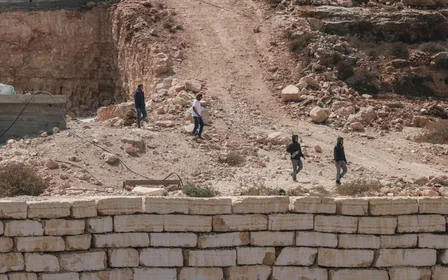
At least 19 attacks by Israeli settlers against Palestinians were recorded by midday on Friday, according to field reports, in a wave of violence across the occupied West Bank.
The Colonisation and Wall Resistance Commission, a Palestinian body monitoring settlements and the separation wall, said the attacks included assaults on olive harvesters, the burning of trees, the theft of crops and livestock, and assaults on Palestinian residents.
It added that the incidents point to an escalation in settler violence during the annual olive harvest, a vital source of income for many Palestinian families.
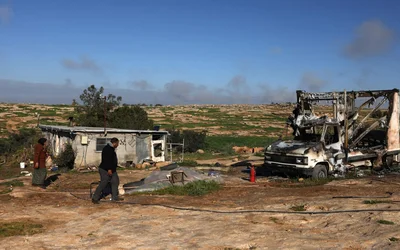
In Tell, settlers burned a vehicle during an assault on farmers. In Qusra, they uprooted more than 50 olive trees.
Olive harvesters were also attacked in Jurish, Beita, An-Nakura, Birzeit, Deir Ibzi and Fara'ata, the commission said.
New MEE newsletter: Jerusalem Dispatch
Sign up to get the latest insights and analysis on Israel-Palestine, alongside Turkey Unpacked and other MEE newsletters
In separate incidents, settlers opened fire in Deir Ballut, while a farmer was wounded in Kafr ad-Dik.
An elderly woman was also wounded in Birin, east of Hebron, after settlers set their dogs on farmers, according to the statement.
Other reported attacks included the theft of sheep in Ein Qiniya and an assault on a Palestinian man and his child in Yabrud, in which their vehicle was also stolen. Settlers also targeted vehicles in Sarada and Al-Rayhan.
Video footage of the incident in Yabrud showed two cars driven by settlers blocking the Palestinians' vehicle. The settlers then got out, beat the man, forced him and his son from the car, and drove away in it.
The commission warned that the attacks were making it increasingly difficult for Palestinians to access and cultivate their land during the harvest season.
“The recurrence of these attacks, with the participation or protection of occupation forces at several locations, reinforces an environment of coercion intended to prevent Palestinians from benefiting from their land and to push them to abandon it,” the commission said.
“Targeting the olive harvest season violates Palestinians’ rights to their land, work and security,” it added.
Violence by Israeli settlers against Palestinians has long been a feature of life in the occupied West Bank and East Jerusalem, but it has intensified sharply since Israel began its genocide in Gaza in October 2023.
Settlers carry out near-daily attacks on Palestinian towns and villages, including arson, vandalism, physical assaults and forced displacement, often under the protection of the Israeli military.
Settler violence on the rise
Attacks frequently intensify during the olive harvest, which typically takes place around October and is a crucial period for Palestinian agricultural communities across the West Bank.
Between 15 and 21 September, the UN Office for the Coordination of Humanitarian Affairs (Ocha) documented 51 settler attacks that resulted in Palestinian casualties or property damage.
At least 800 olive, fruit and palm trees were damaged, uprooted or burned during that week, according to Ocha.
Earlier this year, the UN Independent International Commission of Inquiry on the Occupied Palestinian Territory described the escalation in settler violence against Palestinians as unprecedented and sustained.
The commission said the Israeli government supports the attacks through financial backing, logistical assistance and military protection.
“Violence by settlers is the direct outcome of Israeli policies that support, enable and protect their actions,” said Srinivasan Muralidhar, chair of the commission.
According to Ocha, more than 1,600 settler attacks resulting in Palestinian casualties, property damage or both were recorded between the beginning of January and the end of September.
That amounts to an average of 6.7 attacks per day, compared with five per day in 2025, when 1,836 attacks were recorded.
Around 1,500 attacks were recorded in 2024, compared with 853 in 2022.
Middle East Eye delivers independent and unrivalled coverage and analysis of the Middle East, North Africa and beyond. To learn more about republishing this content and the associated fees, please fill out this form. More about MEE can be found here.