US sanctions International Criminal Court hours after former judge wins Nobel Peace Prize

The Trump administration imposed sanctions on the International Criminal Court (ICC) as an institution on Friday, hours after one of its founding judges won the Nobel Peace Prize.
The measures follow earlier sanctions against half of the court's 18 judges and much of its leadership, including its president and chief prosecutor, in response to its 2024 arrest warrants for Israeli leaders.
Secretary of State Marco Rubio is announced the sanctions in a video statement on Friday.
"President Trump will never allow the International Criminal Court to prosecute Americans," he said.
"That is why, today, the United States is sanctioning the International Criminal Court. We will ban transactions with this rogue court, cutting off their resources and crippling its ability to operate."
New MEE newsletter: Jerusalem Dispatch
Sign up to get the latest insights and analysis on Israel-Palestine, alongside Turkey Unpacked and other MEE newsletters
He added that as a non-member, the US is not subject to the jurisdiction of the court.
'Either the ICC will end its threats, or we will end the ICC'
- Marco Rubio, US Secretary of State
"Either the ICC will end its threats, or we will end the ICC. We expect our allies, many of whom are part of the ICC and that rely on American service members for their defense, to rein in the court," Rubio added.
"We have structured this action to provide an opportunity for States Parties to negotiate and present a solution to address our concerns. If these efforts do not bear fruit, we will continue to adjust accordingly."
The restrictions could prevent the court from conducting transactions in US dollars, effectively cutting it off from large parts of the international financial system and potentially crippling its operations. Banks tend to over-comply with sanctions because of their dependence on that system.
However, ICC officials told Middle East Eye ahead of the announcement that they were prepared to withstand the impact of institutional sanctions and had alternative arrangements in place.
Reacting to the sanctions, the Dutch foreign minister Tom Berendsen said his country, as the host of the court, will continue to support the court.
“The Netherlands will continue to stand firmly behind the ICC. We will continue to do our utmost to ensure that the Court functions well: as a host country and as a treaty party.”
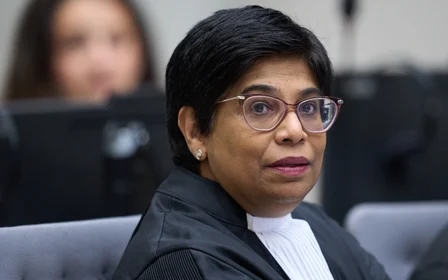
The court's president, Judge Tomoko Akane, also said the court's work will not be interrupted.
"The Court will continue to fully discharge its mandate, with independence and impartiality, acting only on the basis of the law and the evidence, for the sake of the countless victims of grave crimes," Akane said.
The US State Department explained in a fact sheet that the Department of Treasury is issuing a number of general licenses to authorise certain ICC transactions "to protect US interests".
These include a 180-day licence authorising certain activity involving the ICC, including for the maintenance of its operations; authorising certain IT-related activities, including cloud and software services; authorising activity related to the ICC pension plan; and a general licence authorising certain activity related to the ICC detainees.
The State Department said the the 180-day maintenance general licence "is intended to provide time for States Parties to demonstrate meaningful progress on diplomatic and legal resolutions that address fundamental U.S. concerns regarding the ICC." It added that the general licence "can be adjusted in response to the success or failure of such efforts to address our concerns".
ICC officials have previously warned that sanctions targeting the institution could disrupt the purchase of IT services and insurance, the recruitment of investigators and routine financial operations, including payments to dozens of American employees.
In response to US sanctions against the ICC, many have called on the European Union to activate its Blocking Statute, which aims to protect EU companies and individuals from the effects of extraterritorial sanctions imposed by third countries.
It essentially prevents them from complying with foreign laws that could harm their business operations within the EU, even if those laws target activities outside the EU jurisdiction.
If activated, the statute would reassure EU-based service providers that their transactions with the ICC are protected.
'We need people of courage, vision and determination - qualities that Navi Pillay demonstrates in her work on the bench'
- Nobel awarding committee
The European Commission has so far not triggered the mechanism, offering no public explanation for the delay, despite the European Parliament having passed resolutions calling for its activation in July and September last year.
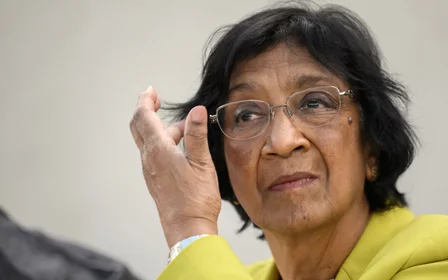
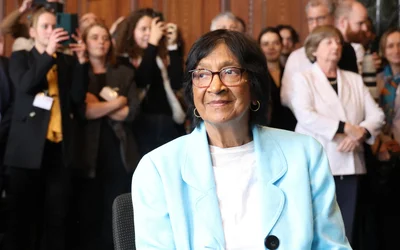
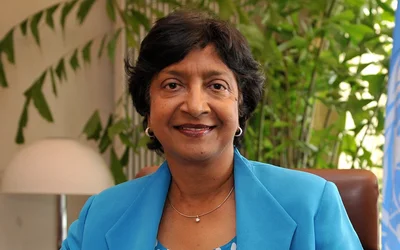
The sanctions came hours after Navi Pillay, the eminent South African jurist and one of the ICC's founding judges, was awarded the Nobel Peace Prize for her contributions to international law.
The awarding committee noted the sanctions on ICC judges and the attacks on the court as it recognised the importance of Pillay's work.
"History has shown that a world operating without the rule of law is unjust, unwise and inhumane. The judges - those who guard the thin red line between order and chaos - are therefore highly deserving of our praise," said the committee.
"But today, as these same judges are sanctioned, and their institutions are attacked, we need people of courage, vision and determination - qualities that Navi Pillay demonstrates in her work on the bench."
'Financial death penalty'
Washington has already imposed sanctions on several ICC top officials, including court president Tomoko Akane, who was sanctioned in August along with senior trial lawyer Abdoulaye Seye.
Former chief prosecutor Karim Khan was the first to be sanctioned in February last year, followed by two deputy prosecutors and nine judges involved in the court’s Palestine and Afghanistan investigations.
The sanctions on court staff have been described as tantamount to a “financial death penalty” as the affected officials have been cut off from basic financial services.
MEE reported in December that diplomats at the ICC's annual Assembly of States Parties meeting in The Hague said the Trump administration had pressed the court to drop its investigations into war crimes in Palestine and Afghanistan as a condition for lifting sanctions.
It also demanded that states amend the ICC’s founding treaty - the Rome Statute - to prevent the prosecution of nationals from countries that are not members of the court, such as the US and Israel.
At the end of its meeting, however, the assembly issued a declaration resisting those demands and rejecting calls to amend the Rome Statute, without naming the US directly.
The court issued arrest warrants in November 2024 for Israeli Prime Minister Benjamin Netanyahu and former defence minister Yoav Gallant over alleged war crimes and crimes against humanity in Gaza, primarily in connection with the use of starvation as a method of warfare.
The ICC also sought warrants for three Hamas leaders, although those named have since been killed.
Established in 2002, the ICC is the world’s only permanent international criminal court with the mandate to investigate and prosecute individuals for genocide, crimes against humanity, war crimes and the crime of aggression.
The court currently has over a dozen active investigations, including the situations in Darfur, Libya, Myanmar and Ukraine.
Middle East Eye delivers independent and unrivalled coverage and analysis of the Middle East, North Africa and beyond. To learn more about republishing this content and the associated fees, please fill out this form. More about MEE can be found here.