The wedding couple who broke the 'Palestine hate march' myth


Why would a photograph of a newly married couple incite a storm of abuse?
Over the past three years, our coalition (comprising Friends of Al-Aqsa, the Palestine Solidarity Campaign, Stop the War and other partners) has organised more than 35 national demonstrations in London to end the genocide in Gaza.
We have been smeared, policed and lectured. But I have never received as much hate online as I did after 10 October, when I posted an image of a bride in white and her groom on X.
They had been taking their wedding photographs on Westminster Bridge and chose to join the front of our march for a while, taking pictures with us and chanting “Free Palestine”.
The replies came fast. “Evil personified.” “Bunch of Nazis.” “Does your god love you?”
New MEE newsletter: Jerusalem Dispatch
Sign up to get the latest insights and analysis on Israel-Palestine, alongside Turkey Unpacked and other MEE newsletters
One meme set a Palestinian flag beside a religious banner, and called us rapists and kidnappers in waiting. One woman shared the post to pity the couple’s families: “Imagine marrying in a hate mob and thinking you are the good guys. Their children will only feel shame.”
Others reached for slurs I will not repeat.
A happy, smiling couple drew abuse, and the abuse was what proved the point. Anyone looking for hate that day would have found it in those replies, not on the bridge in London.
Palestine in the frame
In nearly every culture, a wedding is a public rite of passage: two people make promises in front of a community that acts as witness. It is a statement of hope and faith in the future, and in the people around you. Nobody celebrates their happiest day among people they fear.
The wedding photograph is a carefully chosen record; it is the picture we expect to hang in hallways and show to grandchildren.
Last weekend, that couple chose to put Palestine inside their frame. That is why the image is so threatening.
Our marches have always been about love and freedom. On 10 October, a bride and groom said so on the happiest day of their lives
Since Suella Braverman, then the UK home secretary, called our demonstrations “hate marches” in October 2023, a whole vocabulary has been built around them. In March 2024, the government’s counter-extremism commissioner wrote that London had become “a no-go zone for Jews every weekend”.
Anyone who has attended the marches has seen Jewish demonstrators, including one group this month marching under a banner reading “Holocaust survivor descendants against Gaza genocide”.
Even the Metropolitan Police, which routinely imposes conditions on our marches, said before 10 October that “the majority who attend do so peacefully and lawfully”. As early as February 2024, openDemocracy found that arrests at the protests in their first months had resulted in just 36 charges, with an arrest rate lower than that at the Glastonbury Festival.
Yet pro-Israel cheerleaders repeat the slander until it feels like common sense. The “hate march” label was meant to become that type of common sense. Photographs can break a myth like this, because they offer inarguable evidence.
Edward Said wrote in 1984 that “facts do not at all speak for themselves, but require a socially acceptable narrative to absorb, sustain and circulate them”. For decades, Palestinians have been denied what he called “permission to narrate”.
A bride on Westminster Bridge tells a story the “extremists” script cannot take in. It shows a movement of families, pensioners, children, Jews, Muslims, Christians and people of no faith, so ordinary and so trusted that someone would join it on their wedding day.
Failed narrative
Author Ariella Azoulay writes that a photograph creates a “citizenry” of everyone who looks at it, essentially drawing them into a civic relationship with the people pictured. That is exactly what the angry replies on my social media feed were trying to refuse.
The manufactured narrative also failed for a simpler reason: we were right.
Since we began marching, the world’s leading authorities on genocide and human rights have reached the conclusion we started from. Amnesty International found in December 2024 that Israel was committing genocide in Gaza; the Israeli human rights group B’Tselem said the same in July 2025; and in September 2025, the International Association of Genocide Scholars resolved that Israel’s war in Gaza constituted genocide.
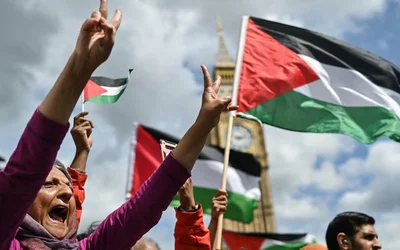
That same month, a UN commission of inquiry found that Israel had committed four of the five genocidal acts defined by the 1948 Genocide Convention. Its chair, Navi Pillay, said Israel was “responsible for the commission of genocide in Gaza”.
The day before our march, Pillay was awarded the Nobel Peace Prize “for her efforts to promote peace and international law”.
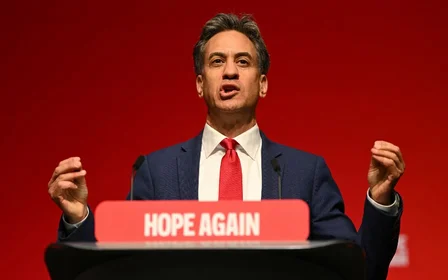
Just weeks earlier, Foreign Secretary Ed Miliband had told the House of Commons that Gaza was “a stain on the conscience of the world and of this country too”, and declared the occupation to be unlawful.
At Labour’s annual conference, he addressed people like us directly: “We hear you. You were right.”
He still will not call it a genocide. British-made F-35 parts still flow into Israel. And the day before Miliband’s speech, more than 50 protesters sitting peacefully with placards were arrested outside the conference hall.
Vindication is not victory. But the couple on the bridge understood something their abusers cannot. Marching for Palestine does not threaten anyone’s future. It is a way of insisting that Palestinians have a future too: the right to marry, raise children and grow old in freedom on their own land.
Our marches have always been about love and freedom. On 10 October, a bride and groom said so on the happiest day of their lives.
The views expressed in this article belong to the author and do not necessarily reflect the editorial policy of Middle East Eye.
Middle East Eye delivers independent and unrivalled coverage and analysis of the Middle East, North Africa and beyond. To learn more about republishing this content and the associated fees, please fill out this form. More about MEE can be found here.