US judge bars Trump from punishing rights groups for liaising with ICC

A federal judge this week blocked the Trump administration from potentially imposing civil or criminal liability on two US-based human rights groups that carry out work in "service" of International Criminal Court (ICC) cases.
Judge Jesse Furman of the Southern District of New York said the plaintiffs "demonstrate a likelihood of success on the merits of their claim that the [presidential executive] Order violates their First Amendment rights to speak", and that "[t]he loss of First Amendment freedoms, for even minimal periods of time, unquestionably constitutes irreparable injury".
Furman then issued a preliminary injunction blocking any speech-based punitive measures against the two groups in question.
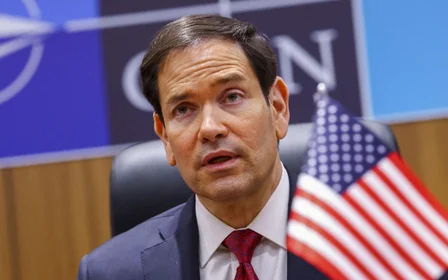
In July, Democracy for the Arab World Now (Dawn), founded by the late Middle East Eye columnist Jamal Khashoggi, as well as the Taxpayer Alliance Against Genocide (Taag), said they felt compelled to immediately go to court after US Secretary of State Marco Rubio wrote in an opinion piece that the US was willing to dismantle the ICC "brick by brick".
A month later, four other US-based rights groups sued the Trump administration over its sanctions on the ICC, insisting that Trump's power to sanction the court is "based on a pseudo national emergency that has no basis in fact", the groups said. That case is separate and ongoing.
New MEE newsletter: Jerusalem Dispatch
Sign up to get the latest insights and analysis on Israel-Palestine, alongside Turkey Unpacked and other MEE newsletters
This week's court order pointed out that Dawn has made several submissions to the ICC "concerning alleged atrocity crimes by Israeli officials in the Occupied Palestinian Territory and the role of US officials in aiding and abetting those crimes".
The aim in filing these submissions "[was] not merely to encourage an ICC investigation but also to serve a broader expressive and public advocacy purpose, including by build[ing] public pressure on state actors to obey the law".
Dawn has now confirmed it is continuing its work.
The Trump administration's sanctions on the ICC itself, however, remain in place.
'Forced to self-censor'
In the early weeks of his presidency some 18 months ago, President Donald Trump signed Executive Order 14203, granting US officials the power to impose sanctions on foreigners for supporting the ICC's investigations into US and Israeli nationals for war crimes, crimes against humanity, and genocide.
He made it a federal offence to provide a "service" to, or receive one from, a sanctioned individual or entity.
ICC investigations, the Trump administration said, constitute a "national emergency" because the ICC lacks jurisdiction over crimes committed by US and Israeli nationals during wartime.
While Washington played a role in the early development of the ICC and signed the Rome Statute in 2000 under the presidency of Bill Clinton, it never submitted the statute to the Senate for ratification, amid fears that the ICC could prosecute US military personnel and officials for alleged war crimes, especially in conflicts in Afghanistan and Iraq.
But Trump himself has been blunt about needing to punish the ICC for specifically going after Israel.
Using Executive Order 14203, Trump has so far sanctioned ICC prosecutors and judges, as well as the Palestinian human rights groups al-Haq, al-Mezan and the Palestinian Centre for Human Rights.
He also famously sanctioned the United Nations special rapporteur for the human rights situation in the occupied Palestinian territories, Francesca Albanese.
"Because the government can interpret the term 'service' to encompass anything that confers a benefit on the recipient, groups like DAWN and TAAG could face civil and criminal charges if they engage in routine advocacy with the sanctioned parties," Dawn said when it filed the lawsuit.
It added that it could face legal trouble for filing a brief with the ICC encouraging it to investigate possible crimes, or even just sharing evidence or ideas with Palestinian human rights groups or Albanese.
"Faced with that threat, DAWN and TAAG - like many Americans - have been forced to self-censor. Many groups have halted their ICC-facing work and severed professional ties with the Palestinian human rights groups and Ms Albanese."
Joe Pace, the lawyer representing the two groups, told reporters at the time that Trump's actions are a "textbook infringement on the First Amendment".
"The Constitution does not permit the government to pick and choose what topics American citizens can discuss amongst themselves or with foreign parties," he said.
Middle East Eye delivers independent and unrivalled coverage and analysis of the Middle East, North Africa and beyond. To learn more about republishing this content and the associated fees, please fill out this form. More about MEE can be found here.