Are we not allowed to say a genocide began on 7 October, too?


Just after 4pm local time on 7 October 2023, Al Jazeera’s Youmna El Sayed stood on a rooftop to update her audience on the latest from Gaza City, which was already under bombardment following the Hamas-led attacks on Israel early that same morning.
Live on air, as she was about to answer a question from a news anchor, we heard the sound of a missile scream down from the sky before thumping into a tower block with a horrible boom, the orange flash of an explosion appearing over her shoulder.
Sayed cried out in shock and ducked from view, but as so many brave Palestinian journalists would do over the next three years, she tried to continue reporting.
“We have just witnessed live what an Israeli air raid looks like on a populated area of Gaza City,” said the anchor, Cyril Vanier. “What we believe is a residential building.”
That initial strike on Palestine Tower, which indeed was a mixed-use residential and office building, was what the Israelis call a “roof knock” - a warning that a building is about to be destroyed, giving people an absurdly short time to escape.
New MEE newsletter: Jerusalem Dispatch
Sign up to get the latest insights and analysis on Israel-Palestine, alongside Turkey Unpacked and other MEE newsletters
Minutes later, the rockets intended to obliterate the tower arrived, and about 80 apartments - homes that would have had family photos on the walls, toys on the floor and dishes in the sink - were instantly reduced to a painful memory.
Vanier’s words were a portent of what was to come, because what we witnessed in that viral moment has since been repeated daily.
Israel’s campaign of extermination against the Palestinian people had begun. The genocide started on 7 October.
'Wicked city'
In fact, it started just hours after Hamas and other groups launched their dawn attack. By 8:24am, the Times of Israel reported that Israeli strikes were under way.
The Indonesian Hospital in Beit Lahiya was struck a short while after, killing two people, including a member of staff. This set in motion what would become a pattern of attacking medical facilities, doctors, patients and employees: over the next three years, more than 1,700 healthcare workers were killed, many in targeted attacks.
Journalist Mohammad al-Salhi was shot dead by Israeli forces in al-Bureij on 7 October, and ambulances were hit outside Nasser Hospital in Khan Younis and in Jabalia, where two paramedics lost their lives and several others were wounded.
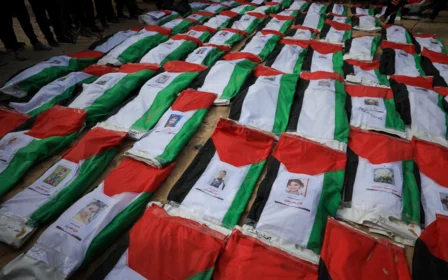
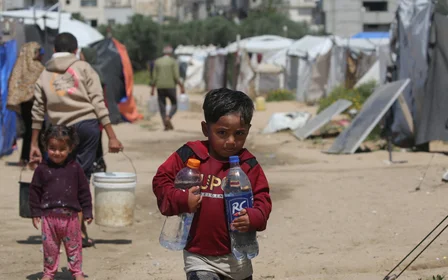
The industrial-scale slaughter of Palestinian children also began on 7 October. Just after 8pm, with the attack on Gaza ongoing for 12 hours, the Israelis hit a three-storey building in the Zeitoun neighbourhood, where three generations of the al-Dos family lived. Fifteen family members, including seven children, were killed. Adam al-Dos, 18 months old, was the youngest.
The entries on Gaza were so fleeting and by-the-numbers that all they did was underline the disparity. They reeked of afterthought
Children were also killed in other strikes that day. By 9pm, a provisional death toll of 232 Palestinians was reported.
Israeli Prime Minister Benjamin Netanyahu and other politicians were not shy about making their intentions immediately clear, with intent a key component of legally determining that a genocide has been committed.
“We will take mighty vengeance for this black day,” Netanyahu said in a televised address. “We will take revenge for all the young people who lost their lives … We will turn Gaza into a deserted island.”
Gaza was “a wicked city”, he added.
Yoav Gallant, then the defence minister, vowed to “change reality on the ground in Gaza for the next 50 years”, while Finance Minister Bezalel Smotrich reportedly told a cabinet meeting that Israel must “be cruel now and not think too much about the hostages”. An army general made the sinister promise that Hamas had “opened the gates of hell on the Gaza Strip”.
All of these statements, and more, were made on 7 October. It is clear that the genocide began that morning.
Hierarchy of suffering
Why, then, did much of the western media this month mark the anniversary with wall-to-wall reporting of Israeli commemorations - and only the paltriest of mentions for Palestinians?
Why did the BBC run a live blog with pages of stories humanising Israelis killed three years ago, while Palestinians continue to be massacred? Why did the Guardian?
To be clear, it’s not the fact that there was coverage. It’s the immense scale and prominence of it: a scale that amounted to tens of thousands of words and hours of television, yet found little room for Gaza.
This highlights the hierarchy of suffering that western media has applied to the events of the last three years. It’s more than a hierarchy of suffering: it’s a hierarchy of peoples.
The BBC’s blog was headlined “Israeli families mourn 7 October victims as memorials held around world”. Its lead image was a girl placing a candle at a fountain in Tel Aviv’s Dizengoff Square, where photos of victims of the attack on Israel sat alongside photos of Israeli soldiers killed while committing genocide in Gaza.
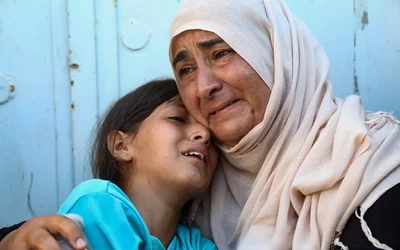
The pages featured dozens of images of Israeli commemorations; of people weeping, embracing and bowing their heads in remembrance, as they should, because they deserve to heal and to remember their loved ones like anyone else.
The point, though, is that with the genocide ongoing, there were only a handful of Palestinians briefly featured, all of them currently living through hell - and not a single blog post was reserved for the Palestinians killed by Israel on 7 October 2023 itself.
The entries on Gaza were so fleeting and by-the-numbers that all they did was underline the disparity. They reeked of afterthought, or of an attempt to see off criticism.
There was no space for the seven Dos children, who were wiped from mainstream media memory as 7 October victims because they were Palestinian.
Taboo subject
The Guardian’s live blog, headlined “World leaders pay tribute to victims as Israel marks three years since 7 October attack by Hamas - as it happened”, was more of the same. Palestinians were featured, but as footnotes drowned out by Israel’s mourning.
In the US, NBC’s live updates, which focused on how Israel was marking the anniversary with memorials “at homes, roadsides, kibbutzim and a music festival site”, gave more room than others to Palestinians - but in doing so, exposed another dichotomy.
It communicated, or at least implied, to the reader that the Israelis killed three years ago were more important than the Palestinians it rightly pointed out were still being killed. Even on the anniversary itself, at least five Palestinians were killed, including a 17-year-old boy and a rescue worker responding to a previous strike.
The fact is, talking about the Palestinians killed on 7 October is a taboo - one fiercely policed by pro-Israel lobbying groups and the western media and political classes.
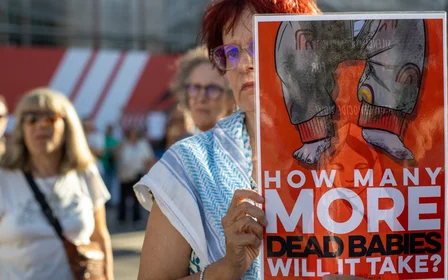
The opening line of a BBC report on an anniversary march in London to demand an end to the genocide said that organisers were “ignoring a request by the Metropolitan Police” for it to be called off. Police, it continued, were worried that the march, organised by the University of London coalition, would distress Jewish students and staff.
It then quoted the Union of Jewish Students as saying that the protest was “provocative, deliberate and must be condemned”.
The BBC only briefly - without naming or, it appears, interviewing anyone - mentioned that protest organisers said they wanted to denounce genocide and fight for a free Palestine.
Over on the Guardian, a statement from the Board of Deputies of British Jews was published in full, calling the protesters, some of whom were Jewish, a “small and extremist minority of British society”. The UK’s defence secretary, Wes Streeting, was featured labelling the march “shameful”. Not a single marcher was quoted.
Media manipulation
The strength of the taboo was also demonstrated by the hysterical reactions from the pro-Israel lobby, along with right-wing and centrist politicians, to New York Mayor Zohran Mamdani’s statement on the day, to which the media hungrily responded.
News stories in the US were not framed around what Mamdani actually said. Instead, they centred on the absurd response to it. It’s worth noting that his statement began not with Gaza, but with a condemnation of the Hamas-led attacks, which he called “horrific war crimes” that were “profoundly painful for so many New Yorkers”.
But that wasn’t enough. Mamdani’s transgression, it seems, was that he went on to condemn the genocide, pointing out how many people were killed and underscoring the fact that despite the “so-called ceasefire”, the slaughter continues.
Israel's genocide against the Palestinian people began on 7 October 2023. It continues. And Palestinian lives are as important as Israeli lives
The New York Times, CNN and Politico all centred their stories around the three paragraphs in which the mayor focused on Palestinians.
Mamdani “draws anger”, the New York Times headline said. For CNN, he drew “ire”. And in the telling of Politico’s headline, he was subject to “bipartisan backlash”.
Those three stories, from some of the most esteemed outlets in the US, collectively provide a pitch-perfect example of media manipulation in action at the highest levels.
Here are the facts: Israel’s genocide against the Palestinian people began on 7 October 2023. It continues. And Palestinian lives are as important as Israeli lives.
That’s the simple truth, whether the western media wants to tell it or not.
The views expressed in this article belong to the author and do not necessarily reflect the editorial policy of Middle East Eye.
Middle East Eye delivers independent and unrivalled coverage and analysis of the Middle East, North Africa and beyond. To learn more about republishing this content and the associated fees, please fill out this form. More about MEE can be found here.