How Israel’s election is further excluding Palestinian citizens from politics

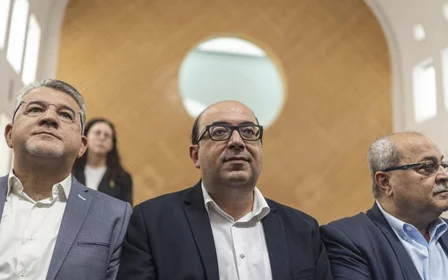
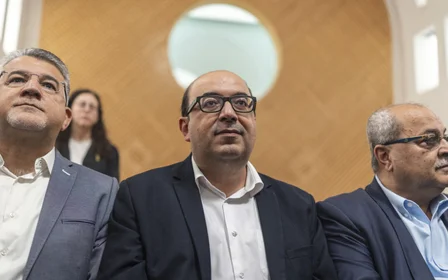
When Sami Abu Shehadeh appeared before Israel's Supreme Court on 1 October, the hearing revealed a great deal about the political position of Palestinian citizens of Israel.
In September, the Central Elections Committee had disqualified both Palestinian electoral lists from the election due on 27 October, along with two individual candidates: Ofer Cassif, a Jewish Israeli lawmaker from Hadash, and Abu Shehadeh, the leader of Balad.
Before a nine-justice panel, Abu Shehadeh was subjected to a public interrogation of his political identity, his sympathy for Israelis killed on 7 October 2023 and his loyalties, centred on an article he published on the Arab48 news site the following day.
He repeatedly tried to reason with the judges and to demonstrate his opposition to the attack and the killing of civilians. He was repeatedly pressed to express remorse for having written the article.
The court overturned the bans on the two lists and on Cassif. But it told Abu Shehadeh that a majority of justices would uphold his disqualification, and gave him a day to withdraw.
New MEE newsletter: Jerusalem Dispatch
Sign up to get the latest insights and analysis on Israel-Palestine, alongside Turkey Unpacked and other MEE newsletters
He did so, saying he wanted to spare the Joint List and parliamentary work more broadly the repercussions of a formal ban, and became the first Palestinian leader forced out of a Knesset race since Israel's disqualification law was enacted in 1985.
Many Palestinians with Israeli citizenship experienced the hearing as humiliating, though hardly surprising. What does it reveal about the political status of Palestinians who remained in the territory on which Israel was established in 1948 and became citizens of a settler-colonial state?
And how does the Israeli affective system - the fear, hostility and suspicion through which Palestinian political expression is interpreted - shape the conditions of Palestinian political participation, even when there are no legal grounds for the punitive measures and political targeting Palestinians face?
Abu Shehadeh's interrogation raises a fundamental question: under what conditions can Palestinians participate in the political institutions of a settler-colonial state while continuing to identify politically with the people whose dispossession constitutes the historical foundation of that state?
To approach these questions, we must return to the formation of Palestinian citizenship after the Nakba.
Military rule
Palestinians who remained were, after a struggle, included in the institutions of the state as citizens. At the same time, they were subjected to military rule, land dispossession, surveillance and the systematic suppression of their national identity and political organisation.
Their citizenship marked no departure from the settler-colonial project. It became one of the means through which they were governed, dominated and dispossessed, and their participation in the Knesset emerged within that structure.
Palestinian parliamentary participation has been permitted, regulated and threatened with elimination
During military rule, which lasted until 1966, many Palestinian citizens voted either directly for Zionist parties, particularly the ruling Mapai, or for "satellite lists" led by Arab candidates but tied to and dependent on those parties.
This pattern was shaped by the aftermath of the Nakba, which left Palestinians struggling for survival after dispossession and defeat, and by military rule itself, which made them dependent on military governors for freedom of movement, employment, permits and nearly every aspect of daily life.
Political mobilisation in this period was shaped by the struggle for survival and resistance to military rule. Discourse centred on sumud, or steadfastness, remaining on the land and civic demands for basic rights, above all the abolition of military rule. The wider Palestinian national question was approached cautiously, through clandestine means.
Forming an independent Palestinian party was not possible. The first Palestinian participation in Israeli elections outside the Zionist parties came through the National Liberation League, which joined the Communist Party, Maki, before the 1949 elections. The party became an important framework for Palestinian political organisation and opposition to military rule.
In 1965, Maki split over Zionism and Palestinian national rights, and its predominantly Palestinian faction established Rakah, which increasingly aligned itself with the Palestinian national movement. The same year, the Arab Socialist List, linked to the nationalist Al-Ard movement, tried to run for the Knesset and was disqualified.
Palestinian political actors have since sought to use the institutions of the state to organise, represent their communities and articulate collective demands, while confronting the limits imposed on their political existence. The current attempt to block Palestinian parties belongs to a long history in which their parliamentary participation has been permitted, regulated and threatened with elimination.
National politics
As the scholars Muhannad Mustafa and As'ad Ghanem have documented, the 1967 war was a turning point. It strengthened Palestinian national consciousness and reconnected Palestinian citizens of Israel with the wider national movement.
New movements and autonomous national institutions followed, including the National Committee of Heads of Arab Local Authorities in 1974 and the Committee for the Defence of Arab Lands in 1975, which organised the first Land Day protests the following year.
In 1977, Rakah joined other Arab and Jewish groups to establish Hadash, the Democratic Front for Peace and Equality.
Its programme combined demands for civic equality and workers' rights with recognition of Palestinian national self-determination, in line with the Palestinian national movement's political programme. Hadash played a central role in Palestinian political organisation and parliamentary representation.
The Islamic Movement, which began developing in the 1970s, expanded its social, religious and political activities during the 1980s and became an increasingly significant force in local politics.
The First Intifada of 1987 deepened political solidarity between Palestinian citizens of Israel and Palestinians in the occupied West Bank and Gaza, expressed in protests against Israel's suppression of the uprising and material support for those under occupation.
The Oslo Accords of 1993 marked another turning point, shifting Palestinian political discourse towards questions of citizenship, collective national rights and the character of the Israeli state.
In this context, Balad, the National Democratic Assembly, emerged in 1995, bringing together nationalist activists and intellectuals from different currents. Its programme challenged the Zionist and colonial foundations of the state, advocating a state of all its citizens and recognition of Palestinians as a national collective with collective rights and cultural autonomy.
Parliamentary limits
Balad's leadership debated whether to enter the Knesset at all. It eventually chose parliamentary politics as a platform for challenging the state's foundations and advancing Palestinian national demands, without accepting the legitimacy of the existing political order.
The Islamic Movement, meanwhile, split into northern and southern branches in 1996 over the same question, with the southern branch entering parliament through the United Arab List, Ra'am.
Alongside Ta'al, the Arab Movement for Renewal, these three parties contested elections with varying Palestinian turnout. The Second Intifada marked another turning point, and turnout fell to its lowest level to that point in 2009, amid lively debate over the effectiveness of parliamentary participation.
In 2014, the Knesset raised the electoral threshold, a move widely seen as an attempt to exclude Palestinian representation, since none of the parties could be sure of clearing it alone. In response, the four parties formed the Joint List for the 2015 election.
This history shows that Palestinian parliamentary participation has never been a settled arrangement. There has never been a broad political consensus on whether to take part at all.
Its forms and meanings have been reshaped repeatedly by the wider national struggle and by the changing conditions of Palestinian citizens, yet these different strategies have continued to confront the structural limits imposed on Palestinian political participation.
Palestinian parties are contesting the 27 October election on two lists: the Joint List, comprising Hadash, Balad and Ta'al, and Ra'am on its own.
The split goes beyond electoral tactics. It reflects a broader debate among Palestinians over the purpose of parliamentary representation and the implications of seeking integration into Israeli state institutions, with Ra'am taking an increasingly integrationist approach while the Joint List has largely held to an oppositional stance.
Narrowing margins
Palestinian participation in the Knesset has never been free of the constraints of Zionist politics, dominant Israeli affects and a politics of fear. The attempts to disqualify Palestinian parties, culminating in Abu Shehadeh's questioning over his political views, invite us to ask what is changing in the way those constraints are enforced in the conjuncture since 7 October 2023.
Palestinian political expression has historically been shaped by Zionist dominance, securitisation and repression. But the period since 7 October has seen a sharp intensification of these restrictions, redrawing the boundaries of permissible Palestinian political life.
People avoid demonstrations, delete social media posts, withdraw from political activity or stay silent, even when nothing they have done is unlawful
This is evident in the growing criminalisation of political expression, including solidarity with Gaza; restrictions on political organisation and collective mobilisation; police raids on party offices such as those of Hadash; the suppression of demonstrations; and the arrest and prolonged detention of activists.
It is evident, too, in the use of administrative detention against Palestinian citizens of Israel. According to Justice Ministry data, Israeli courts handled 297 such cases involving Palestinians from inside Israel and East Jerusalem between the start of the genocide in Gaza and May 2025.
The already narrow margins for political organising have shrunk further, and the line between lawful and unlawful political activity has blurred. Forms of expression and organisation that were possible before 7 October, even within a restrictive climate, are increasingly prohibited, punished or prevented in practice.
These restrictions are not imposed through legislation or state repression alone. The prevailing climate, growing hostility towards Palestinian political expression, and the spread of surveillance and disciplinary practices across universities, hospitals and workplaces also shape what Palestinians can say and identify with.
Expressions of Palestinian national identity, collective grief and solidarity are increasingly treated as support for terrorism, while the fear of arrest, dismissal, disciplinary action or social retaliation leads Palestinians to police themselves. People avoid demonstrations, delete social media posts, withdraw from political activity or stay silent, even when nothing they have done is unlawful.
The boundaries of permissible participation are thus being redrawn through political sentiment, the anticipation of punishment and the internalisation of threats.
Leadership under fear
Here we return to the question of parliamentary participation and its limits in the current conjuncture. At stake is not only whether the narrow margins for Palestinian participation in Israeli politics are closing further, but also how this intensification of hostility and political violence might reshape Palestinian strategies and collective mobilisation more broadly.
It raises, in particular, the question of how far the Palestinian political leadership inside Israel has itself been shaped by Israeli affective politics of fear, hostility and intimidation since 7 October.
The prevailing atmosphere of fear and caution was reflected in the leadership's response. Police banned protests in Umm al-Fahm and Sakhnin, and in November 2023 arrested the head of the High Follow-Up Committee, Mohammad Barakeh, on his way to a vigil in Nazareth.
A leadership-only vigil organised by the committee in Nazareth on 28 December 2023 was announced minutes beforehand to evade the police. On 20 January 2024, more than three months into the genocide, a Hadash-led rally went ahead in Haifa, after three police refusals and a petition to the Supreme Court, with attendance capped at 700.
Such caution is understandable amid intensified repression. But it has shielded neither Palestinian political leaders nor Palestinians more broadly from persecution and political targeting, as Abu Shehadeh's forced withdrawal shows.
That raises a more fundamental question about whether the Palestinian leadership inside Israel can respond adequately to the magnitude and complexity of the transformations it confronts.
Could these conditions push Palestinians inside Israel towards a renewed articulation of their struggle as part of the broader Palestinian national struggle, and what would that mean for the future of parliamentary participation? And will they prompt a more fundamental rethinking of political organising beyond the ever more restrictive boundaries of parliamentary representation?
The views expressed in this article belong to the author and do not necessarily reflect the editorial policy of Middle East Eye.
Middle East Eye delivers independent and unrivalled coverage and analysis of the Middle East, North Africa and beyond. To learn more about republishing this content and the associated fees, please fill out this form. More about MEE can be found here.