
Arab recognition of Israel rewards its relentless land theft


One of the most intimidating aspects of modern US relations with the Arab and Muslim world is Washington's insistence that all Arab and Muslim-majority countries normalise relations with the state of Israel as a reward for its ongoing genocide against the Palestinian people.
These demands have intensified since the US and Israel launched their war of aggression against Iran in February. Washington's long-standing push for Saudi normalisation continues unabated, as does its pressure on Qatar, Iraq, Libya, Tunisia, Syria, and Indonesia, among others, to follow suit.
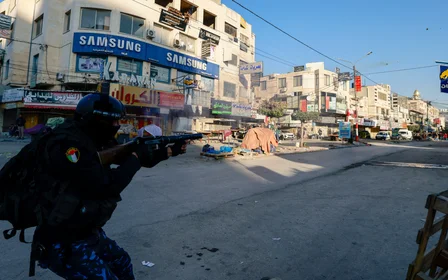
More recently, the US succeeded in bringing to power a new Lebanese government that has gone as far as supporting Israel's occupation of Lebanese territory by signing an agreement last month recognising the "sovereignty" of the genocidal state.
But even before Israel began its genocide, Arab regimes' recognition of Israel has always been fraught with the question of Israel's borders.
Which Israel, and which borders, are these Arab and Muslim-majority countries required to recognise?
New MEE newsletter: Jerusalem Dispatch
Sign up to get the latest insights and analysis on Israel-Palestine, alongside Turkey Unpacked and other MEE newsletters
Which borders of Israel did Egypt and Jordan - let alone the Palestine Liberation Organisation - recognise when they normalised relations in 1978-1979 and in 1993-1994, respectively? What about the Arab countries that signed the Abraham Accords in 2020-2021?
These are essential geopolitical questions when one is dealing with a settler-colonial superpower demanding that decolonised countries and colonised peoples recognise its settler-colonial proxy state in the Middle East and normalise relations with it.
The hunger for land
The very essence of European settler-colonial states since their inception has been the continuous theft of indigenous territory and the expansion of their borders.
From the United States to South Africa, and from Canada to Australia, New Zealand and Israel, the hunger of settler-colonies for more territory and for ever-expanding borders has been a defining feature of their policies.
Settler-colonies often invoke arguments of national security to justify this insatiable hunger for territory, backed by racially supremacist ideologies.
Since its emergence in Palestine during the Crusades, European settler-colonialism possessed an intrinsic ambition to expand its territories and borders.
Israel has always been more explicit about its hunger and avarice for land, which it justified through European Jewish supremacy and, later, pan-Jewish supremacy
Differing Crusader knights carved up several kingdoms in Palestine and its vicinity, whose borders remained in flux for more than two centuries due to invasions and native counterattacks.
As the Latin Kingdom of Jerusalem, among others, inspired later European settler-colonialism in the Americas, the same obsession with expanding territory and borders marked white settler-colonialism three centuries later in North and South America - both before and after the European settlers won independence from their mother countries.
Indeed, the history and geography of the United States since independence are nothing if not a story of territorial expansion and changing borders justified by white Christian supremacy.
President Donald Trump's current quest to annex Canada, Greenland and Venezuela continues the same tradition of expanding US territory and borders. Other settler-colonies have had a similar, if less illustrious, history.
Israel has always been more explicit about its hunger and avarice for land, which it justified through European Jewish supremacy and, later, pan-Jewish supremacy.
Since its establishment through ethnic cleansing and terrorism, the fledgling European Jewish settler-colony has refused to declare official borders for its state.
Follow Middle East Eye's live coverage of Israel's genocide in Gaza
Indeed, once the Zionist conquest of Palestine began on 30 November 1947, the leader of the Jewish settlers, David Ben Gurion, insisted that the Zionist militia "should not limit itself to the designated borders" specified in the United Nations Partition Plan, issued the previous day under pressure from the United States.
The plan granted the Jewish colonists, who constituted 30 percent of the population, 55 percent of the country. Ben Gurion nevertheless insisted that they should "go beyond them", adding that "when the time came to declare independence, no mention should be made of borders".
When Pinhas Rosen, who later became Israel's minister of justice, raised the legal issue of specifying the new state's borders, Ben Gurion replied: "When we declare the State we do not have to determine borders nor do we have to seek international recognition."
'No territorial definition'
By the time Israel declared independence on 14 May 1948, Ben-Gurion had already engineered a vote of the 13-member Zionist "People's Administration", a proto-cabinet of the settlers, in which five members voted against the four others attending the meeting to exclude any mention of borders from the "Declaration of the Establishment of the Jewish State".
When objections were raised, Ben Gurion, inspired by the American settler precedent, countered that "this is a declaration of independence. For example, there is the American Declaration of Independence. It includes no mention of territorial definitions."

Ben Gurion was, of course, correct, and his comparison was most apt.
In admitting Israel to the United Nations in May 1949, the General Assembly stipulated that Israel must abide by the borders set by the Partition Plan and by General Assembly Resolution 194, which demanded that Israel allow the Palestinian refugees it expelled to return home. Israel refused.
Israeli Prime Minister Ben-Gurion went further by unilaterally annexing West Jerusalem, which was supposed to be under UN jurisdiction, on 5 December 1949.
He declared that Israel was no longer bound by the UN Partition Plan insofar as it pertained to the Palestinian territories it had conquered or UN control of West Jerusalem.
Indeed, Israel considered the territories it conquered from the projected Palestinian state and the UN territory of Jerusalem to be part of Israel, even though the only international document that granted Israel any form of legitimacy was the non-binding Partition Plan, which specified its boundaries.
This is why, despite increasing pressure from the US, Britain remained adamant that it would not recognise Israel until the "frontiers of the State shall be clearly defined".
Here, Ben Gurion's faith in the US precedent to which he compared his fledgling settler-colony would prove prescient.
The US representative at the UN rose to the occasion and argued against the British that, when his country gained independence in 1776, "the land had not even been fully explored and that no one knew where American claims ended and where European states' claims began".
Ever-expanding borders
Israel continued expanding its borders in the decades that followed.
Between 1948 and 1967, it took over and annexed the Demilitarised Zone (DMZ) on the Syrian border. In 1956, it colluded with the French and the British to invade and occupy Gaza and Egypt's Sinai Peninsula, refusing to withdraw.
When the Eisenhower administration insisted the Israelis withdraw, Ben-Gurion expressed outrage: "Up to the middle of the sixth century, Jewish independence was maintained on the island of Yotvat south of the Gulf of Eilat, which was liberated yesterday by the Israeli army... Israel terms the Gaza Strip an integral part of the nation. No force, whatever it is called, was going to make Israel evacuate Sinai. And the words of Isaiah the Prophet were fulfilled."
But this time, Ben Gurion was wrong. Furious that its little proxy had collaborated with Britain and France, the US suspended aid to Israel and applied pressure at the UN, spearheaded by the Soviets, forcing the young settler-colony to withdraw - but only temporarily.
Israel invaded both territories again in 1967, along with the entire West Bank and the Golan Heights, tripling its territorial mass.
Israel annexed East Jerusalem and the Golan Heights in 1980 and 1981 respectively, in moves never recognised by the international community, and has all but annexed the West Bank since.
And though it eventually withdrew from Sinai, it has never allowed the Egyptians to exercise full sovereignty over it. It likewise maintained its occupation of Gaza without respite, including through its ongoing genocide against the Palestinian people of Gaza, which began in October 2023.
Israel also invaded Lebanon in 1978 and again in 1982, expanding its territory further until it was forced to withdraw by the Lebanese resistance in 2000.
Israel returned to Lebanon after October 2024 and now occupies about 2,000 square kilometres of the country with the agreement of the US-installed Lebanese government, which is now officially collaborating with Israel and seeks to disarm the very resistance movement that ended the last Israeli occupation.
The agreement the Lebanese government signed with Israel last month recognises Israeli sovereignty, presumably over all the territories Israel claims for itself. There were no caveats about borders.
Which Israel?
Meanwhile, Israel has occupied wide swaths of land across southern and southwestern Syria since 2024, amounting to about 600 square kilometres, while plans to establish Jewish settlements are under way with the tacit agreement of the post-Assad government in Syria.
The new government has issued little more than muted calls for Israel to withdraw while conducting direct negotiations with the genocidal state.
It seems that what Arab and Muslim-majority countries are being called upon to recognise is an Israel with whichever borders its Jewish colonists decide they need
Buoyed by his infatuation with Trump, Syria's new president, Ahmed al-Sharaa, declared last week: "As long as [Israel] refuses to withdraw, why should we sign an agreement with it?"
It remains unclear whether his demand encompasses the DMZ that Israel annexed as a condition for normalisation.
In other words, it is unknown whether he - like the other Arab states that have normalised relations - is signalling a willingness to normalise on the basis of Israeli borders that include all other occupied and annexed territories, with the exception of most Syrian lands.
Based on the above, it seems that what Arab and Muslim-majority countries are being called upon to recognise is an Israel with whichever borders its Jewish colonists decide they need.
The Israeli territory delineated by the 1947 Partition Plan, the territories Israel conquered between 30 November 1947 and January 1949 when it signed armistice agreements with neighbouring Arab countries, and Israel's annexation of West Jerusalem in December 1949, have all become non-negotiable territories and borders - as has the entire DMZ with Syria, which Israel occupied against international law.
While for a few decades Israel pretended that the post-1967 borders, which had tripled its 1949 territory, were negotiable, its annexation of East Jerusalem and the Golan Heights took them off the table.
The insistence of Israel's leaders in the last two decades on never giving up the West Bank has also removed it from the category of negotiable territory and borders.
Now that Israel is claiming to negotiate with Lebanon, which the US has instructed to normalise with Israel, about the territory it has occupied and expanded since October 2024, it insists that the US-installed Lebanese government dismantle the anti-occupation resistance movement before the occupation ends, if it ever does.
It remains unclear if the Syrian territory Israel has occupied since 2024 is negotiable at all.
Recognising the occupation
When Egypt's Anwar Sadat signed the peace treaty with Israel in March 1979, his regime recognised Israel's post-1967 expanded borders except for Sinai.
The treaty established the international border between Israel and Egypt as that of the 1906 border between Egypt and Ottoman Palestine, separating the two countries "without prejudice to the issue of the status of the Gaza Strip".
This was the case even though the strip's international status was then, as it remains today, that of an illegally occupied territory.
In 1994, the Jordanians followed suit. Their peace treaty with Israel recognised the boundary established by the 1922 British "Transjordan Memorandum" between British-mandated Palestine and British-mandated Transjordan as "the permanent, secure and recognised international boundary between Israel and Jordan, without prejudice to the status of any territories that came under Israeli military government control in 1967".
Essentially, both Egypt and Jordan recognised Israel's illegal occupation of the territories designated by the 1947 Partition Plan as part of the Palestinian state, as well as Israel's 1949 illegal annexation of West Jerusalem.
That neither country referred to the occupied DMZ on the Syrian border, let alone the Golan Heights - which Israel had officially annexed by the time Jordan signed its treaty - amounted to no less than tacit recognition of those annexations.
In the case of the PLO, the Oslo Accords with Israel recognised no borders, even though the organisation recognised Israel's so-called "right to exist in peace and security", relegating the issue of borders to what was then termed the "permanent status negotiations", which never materialised.
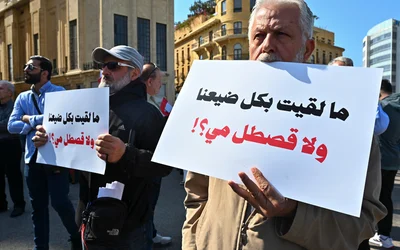
Still, it remains unclear which borders of Israel the PLO recognised as those within which Israel has a "right to exist".
Unlike Egypt and Jordan, whose peace treaties the Abraham Accords referenced, the UAE, Bahrain, Morocco and Sudan were able to avoid the issue of borders altogether when they normalised relations with Israel in 2020 and 2021, since none of them shares a border with Israel.
Today, Arab and Muslim-majority countries must be clear that, if they decide to recognise the genocidal settler-colony of Israel, they are doing so to reward it for the genocide it continues to inflict on the Palestinians with more stolen Arab territory.
Indeed, Israeli Prime Minister Benjamin Netanyahu made clear in 2025 that what Israel's Jewish colonists and his regime still covet are the lands of neighbouring Jordan, Egypt, Iraq, Saudi Arabia, as well as Syria and Lebanon - a vision that elicited condemnation from the very Arab and Muslim-majority countries the US is pressuring to normalise relations with Israel as a reward for its ongoing genocide.
As every territorial expansion Israel has brought about and every new border it has delineated, except for Sinai, has become irreversible over time - although a minister in Netanyahu's government called in 2024 on Israel to recolonise Sinai - these new territories, too, will soon become permanent parts of Israel.
Given this record, one wonders whether any Arab states will remain in the region to recognise Israel after it annexes their own territories inside its ever-expanding borders.
The views expressed in this article belong to the author and do not necessarily reflect the editorial policy of Middle East Eye.
Middle East Eye delivers independent and unrivalled coverage and analysis of the Middle East, North Africa and beyond. To learn more about republishing this content and the associated fees, please fill out this form. More about MEE can be found here.