Turkey is hailing an 'Islamic Nato' it can neither afford nor deliver


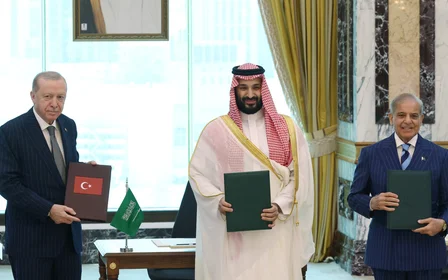
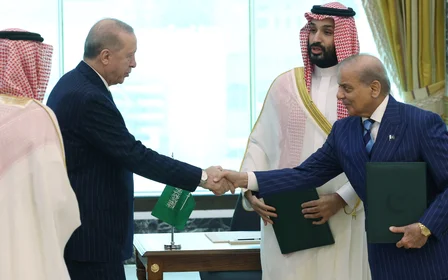
To characterise the defence agreement signed in Mecca on 7 August between Turkey, Pakistan and Saudi Arabia as an initiative devised in response to a single threat that emerged overnight is both incorrect and incomplete.
It represents a long-standing need for alignment, brought into sharp relief three years ago by Hamas's attacks on Israel and the genocide that Israel has carried out since with US support.
Given Israel's boundless destructive role in the breakdown of global and regional systems, coupled with Iran's disruptive initiatives, which are in fact not particularly new, there was really no other viable path for these three countries.
In an atmosphere where the global security architecture and the very perception of security are unravelling, many regions are seeking security structures of their own.
As the European Union develops a defence approach relatively independent of the US and Nato, it is only natural for Turkey to pursue similar endeavours with countries it believes share a common outlook.
New MEE newsletter: Jerusalem Dispatch
Sign up to get the latest insights and analysis on Israel-Palestine, alongside Turkey Unpacked and other MEE newsletters
Consequently, there is no expectation that this pact will replace either Nato or the three countries' other defence commitments. It is, however, defining a mission for itself in the space left vacant by other alliances.
The timing, content and practical implications of the agreement are, of course, open to scrutiny. In scrutinising them, one must not forget that none of the three countries possesses the capacity to balance the evolving security risks on its own. In fact, no country, including the US, has such a capacity.
One factor making the Mecca pact inevitable is the lowered threshold for conflict between states. Armed conflict between states has never been closer
The effort to establish an order represented by the Abraham Accords, which either exclude or antagonise most countries in the region, accelerated this alliance as it converged with global and regional dynamics.
One factor making the Mecca pact inevitable is the lowered threshold for conflict between states. Armed conflict between states has never been closer.
Rival countries once used proxy organisations rather than confronting each other directly. In the Middle East, the role of proxies has diminished significantly, and countries now engage in direct conflict without intermediaries.
Israel's destructive policies and US President Donald Trump's lawlessness have played a major role in this. Iran has responded in kind, both to defend itself and to re-establish the control on the ground that it had long since lost. Otherwise, it would have been unthinkable a decade ago for missiles fired from Iran to head towards Turkey, only to be intercepted by Nato.
This is now the new normal in global security.
Not Nato, not a declaration
It is rather ambitious to read the same meaning into the parties' references to Nato's "an attack on one member is an attack on all" clause in the Mecca agreement. The legal formula resembles Nato's Article 5, but the two structures differ widely in institutional depth, joint command, force structure and operational readiness.
Nato is an organisation born in a different historical context, within a distinct geographical and demographic framework. It was established with a clear mission: to counter a bloc that threatened all its members simultaneously.
Although members have faced numerous direct and indirect attacks since its inception, Article 5 has been invoked only once, after the 11 September 2001 attacks on the US. Either the members did not call for it, or they deemed the tensions they experienced to fall below the threshold of armed attack or outside the alliance's geographical umbrella.
Here, by contrast, each country must manage risks that do not directly threaten the others. It is therefore difficult to speak of a unified perception of threat.
The accelerating pace of events has begun to test the Mecca pact sooner than expected.
For now, the partnership, which is expected to progress through advanced defence industry cooperation, mutual technical assistance and shared diplomatic positions, must produce practical responses to developments such as those in Yemen, where Saudi Arabia has already invoked it against the Houthis. The Mecca pact is not Nato, but it is no longer merely a political declaration.
While its members may perceive the risks they face similarly, it remains unclear what kind of common security and regional perspective they aim to establish to replace the current system.
The alliance also needs time to deepen. The lack of geographical continuity, technical compatibility and coordination on threats and projections are gaps that will not be easy to close, though they may be partially overcome over time.
Why now for Turkey
Alongside these global and regional changes, it is essential to take into account that Turkey's own security scope has expanded. Where Ankara once based its security perception entirely on defending its borders, its interests now stretch from the Horn of Africa to the Caucasus.
It would be incorrect to explain this solely through the expansionist strategy of the ruling Justice and Development Party (AKP) or the perception of geography and civilisation once described as "neo-Ottomanism".
The failure to establish a stable order in the post-Cold War era has compelled a country of Turkey's stature to extend its military presence across a vast area.
In an environment where the regulatory institutions of the global economic system have become dysfunctional, the sustainability of commercial interests also depends on an architecture built through ports, bases and alliances.
The AKP's contribution here lies in the framework it developed, particularly over its first 15 years in power, based on its reading of the world and the networks of relationships required to act on it.
However much it may be denied today, the approach built during Ahmet Davutoglu's tenure as foreign minister, and the experience President Recep Tayyip Erdogan has accumulated over 24 years of dealing with other leaders, made this possible.
Ankara's three dilemmas
As for Turkey's dilemmas, the first is capacity. The country is going through one of the deepest economic crises in the history of the republic. A country whose citizens are struggling to make ends meet may still possess a strong defence, but only at the cost of additional burdens on every other area of public life.
A budget channelled into defence means cuts to healthcare, education, agriculture and the already rock-bottom living standards of ordinary people. That, in turn, signals a serious crisis of sustainability.
Secondly, the current government is struggling to establish the minimum level of social legitimacy required to sustain such ambitious security structures. As has been seen time and again, sending troops abroad or forming defence alliances has won support in parliament well beyond the ruling party's number of seats.
At present, however, the government sees politics as a zero-sum game and has left no stone unturned in its efforts to eliminate its political rivals. Parliamentary approval is a necessity for international agreements and cross-border troop deployments, and a government bent on eliminating its rivals will find it harder to secure the broad support such commitments require.
Labelling a three-nation alliance whose details are not even clear as an 'Islamic Nato' from day one amounts, if not to self-deception, then to telling lies to the public
Attempting to bridge this gap with an authoritarian "I've done it, so it's done" mentality does not render the action democratic or lawful, even if the step taken is correct and necessary.
The third area of concern is the hollow rhetoric that the government itself has fuelled. The fact that the agreement bears the name of Mecca, a city sacred to Muslims, undoubtedly carries great symbolic value, and it would be wrong to dismiss it.
Yet labelling a three-nation alliance whose details are not even clear as an "Islamic Nato" from day one amounts, if not to self-deception, then to telling lies to the public. So does constructing highly problematic narratives by adding up the countries' military forces as if they were items on a grocer's list.
Claims that the three together constitute the world's largest tank fleet, the second-largest inventory of military vehicles and the third-largest helicopter fleet are of this kind.
Such rhetoric will always have an audience, but realism is the more sensible long-term approach, given the disappointments and traumas societies would otherwise have to endure.
The views expressed in this article belong to the author and do not necessarily reflect the editorial policy of Middle East Eye.
Middle East Eye delivers independent and unrivalled coverage and analysis of the Middle East, North Africa and beyond. To learn more about republishing this content and the associated fees, please fill out this form. More about MEE can be found here.