Iran will not trade its nuclear insurance policy for worthless American promises


US President Donald Trump last month rejected an Iranian proposal to reopen the Strait of Hormuz and resume negotiations, while hinting that talks might continue. But the fundamental barrier to a lasting agreement is Washington’s habit of rewriting the rules after the ink dries.
Consider the last diplomatic opening. The June memorandum between the US and Iran promised to release frozen funds for recipients chosen by Iran’s central bank.
Five days later, US Vice President JD Vance outlined a different arrangement: Washington and Qatar would approve the process, while the money would be restricted to purchases of American soy, corn and wheat. Washington was writing a shopping list with Iran’s money.
That bait-and-switch highlighted a fatal flaw in American diplomacy. Washington expects Iran to trade lasting nuclear dismantlement for benefits the US can withdraw overnight.
The more nuclear capacity Tehran surrenders, the more it depends on its adversary’s whims to deliver the rewards. Without enforceable, symmetrical remedies for American non-compliance, Washington’s preferred bargain leaves Iran easier to coerce precisely because it complied.
New MEE newsletter: Jerusalem Dispatch
Sign up to get the latest insights and analysis on Israel-Palestine, alongside Turkey Unpacked and other MEE newsletters
The US justified withdrawing oil and banking relief by citing Iranian attacks on shipping. But treating those clashes as the beginning of the story ignores the diplomatic sabotage that preceded them.
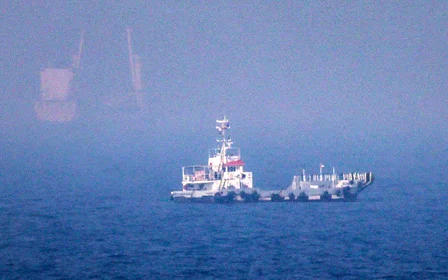
Under the June interim agreement, Washington agreed to lift its naval blockade and grant oil waivers in exchange for a halt in hostilities and Iranian cooperation to restore Hormuz transit, pending Iranian-Omani talks over maritime administration. Tehran agreed to facilitate passage, not to surrender maritime oversight.
Yet just one day later, a US-backed maritime centre recommended a southern route through Omani waters to bypass northern lanes associated with Iranian control. Washington was thus demanding Iranian cooperation, while simultaneously plotting a route to reduce Tehran’s leverage over Hormuz.
When Iranian forces opened fire on 25 June on a vessel using the uncoordinated bypass route, the deal’s cooperative premise had already dissolved into a raw contest for control.
Hollow promises
The promised financial relief proved equally hollow. By late June, Qatar confirmed that the mechanism for releasing Iran’s frozen funds remained unresolved, while Washington’s proposed arrangement restricted the money to purchases of American agricultural goods - tying Iran’s access to its own sovereign assets to Washington’s domestic priorities.
When further clashes erupted in July, the US Department of the Treasury revoked oil authorisations just 16 days after issuing them. It took no election or new administration; the same White House that granted relief quickly snatched it back.
Washington treats its unilateral discretion to reverse commitments as strategic leverage. For Tehran, that discretion is precisely what makes American commitments unreliable.
Washington has spent years dictating what Iran must surrender; the next deal must also ask what the US will put beyond its own discretion
Iran has already experienced the consequences of substantial nuclear concessions. Under the 2015 nuclear agreement, it reduced its enriched-uranium stockpile, dismantled centrifuges, and rendered the Arak reactor vessel unusable. Trump withdrew from the deal in May 2018, while the International Atomic Energy Agency (IAEA) confirmed Iran’s full compliance; Tehran waited more than a year before scaling back its commitments.
Inspectors could verify the surrendered uranium and dismantled centrifuges, but they could not verify whether Washington would honour its commitments. Rebuilding a disabled reactor takes years, while reimposing US sanctions takes a single “stroke of a pen”.
Regional war has transformed this imbalance into a security dilemma. For Tehran, nuclear latency - the ability to move quickly towards a weapon without actually possessing one - is increasingly viewed not simply as bargaining leverage, but as strategic insurance against catastrophic and existential escalation.
Nuclear latency has not deterred conventional strikes. But the prospect of a rapid nuclear breakout forces adversaries to calibrate their campaigns: pushing for state collapse leaves a cornered Iran with no choice but to finally build the bomb.
Fatal paradox
Herein lies the fatal paradox of Washington’s strategy. The war might have reduced Iran’s nuclear capacity, but it also increased the value Tehran attaches to retaining a nuclear hedge. American policymakers treat military escalation as leverage to compel nuclear surrender, blind to the fact that the pressure itself makes surrender suicidal.
Demanding that Tehran dismantle its hedge, without altering the threats that make it valuable, risks turning military gains into diplomatic failure. Washington can destroy facilities; it cannot expect the same campaign to make nuclear restraint more acceptable.
If compliance leaves Tehran more exposed to the next bombing campaign, Washington is not preventing a bomb, but rather manufacturing the strategic necessity for it.
Any new agreement must include restoring full IAEA access. Negotiators cannot freeze a stockpile that inspectors cannot monitor. But demanding transparency requires acknowledging Tehran’s intelligible pessimism: having watched the agency fail to unequivocally condemn attacks on its nuclear facilities, Tehran views intrusive inspections not as a routine baseline, but as a major security concession.
Once stockpiles are verified and immobilised, deeper reductions, such as diluting 60 percent material, must strictly follow demonstrated American performance: actual oil sales, accessible sovereign assets, and an enduring ceasefire.
This requires reciprocal irreversibility: reversible steps, such as immobilising nuclear material, should initially be exchanged for reversible measures, such as sanctions waivers. Progressively harder-to-reverse concessions, such as downblending, should be matched by progressively harder-to-revoke economic and security commitments from Washington.
That means moving up a durability ladder, from flimsy presidential waivers towards normalised banking access, sovereign funds secured in independent international escrow, congressional repeal of statutory sanctions, and deeper long-term commercial integration with the global economy. Permanent Iranian nuclear concessions cannot be purchased with temporary presidential promises.
Another countdown
Economic relief alone cannot resolve a security crisis. Washington cannot demand that Iran surrender its nuclear hedge, while simultaneously underwriting the threat that gives that hedge much of its value.
The US must formally pledge not to launch unprovoked strikes against a compliant Iran, while explicitly withholding intelligence, aerial refuelling, base access and munitions that could be used in an Israeli attack. Should Israel strike a compliant Iran anyway, the agreement must mandate an automatic suspension of specified US offensive military aid.
To enforce boundaries, dispute resolution must be independent and insulated from unilateral political vetoes. If Washington withholds earned relief, or if the US or Israel strike a compliant Iran, an independent panel established at signing should clear Tehran to halt nuclear reductions and suspend deal-specific restrictions, without losing economic relief already secured.
Iran would remain bound by the baseline safeguards of the Non-Proliferation Treaty, and verified Iranian violations would trigger predetermined consequences, including a rapid sanctions snapback.
Beyond the agreement itself, a durable settlement requires a transformed regional security architecture. Iran’s neighbours have legitimate concerns over maritime disruption and cross-border escalation. The nuclear pact should therefore run alongside a regional security process - one involving Iran, Iraq, and the six Gulf Cooperation Council states - that explores cooperative frameworks like a regional fuel-cycle consortium.
This would allow Iran to retain domestic enrichment under shared regional ownership and oversight, thus reducing mutual threats, rather than substituting American hegemony for Iranian dominance.
The objective is not simply to delay an Iranian bomb, but to reduce the strategic incentive to build one in the first place. That requires a regional security environment in which remaining without a nuclear deterrent is strategically sustainable for Tehran.
No agreement can erase Iran’s nuclear knowledge, but a durable settlement can reduce the strategic value of turning that knowledge into a weapon. Washington has spent years dictating what Iran must surrender; the next deal must also ask what the US will put beyond its own discretion. If the answer is nothing, another signature will simply buy another countdown.
The views expressed in this article belong to the author and do not necessarily reflect the editorial policy of Middle East Eye.
Middle East Eye delivers independent and unrivalled coverage and analysis of the Middle East, North Africa and beyond. To learn more about republishing this content and the associated fees, please fill out this form. More about MEE can be found here.