
The Greens should not be eclipsed by the Burnham bounce - this is their moment


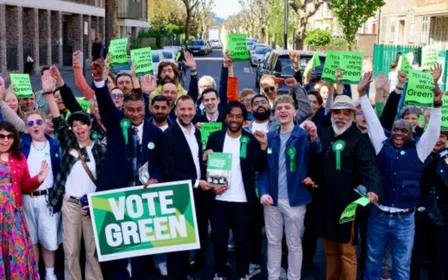
In recent years, the Green Party has firmly established itself as the primary electoral outlet for left-leaning voters in England and Wales disillusioned by Labour’s domestic, economic and foreign policy. Its more combative approach under Zack Polanski, its firm stance in support of Palestinian liberation and left-populist economic policies have all enabled it to make significant inroads into Labour’s fragmenting progressive base.
By eating into the Labour Party’s support among young voters and those from minority backgrounds, particularly British Muslims angered and alienated by Keir Starmer’s active complicity in Israel’s genocide in Gaza, the Greens also played their part in hastening Starmer’s political demise, contributing to the sense that Labour was facing an existential wipeout unless it rapidly found some way of changing course - or at least giving the appearance of having done so.
But Andy Burnham’s rise to the Labour leadership, and the premiership, poses the Greens with a thornier challenge. Certainly, Burnham is a far more capable and charismatic politician than Starmer, and has the benefit of having spent a considerable amount of time outside the Westminster bubble (even if Burnham’s much-vaunted “Manchesterism” is little more than a buzzword). There are good reasons to doubt whether Burnham’s ambitious rhetoric has any underlying substance, but it has been enough to stall the Greens’ momentum.
Last month's mayoral election in Greater Manchester is a case in point. The Greens ran a peculiar, confused campaign, trying to position themselves as the only party that could stop Reform UK’s Sian Astley from winning, even though it was clear that Labour was the party to beat. In the event, the Green Party’s Geraldine Coggins won nearly 200,000 fewer first-preference votes than the winning Labour candidate, Manchester City Council leader Bev Craig, albeit on the lowest turnout since the city-region mayoralty was introduced.
Granted, expectations for the Greens are much higher than they were just a couple of years ago, but this can only be regarded as a disappointing showing. Even so, it is wise not to over-analyse a single result.
New MEE newsletter: Jerusalem Dispatch
Sign up to get the latest insights and analysis on Israel-Palestine, alongside Turkey Unpacked and other MEE newsletters
Burnham won his three Greater Manchester mayoral contests with more than 60 percent of the vote on each occasion, and even in his absence, Labour was always going to be difficult to beat on his former turf so soon after his departure for Downing Street.
So overwhelming was Starmer’s unpopularity by the end of his tenure, his removal was inevitably going to give Labour a lift in the opinion polls. Some of the Greens’ softer support has drifted back to Labour in the hope that Burnham can deliver some noticeable kind of change; as a result, Labour is now neck-and-neck in the polls with Nigel Farage’s Reform UK, which has seen its own momentum weaken in recent months. But the thing about honeymoons is that they’re typically shortlived.
Media hostility
The Greens are also being subjected to a level of media hostility they have not seriously encountered before now, a tacit recognition that they have emerged as a significant national political force. Inevitably, and by design, this amplification of social media controversies and internal discord - as with Labour under Jeremy Corbyn - deflects attention away from policy in favour of trivia. The media cycle revolves around culture-war flashpoints and outrages, making it extremely difficult to keep the focus on matters of actual substance.
Nevertheless, the Greens do appear divided over how they should respond to Burnham. One tendency is prepared to offer tacit support for Burnham in the hope that he can nudge Labour back towards a more centre-left position. The party’s left wing, on the other hand, argues that the Greens should stick to their guns and hold to an oppositional, left-populist orientation, continuing to attack and expose Labour’s limitations.
Influential Green Party figures, including Caroline Lucas, Adrian Ramsay and Ellie Chowns, seem to favour a softly-softly approach towards Burnham’s Labour; Lucas publicly urged the Greens to effectively stand aside for Burnham in the Makerfield by-election back in June. Such a strategy, however, risks leading the party into a cul-de-sac. The Labour Party has historically sought to discipline and neuter parties to its left while offering as few concessions as it can get away with in return. The Greens should be mindful of this.
Proportional representation is the most obvious example. This is the Greens’ single biggest constitutional objective. While Burnham has previously expressed support for reform, the ingrained resistance to PR within the Labour hierarchy runs much deeper than any individual leader, and Burnham has a history of folding when faced with serious institutional pressure. The Greens could therefore be jeopardising their political independence, and their distinctive appeal, for promises that fail to materialise.
There is no reason for panic. The Greens have made impressive progress in a relatively short period of time, establishing themselves as a serious national electoral force capable of challenging and beating Labour in many of its urban heartlands. It was always probable that when Starmer was eventually deposed, a lull in their polling would follow. Setbacks like this should be kept in perspective.
Anti-establishment appeal
Falling into line behind Labour would be a serious mistake for the Green Party, depriving it of much of its anti-establishment appeal. Much of the Greens’ recent success has been predicated on positioning the party as a left-wing alternative to the Tweedledum and Tweedledee show at Westminster, not as a prospective junior partner to a marginally less unpalatable Labour Party. Lining up alongside Burnham’s Labour now would risk undoing the work that has enabled their growth to this point.
Climate change is now a tangible feature of everyday
life, exacerbating the cost-of-living crisis that Burnham has sworn to tackle
In any case, Burnham’s room for manoeuvre is likely to prove much narrower than his more naive supporters are hoping. His new Chancellor, John Healey, has already warned ministers that they must brace themselves for further spending cuts to fund commitments elsewhere, specifically on arms expenditure. After 16 years of austerity and underinvestment, there is precious little left to trim without inflicting yet more damage on living standards and the social fabric as a whole.
The impact of the climate crisis, too, grows ever more egregious while Burnham prepares to drill for more North Sea oil - at the behest of the White House. Britain’s exceptionally hot, dry summer has already resulted in England’s earliest harvest ever, with warnings that rising prices and some food shortages could soon follow. Climate change is now a tangible feature of everyday life, exacerbating the cost-of-living crisis that Burnham has sworn to tackle.
Burnham has undeniably won back some wavering Labour voters, but their loyalty to Labour is already conditional. Before too long, they will want to see Burnham’s warm words backed up by meaningful action. The Greens should therefore resist the temptation to retreat. Rather, they should insist on the need for fundamental social and economic transformation, instead of cosying up to a Labour Party that remains incapable of delivering either.
The views expressed in this article belong to the author and do not necessarily reflect the editorial policy of Middle East Eye.
Middle East Eye delivers independent and unrivalled coverage and analysis of the Middle East, North Africa and beyond. To learn more about republishing this content and the associated fees, please fill out this form. More about MEE can be found here.