How US sanctions are targeting Iranian education


In the last week of August, I received several messages from Iran, all bewildered, about the English language proficiency exams having been cancelled. "Students like me are very surprised and shocked," one of them said, "because it is unaffordable to take the exam abroad."
Since the 12-day war of June 2025, and then the US war that began in February 2026, students have travelled to Turkey or Armenia to sit the Test of English as a Foreign Language (TOEFL) or the International English Language Testing System (IELTS), a journey that requires planning and money at a time when the war has disrupted the first and sanctions have devoured the second.
This time, even abroad, there is no chance: the TOEFL, administered by the Educational Testing Service (ETS), has barred Iranian passport holders from registering. The IELTS, run by the British Council, shut its programme for Iranians in 2025. ETS has suspended the Graduate Record Examination (GRE) for Iranians, too. The circle closes with Duolingo, which has stopped enrolling Iranians.
A language certificate is the rite of passage before a western university can issue a formal offer, itself an essential document in the visa dossier. "We are stuck here!" I have heard dozens of times from students holding offers at prestigious European and American universities.
The US Treasury and its secretary, Scott Bessent, have orchestrated this trap. On 24 August, its Office of Foreign Assets Control indefinitely suspended General License G - the 2014 carve-out through which US universities and testing bodies could provide educational services inside Iran, the TOEFL among them. The removal escalates Washington’s sanctions war to the most civilian matter there is: learning.
New MEE newsletter: Jerusalem Dispatch
Sign up to get the latest insights and analysis on Israel-Palestine, alongside Turkey Unpacked and other MEE newsletters
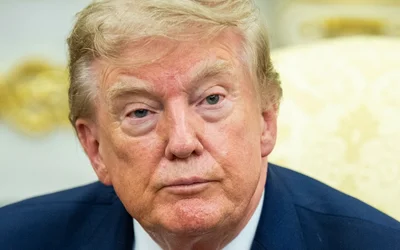
President Donald Trump’s administration is moving against Iranian teenagers, in the not-so-concealed hope that they will revolt against the Islamic Republic.
The outcome may be welcome among Iranian authorities, who have long regarded the brain drain of Iran’s most gifted students with concern and a certain nonchalance. Estimates reported in Iranian academic journals put the exodus at up to 80 percent of science Olympiad medallists and top scorers in the Konkur, the university entrance exam.
Sharif University of Technology, the region’s leading science institution, is the main pipeline into elite western academia; its faculty report that the best engineering graduates move straight into funded PhD places at Stanford, MIT, the Swiss Federal Institute of Technology Lausanne and Toronto.
Imported brilliance
Consider Maryam Mirzakhani, twice an Olympiad gold medallist for Iran before she graduated from Sharif in 1999. She took a PhD at Harvard and became a full professor at Stanford. Her work on moduli spaces earned her the Fields Medal in 2014 - the first woman, and the first Iranian, to receive mathematics’ equivalent of the Nobel. She tragically died of cancer three years later, at 40, an icon of Iranian science.
Behzad Razavi, another Sharif alumnus, left Tehran in the 1980s, took his doctorate at Stanford and became a professor at UCLA, where he wrote the canonical textbooks of chip design. And then there is the long list of Iranian CEOs in Silicon Valley.
The damage will not stop at Iranian teenagers’ dreams.
For half a century, US firms have drawn on these cohorts: the semiconductor labs and medical schools of California and Massachusetts. Within a few years, the effects will be felt there, too. Unless Europe finds a way around the US dictum, the traffic will simply change direction: Shanghai, Shenzhen, Kuala Lumpur.
The US appetite for imported brilliance is itself under attack from a Maga administration that treats its own research universities as hostile. Data indicates a steep drop in Iranian student visa issuance, with refusal rates exceeding 40 percent, alongside prolonged "administrative processing" delays.
This xenophobia has found fertile ground across the West: Norway, Germany and Switzerland have rejected or stalled Iranian graduate students, even those holding full scholarships, on the pretext that their education could serve Iran’s technological capabilities - a tightening buttressed by Europe’s turn to the right.
All this while western universities axe critical research in the humanities and social sciences, and expand ties to the military-industrial complex.
English, more than any other field of knowledge in Iran, is imbued with geopolitical tension as well as intimate desire. In the play English, for which Sanaz Toossi won the 2023 Pulitzer for drama, a storefront classroom in Karaj puts a medical student waiting to leave for Australia beside a grandmother hoping to speak to a granddaughter in Canada who has no Persian, both studying for the TOEFL in an "English only" room. However hard they try, their intimate selves have nowhere to sit in a borrowed tongue. Persian, not English, is a destiny hard to abandon.
Long legacy
Washington’s ban lands on ground already prepared. The Islamic Republic’s educational bodies, under the late Ayatollah Ali Khamenei, undertook a systematic effort to curtail the reach of western language and education enterprises.
The Academy of Persian Language and Literature purged western technical and administrative loanwords in favour of Persian coinages - balgard for helicopter, rayaneh for computer; restrictions on foreign language teaching in primary schools followed, justified as defence against western "cultural invasion", but also as a decolonial turn towards the legacy of Persian.
This engineering of knowledge is not without paradox: the supreme leader was himself a literary man, a reader of western novels, a poet, a host of literary soirees
By 2019, part of a larger detachment from the West’s cultural industry, Iran’s Ministry of Intelligence had banned all collaboration with or affiliation to the British Council, seen as a covert espionage network, and the private language sector came under stricter oversight.
These measures moved hand in hand with a broader attack on the humanities and social sciences in Iranian universities, not unlike the cuts now targeting US and UK higher education. Sociology, political science, law and philosophy saw intakes capped, their western-derived curricula paired with Islamic equivalents.
This engineering of knowledge is not without paradox: the supreme leader was himself a literary man, a reader of western novels, a poet, a host of literary soirees. In his view, literature and technology belonged to the same arsenal against western imperialism, cultural or military.
The attitude draws on a long legacy: from the pre-Islamic Academy of Gondishapur to polymaths such as Avicenna, Khayyam and al-Biruni, knowledge stood at the heart of the ethical order of Iranian polities.
And when Washington weaponises knowledge out of frustration in a war that has bogged it down - a war fought on behalf of Israel - one wonders what ways Iranians will find to continue their educational pursuits. An apocryphal saying hints at what may be waiting: Utlubu al-‘ilm walaw bi’l-Sin - "seek knowledge, even as far as China".
The views expressed in this article belong to the author and do not necessarily reflect the editorial policy of Middle East Eye.
Middle East Eye delivers independent and unrivalled coverage and analysis of the Middle East, North Africa and beyond. To learn more about republishing this content and the associated fees, please fill out this form. More about MEE can be found here.