Muslims are not creating an 'Islamic Republic' in Britain. This is their home


A few days ago, Prime Minister Benjamin Netanyahu offered a startling description of one of Israel’s oldest allies.
In an interview with Israeli Army Radio, Netanyahu referred to the “Islamic Republic of Britain”, describing the country as the “first Islamic republic to get a nuclear weapon”.
It was meant as a warning. But it revealed far more about the politics behind the phrase than about Britain itself.
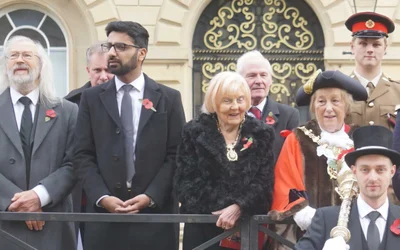
Britain is a diverse democracy in which Muslims constitute around six percent of the population. Their growing visibility - in politics, culture, professional fields and public life - is the ordinary consequence of generations of settlement, citizenship and participation.
Yet in the politics of anti-Muslim alarmism, visibility is recast as domination, diversity as “Islamisation”, and participation as infiltration. The underlying proposition is a curious one: when Muslims become sufficiently visible in a democracy, democracy itself has somehow become Muslim.
New MEE newsletter: Jerusalem Dispatch
Sign up to get the latest insights and analysis on Israel-Palestine, alongside Turkey Unpacked and other MEE newsletters
The selectivity is telling. Britain recently had a practising Hindu prime minister, Rishi Sunak. Curiously, Netanyahu and his ideological allies detected no impending “Hinduisation of Britain”. There were no warnings that Westminster was becoming a Hindu republic.
Sunak was succeeded by Keir Starmer, whose wife is Jewish and whose children were raised within Jewish traditions. Again, no talk of the “Judaisation of Britain”, nor any speculation about a Jewish republic emerging on the banks of the Thames.
Britain is now led by Andy Burnham, a Catholic. So far, the “Catholicisation of Britain” has apparently escaped Netanyahu’s attention too.
Ethnic diversity
Yet introduce Muslims into precisely the same plural society, and the vocabulary abruptly changes. Muslim mayors, MPs, doctors, lawyers and voters become evidence not simply of participation, but of “Islamisation”. Their visibility becomes demographic menace; their political influence, infiltration.
Religious pluralism, it seems, remains religious pluralism - until the religion happens to be Islam.
The facts are considerably less dramatic. There are roughly four million Muslims in Britain. They remain a small minority within one of the most religiously and ethnically diverse societies in Europe.
Integration does not mean becoming invisible. It does not mean abandoning one's faith, name, culture or political opinions
Britain has no remotely significant political movement seeking to establish an Islamic state. The fantasy of an impending caliphate belongs overwhelmingly to the imagination of those warning against it.
The British state, meanwhile, remains stubbornly British. Parliament has not been replaced by a shura council. British law has not been supplanted by Islamic law. Buckingham Palace has not become the seat of a caliph. The country’s institutions, constitution and political culture have not undergone some clandestine Islamic transformation.
What has changed is much simpler: British Muslims have become more visible.
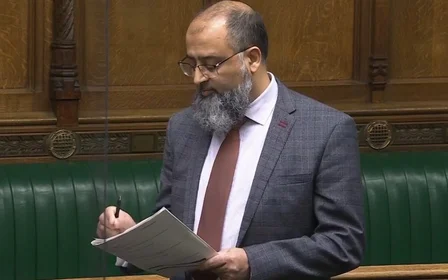
They are doctors and teachers, lawyers and engineers, academics and journalists. They sit in parliament and local councils. Their contribution in the National Health Service (NHS) is particularly striking: figures from 2019 showed that nearly 13,000 doctors in England were Muslim - around one in ten of the medical workforce, roughly twice their share of the population.
They run businesses, work in hospitals, teach in universities, serve their communities and vote in elections. Their children and grandchildren speak English as their first language, and know Britain not as a temporary host country, but as home.
To portray this as evidence of an Islamic takeover is to confuse citizenship with conquest - and that confusion has a history.
Permanent foreignness
Islam is not a newcomer to the European story. For more than a millennium, Europe and the Muslim world have encountered one another through war, trade, scholarship, migration, diplomacy and cultural exchange.
Muslim civilisation flourished for centuries in al-Andalus. Arabs and Ottomans appeared repeatedly in the political imagination of Christian Europe. From Poitiers to Vienna, the Muslim “other” helped Europe define what it believed itself to be.
Islam was therefore never simply outside European history. It was one of the forces against which, and through interactions with which, Europe fashioned itself.
After the Second World War, that relationship changed fundamentally. European countries rebuilding shattered economies drew workers from colonies and former colonies. Britain received migrants from South Asia and elsewhere; France from North Africa; other European states from their own spheres of colonial influence or labour recruitment.
These men and women worked in factories, transport systems, hospitals and public services. They helped rebuild Europe, while frequently living at its social margins.
But even that was not the beginning of the story.
Long before postwar migration transformed Britain, Muslims had fought and died in enormous numbers alongside British and Allied forces. Estimates cited in parliament put their contribution at at least 2.5 million soldiers and labourers during the First World War and 5.5 million during the Second World War, with nearly 1.5 million believed to have been killed in action across the two conflicts.
Muslim soldiers fought in the trenches of France and Belgium, across North Africa and the Middle East, and in the campaigns of the Far East. More than 400,000 Muslims from British India served during the First World War alone.
Their sacrifice sits uneasily beside a contemporary politics that so readily casts Muslims as newcomers, outsiders or people whose belonging must continually be proved. Muslims are not an alien presence newly inserted into the British story. They helped fight its wars, defend its freedoms and shape its history.
They settled. Their children were born, and then their grandchildren. The “migrant” became the citizen.
That transformation matters because much of today’s rhetoric remains trapped in the language of arrival, as though millions of Europeans of Muslim background had only just stepped off a boat and might at any moment be persuaded to return somewhere else.
But where, exactly, is a fourth-generation Londoner supposed to “return” to? Britain is home. That is the reality with which the politics of permanent foreignness struggles to contend.
Modern Britain is not a sealed cultural inheritance passed untouched from one generation to another. It is a society continually shaped by the people who inhabit it. Christian, Jewish, Muslim, Hindu, Sikh, secular and non-religious lives now overlap within the same national space.
And integration has never meant that minorities simply dissolve into an unchanged majority culture. It works both ways.
Societal evolution
Migrants and their descendants absorb the language, institutions, habits and sensibilities of the societies in which they live. Those societies, in turn, are changed by them: food, music, language, fashion, cities, political priorities, ideas of belonging - all of these things change.
This is not “Islamisation”. It is what societies do: they evolve.
The alternative is to imagine national identity as something preserved under glass, authentic only if protected from the contaminating presence of people who look different, worship differently or have different names.
That vision has always been historically dubious. In modern Britain, it is simply untenable.
There is, however, a political reason for portraying ordinary social change as civilisational danger.
Across Europe, sections of the populist and far right have discovered that Muslims make an extraordinarily useful political abstraction. Housing shortages, pressure on public services, economic insecurity, social fragmentation and failures of government can all be folded into a simpler story: the country is being taken away from you.
The Muslim then ceases to be a neighbour, colleague, surgeon, shopkeeper, teacher or fellow citizen, and becomes a symbol of national decline.
Netanyahu’s language belongs within these broader politics of threat. And his rhetoric does not exist in isolation.
Israel's diaspora affairs minister, Amichai Chikli, has been remarkably candid about the political utility of such fears. Speaking recently about Western audiences, he argued that while antisemitism attracts relatively little interest, “radical Islam interests them very, very much” before adding: “And therefore we need to take advantage of that.”
The remark is revealing.
When a senior Israeli minister explicitly identifies Western anxiety about Islam as something to be harnessed, Netanyahu's talk of an “Islamic Republic of Britain” looks less like an isolated provocation and more like part of a wider political strategy turning Muslims into a common civilisational threat around which alliances can be built and criticism of Israel deflected.
That strategy is also politically convenient.
At a moment when Britain and other western governments face growing pressure over Israel’s conduct towards Palestinians, criticism can be answered not on its merits, but by questioning the societies producing it. Opposition to Israeli policy becomes evidence of Islamist influence; Muslim political participation becomes infiltration; demographic evolution becomes civilisational surrender.
The argument effectively turns democracy against itself.
Muslims are told to integrate. But when they integrate successfully, enter institutions, vote, organise and acquire political influence like other citizens, that very participation is offered as evidence that they have acquired too much power.
They are required to participate - but preferably without consequence.
Part of the story
This is why the phrase “Islamic Republic of Britain” deserves more than ridicule. Beneath its absurdity lies a deeply exclusionary idea of citizenship: that some citizens belong naturally to the nation, while others remain permanent guests whose political visibility requires explanation.
A Muslim can apparently be British - provided his/her Britishness remains sufficiently inconspicuous.
But citizenship does not work that way. A British Muslim elected to parliament is not evidence that Muslims have captured Britain. It is evidence that British Muslims vote and stand for election.
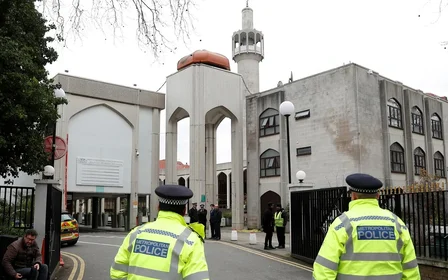
A Muslim doctor in the National Health Service is not evidence of Islamisation. A mosque beside a church, synagogue or temple is not evidence of conquest.
Britain is not becoming an Islamic republic. It is becoming what it has been becoming for generations: a more diverse version of itself
A Muslim family whose grandparents arrived from Pakistan, Bangladesh, India, Somalia or Morocco does not become less British because they retain a religious inheritance alongside their national one.
Pluralism is not the disappearance of Britain. It is contemporary Britain - and the growing political presence of Muslims should be understood accordingly. As communities become established, educated and socially rooted, their political participation naturally increases. The same process has occurred repeatedly with minority communities across democratic societies.
There is nothing mysterious about it. The more interesting question is why Muslim participation so readily becomes a source of panic.
Perhaps this is because the controversy is not really about whether Muslims can integrate. It is about whether some people are prepared to accept what integration actually means.
Integration does not mean becoming invisible. It does not mean abandoning one’s faith, name, culture or political opinions. And it certainly does not mean forfeiting the right to influence the country of which one is a citizen.
It means belonging.
Britain is not becoming an Islamic republic. It is becoming what it has been becoming for generations: a more diverse version of itself.
Its Muslims are not standing outside that story. They are very much a part of it.
The views expressed in this article belong to the author and do not necessarily reflect the editorial policy of Middle East Eye.
Middle East Eye delivers independent and unrivalled coverage and analysis of the Middle East, North Africa and beyond. To learn more about republishing this content and the associated fees, please fill out this form. More about MEE can be found here.